Are Prop Firm Accounts Real Money? Simulated Accounts Explained (2026)
Short answer: at most prop firms, the account you trade is simulated, but the fee you pay and the rewards you withdraw are real money. You trade a demo-style account with real market prices, and if you pass and follow the rules, the firm pays you a share of your simulated profit from its own funds. At TRFC, evaluations use simulated accounts, and approved rewards are paid out every 14 days.
This guide explains which parts of a prop firm account are simulated and which are real, why most firms work this way, and what to check before you buy any challenge. TRFC details below are as listed on trfc.tech in November 2026; always check the current terms of any firm before you start.
What "simulated" means in a prop firm challenge
A simulated account is a trading account that uses live market prices but does not send your orders to the real market. Your profit and loss are calculated exactly as they would be on a live account: spreads, swaps and price moves all count. The difference is that no real position is opened in your name.
For a trader, this has three practical effects:
- You cannot lose more than the fee. If you hit a drawdown limit, the account closes. You do not owe the firm the loss.
- Your results are still judged on real prices. A simulated account is not an easy mode. The same discipline that keeps a live account alive keeps a challenge alive.
- The money you receive is real. When you reach the reward stage and request a payout, the firm pays you in real funds from its own balance sheet.
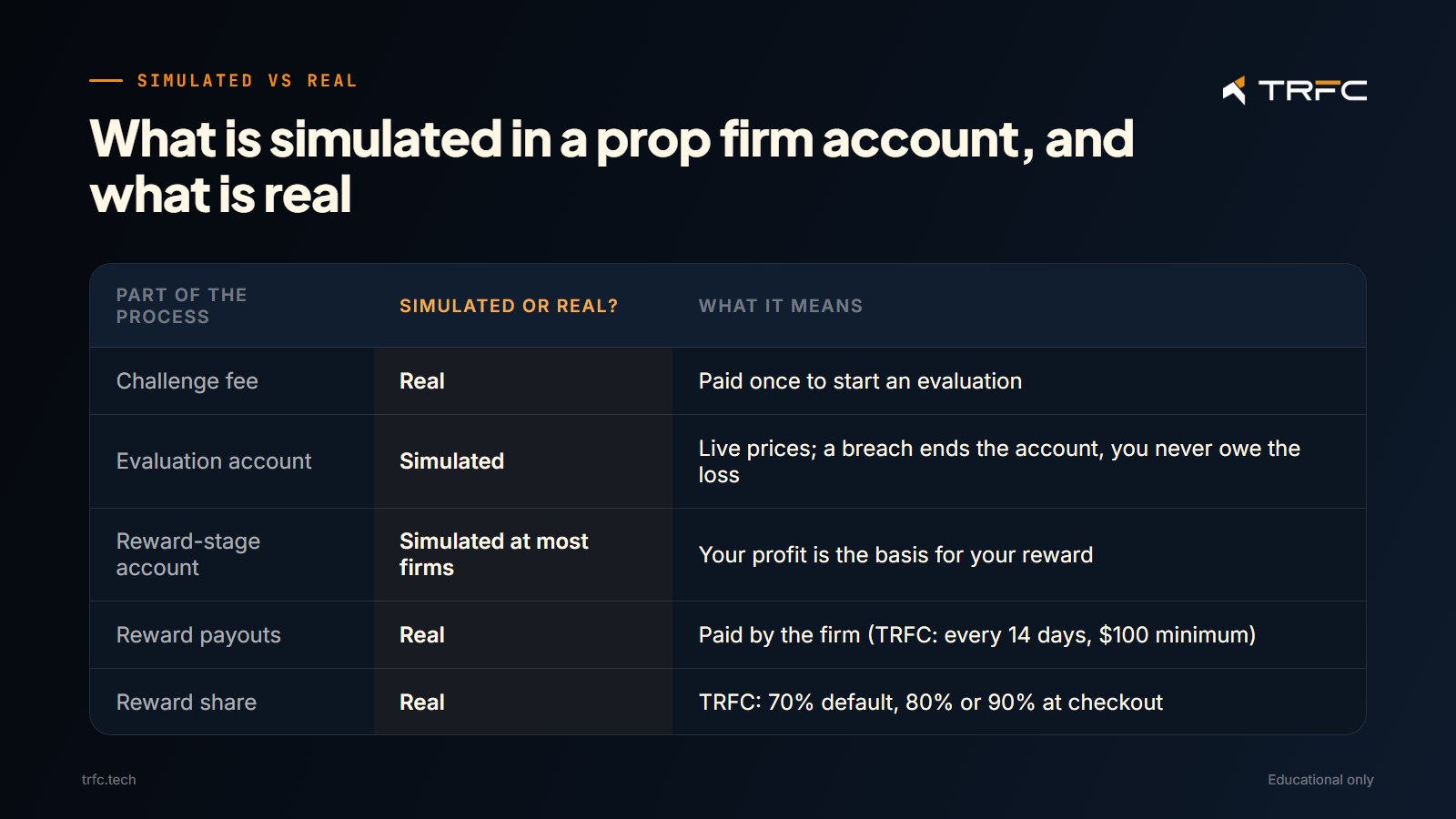
Simulated vs real: a side-by-side view
| Part of the process | Simulated or real? | What it means for you |
|---|---|---|
| Challenge fee | Real | You pay it once to start an evaluation. At TRFC, prices start at $49 for a $8K 3-Step account (as listed in November 2026). |
| Evaluation account | Simulated | Live prices, simulated execution. Breaking a rule ends the account; you never owe the loss. |
| Reward-stage account | Simulated at most firms | You keep trading under the firm's rules; profit becomes the basis for your reward. |
| Reward payouts | Real | Paid by the firm. At TRFC: every 14 days, $100 minimum, $25 fee, usually 24–72 business hours after approval. |
| Your reward share | Real | The percentage of simulated profit you receive. At TRFC: 70% by default, with 80% or 90% available at checkout. |
Why most prop firms use simulated accounts
Simulated accounts let a firm assess many traders at once without placing each trader's orders in the market. Industry guides in 2026 describe the same pattern: evaluations are almost always simulated, and many firms keep the funded or reward stage simulated too, paying traders from the firm's own funds. A smaller number of firms move consistent traders to live execution after a track record or payout threshold.
Neither model is automatically better. What matters is that the firm says clearly which one it uses, that its rules are written down, and that it has a record of paying traders.
Is a simulated account "fake"?
No, and this is the most common misunderstanding. A simulated account uses real market data, so a good trade is good and a bad trade is bad. What is simulated is the execution, not the market. In practice, many traders find a challenge harder than a demo account, because the drawdown limits and minimum profitable days force them to manage risk every single day.
It helps to treat your simulated account like a business account. Our guide on the TRFC blog has more on risk routines, daily drawdown and payout rules.
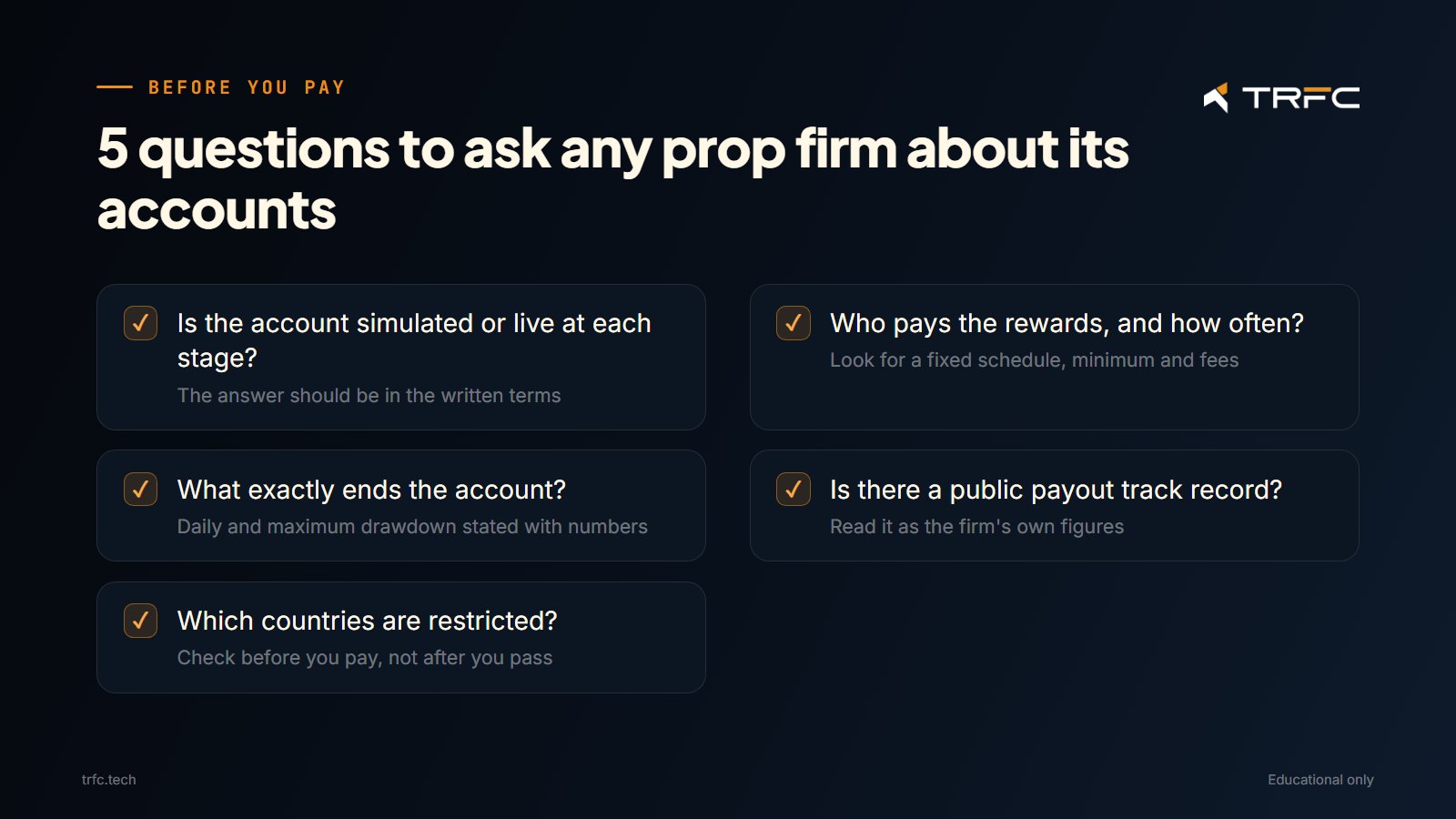
Five questions to ask any prop firm
- Is the account simulated or live, at each stage? The answer should be in the terms, not only in a chat reply.
- Who pays the rewards, and how often? Look for a fixed schedule, a minimum amount and any fees.
- What exactly ends the account? Daily drawdown, maximum drawdown and any consistency rule should be stated with numbers.
- Is there a public payout track record? Numbers of traders and payouts help, but read them as the firm's own figures.
- Which countries are restricted? Check this before you pay, not after you pass.
Key facts about TRFC
- TRFC evaluations use simulated accounts with live market prices.
- Account sizes from $3K to $200K, with 1-Step, 2-Step, 3-Step and Instant options.
- Reward share of 70%, 80% or 90%, chosen at checkout (70% is the default).
- Payouts in USDT (TRC20/ERC20) every 14 days, $100 minimum, $25 fee, usually 24–72 business hours after approval.
- A free 30-day trial lets you test the platform before you pay.
- Track record shown on trfc.tech: 2,600+ traders, 130+ payouts and $400K+ in rewards since 2023.
- Restricted countries include the US, Canada, the UK, the EU, Japan and China, among others.
Want to see the rules for each plan side by side? Compare TRFC challenges and pick the account size and reward share that fit you.
FAQ
Are prop firm accounts real money?
Usually not. Most prop firm accounts are simulated, using live prices. The challenge fee you pay and the rewards you withdraw are real money.
Where does the payout money come from if the account is simulated?
The firm pays rewards from its own funds, based on the profit you make on the simulated account and your reward share.
Can I lose more than the challenge fee?
No. If you break a drawdown rule, the account ends. You do not owe the firm the trading loss.
Is a simulated account easier than a live one?
Not really. Prices are real, and the drawdown limits and minimum profitable days make risk control stricter than on most personal accounts.
Does TRFC use simulated accounts?
Yes. TRFC evaluations use simulated accounts, and approved rewards are paid every 14 days with a $100 minimum.
Educational only, not investment advice. TRFC evaluations use simulated accounts.