How to Use ATR for Stop Losses and Position Sizing
Have you ever placed a stop that felt sensible, only to be taken out by normal noise a few minutes before price moved your way? Often the stop was not "wrong". It was simply the same distance on a quiet day and on a wild one. The Average True Range, or ATR, is a simple way to fix that. It measures how much a market usually moves, so your stop distance and your position size can follow the market's real behaviour instead of a fixed guess.
This guide explains what ATR is, how to use it for stop placement, and, most importantly for prop traders, how to turn an ATR-based stop into a position size that respects your daily and maximum drawdown.
What ATR measures
ATR was introduced by J. Welles Wilder. For each candle it takes the "true range": the largest of these three values:
- the current high minus the current low;
- the current high minus the previous close;
- the previous close minus the current low.
It then averages the true range over a period, most often 14 candles. The result is shown in price units, for example "ATR(14) = 18 points" on an index or "0.0065" on a currency pair.
Two things are worth remembering:
- ATR shows size, not direction. A rising ATR means candles are getting bigger, whether price is going up or down.
- ATR depends on the timeframe. A 1-hour ATR is much smaller than a daily ATR. Use the ATR of the timeframe you actually trade.
Using ATR to place stops
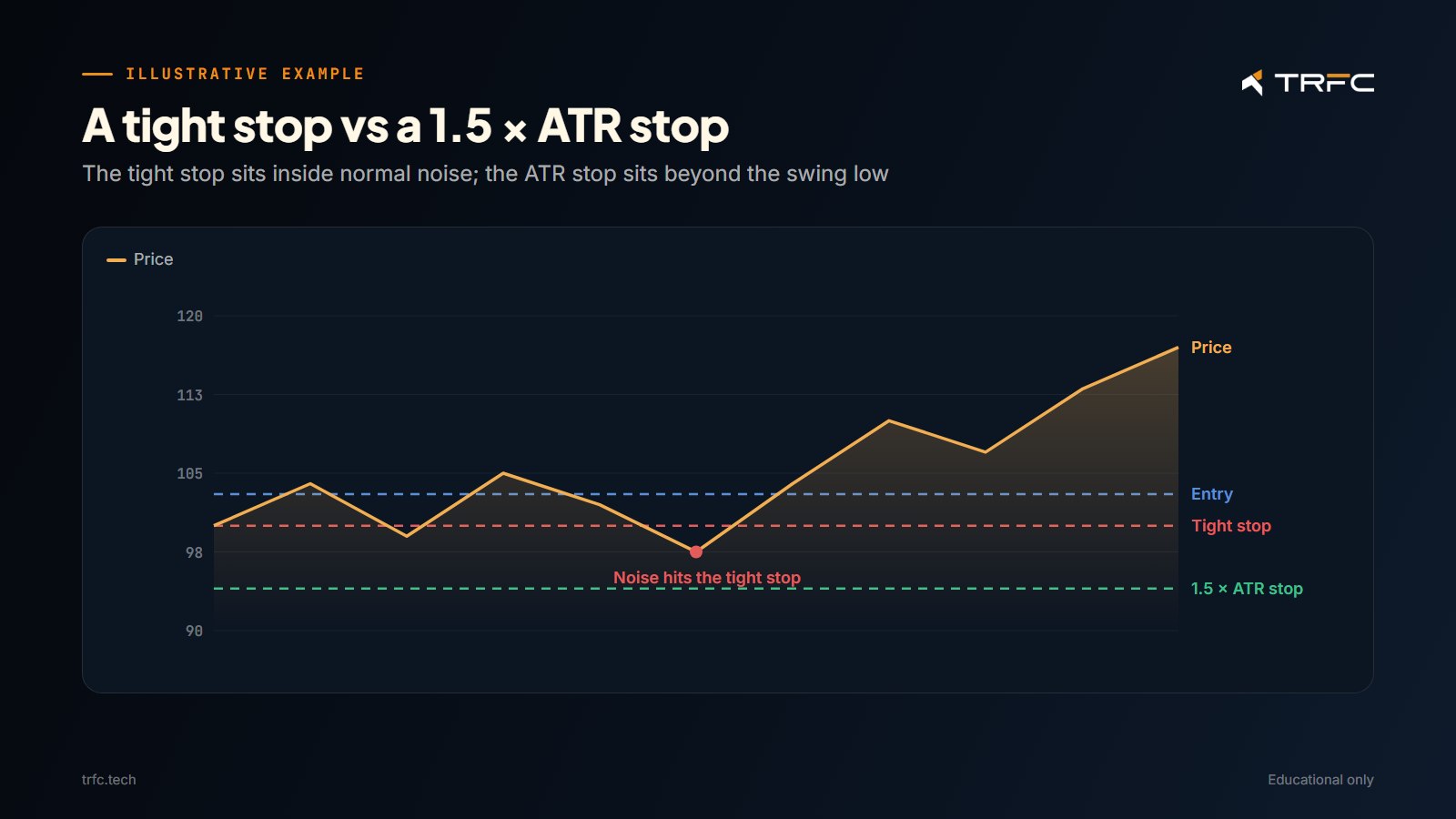
The idea is simple: place your stop beyond the level that would prove your idea wrong, and make sure it is at least far enough away that ordinary movement is unlikely to touch it. Many traders use a multiple of ATR as that minimum distance, often somewhere between 1 and 2 times ATR.
- Find the structural level first. For a long trade, that might be below a recent swing low or below a support zone. ATR does not replace structure. It checks it.
- Add an ATR buffer. If the swing low is very close to your entry, a stop just under it sits inside normal noise. Pushing it to, say, 1.5 × ATR below entry (or a fraction of ATR beyond the level) gives the trade room to breathe.
- If the needed stop is too wide, skip the trade or wait. A very wide ATR stop is the market telling you the risk on this setup is high right now.
Turning an ATR stop into a position size
This is where ATR becomes really useful. A wider stop does not have to mean more risk, as long as the position gets smaller. The formula is:
Position size = (account risk per trade) ÷ (stop distance × value per point)
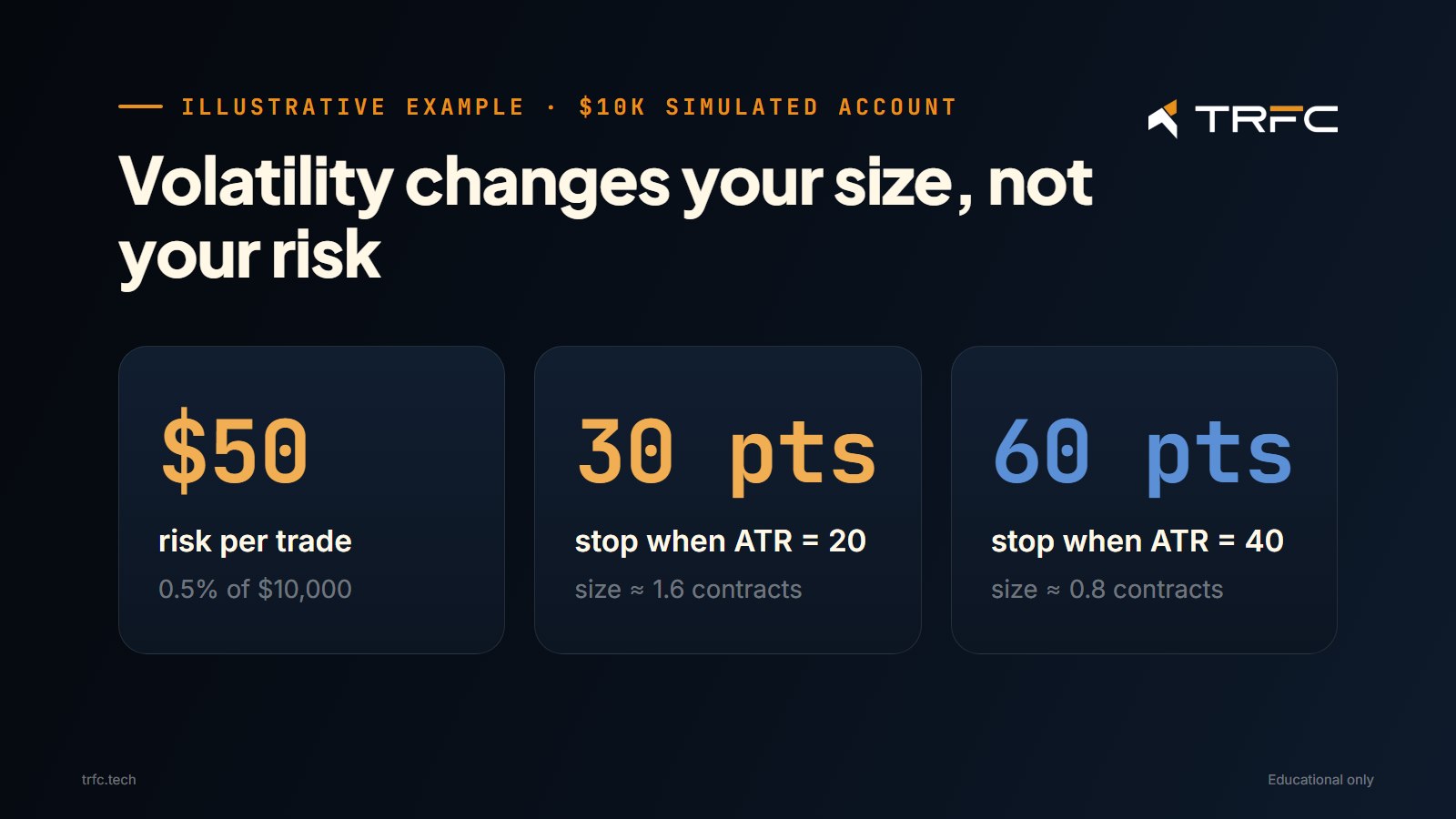
Illustrative example: a $10,000 simulated account risking 0.5% per trade, which is $50. The 1-hour ATR(14) on an index is 20 points, and you use a 1.5 × ATR stop, which is 30 points. If one contract is worth $1 per point, the size is $50 ÷ (30 × $1) ≈ 1.6 contracts. If tomorrow ATR doubles to 40 points, the stop becomes 60 points and the size halves to about 0.8. The dollar risk stays at $50 either way.
That is the point: volatility changes your size, not your risk.
Why this matters on a prop account
- Daily drawdown. When ATR jumps (around news, or at a session open), fixed-size traders take bigger losses on the same number of stops. ATR sizing keeps each loss the same size, so a run of stop-outs stays inside the daily limit. At TRFC the daily limit is a percentage of the initial balance, and open trades count in real time.
- Maximum drawdown. Keeping risk per trade fixed makes it easy to count how many losing trades your buffer can absorb, for example 12 losses at 0.5% inside a 6% limit.
- Trade-level rules. ATR sizing helps you stay within lot limits (TRFC allows at most 5 lots per symbol) and avoid one oversized trade making most of the target.
Common ATR mistakes
- Using a daily ATR for a 15-minute trade. The stop ends up far too wide and the size far too small, or the reverse.
- Using ATR alone. A stop that is "1.5 ATR away" but sits right in front of a major level can still be a poor stop.
- Forgetting the spread. On tight stops, add the spread to your stop distance before sizing.
- Changing the multiple after a loss. Pick a multiple, test it in your journal over many trades, and keep it steady.
A simple routine to try
- Add ATR(14) to the timeframe you trade.
- Mark your structural invalidation level.
- Check that the stop is at least 1–1.5 × ATR from entry; widen it to the level plus a small buffer if needed.
- Calculate size from your fixed risk per trade.
- Log the ATR value with every trade, so you can see which conditions suit your strategy.
FAQ
What is a good ATR setting?
14 periods is the common default and a sensible starting point. Shorter settings react faster to sudden changes in volatility; longer ones are smoother. Test any change in your journal before using it on an evaluation.
Is a bigger ATR stop riskier?
Not if you size correctly. A wider stop with a smaller position can carry exactly the same dollar risk as a tight stop with a larger position.
Can ATR tell me where to take profit?
Some traders use ATR multiples as a rough guide for how far price might travel in a session, but it is a measure of typical movement, not a forecast. Combine it with structure and your own risk-reward rules.
You can practise this risk-free with TRFC's free 30-day trial, or explore TRFC challenge plans. For more on risk, read risk-reward ratio for prop trading and support and resistance as zones.
Educational only, not investment advice. TRFC evaluations use simulated accounts.