Decision Fatigue in Trading: Why Your Last Trades of the Day Are Often Your Worst
You start the session sharp. You wait for your setup, size it properly and leave the rest alone. Four hours later you are taking trades you would never have taken at 9 am: a little early, a little too big, on a chart you had not even planned to watch. Nothing about the market changed. You did.
Traders often call this "losing focus", but there is a more useful way to see it: every trading decision has a cost, and by the end of a long session you have spent most of your budget. This article looks at how that tiredness shows up in your trading, and how to build a day that needs fewer decisions in the first place.
What "decision fatigue" means for a trader
Decision fatigue is the idea that the quality of our choices drops after we have made a lot of them. Psychologists still debate exactly how strong the effect is and why it happens, so treat it as a practical lens rather than a hard law. But almost every trader recognises the pattern: after hours of watching price, weighing entries and managing open positions, judgement gets looser.
Trading is unusually heavy on small decisions. Is this a setup? Is it good enough? Where is the stop? Move it or leave it? Take partial profit? Each one is minor on its own. Together they add up to hundreds of choices a day, many made under uncertainty and with money on the line.
How it shows up in your results
Tired traders rarely make one big, dramatic mistake. They make several small, quiet ones:
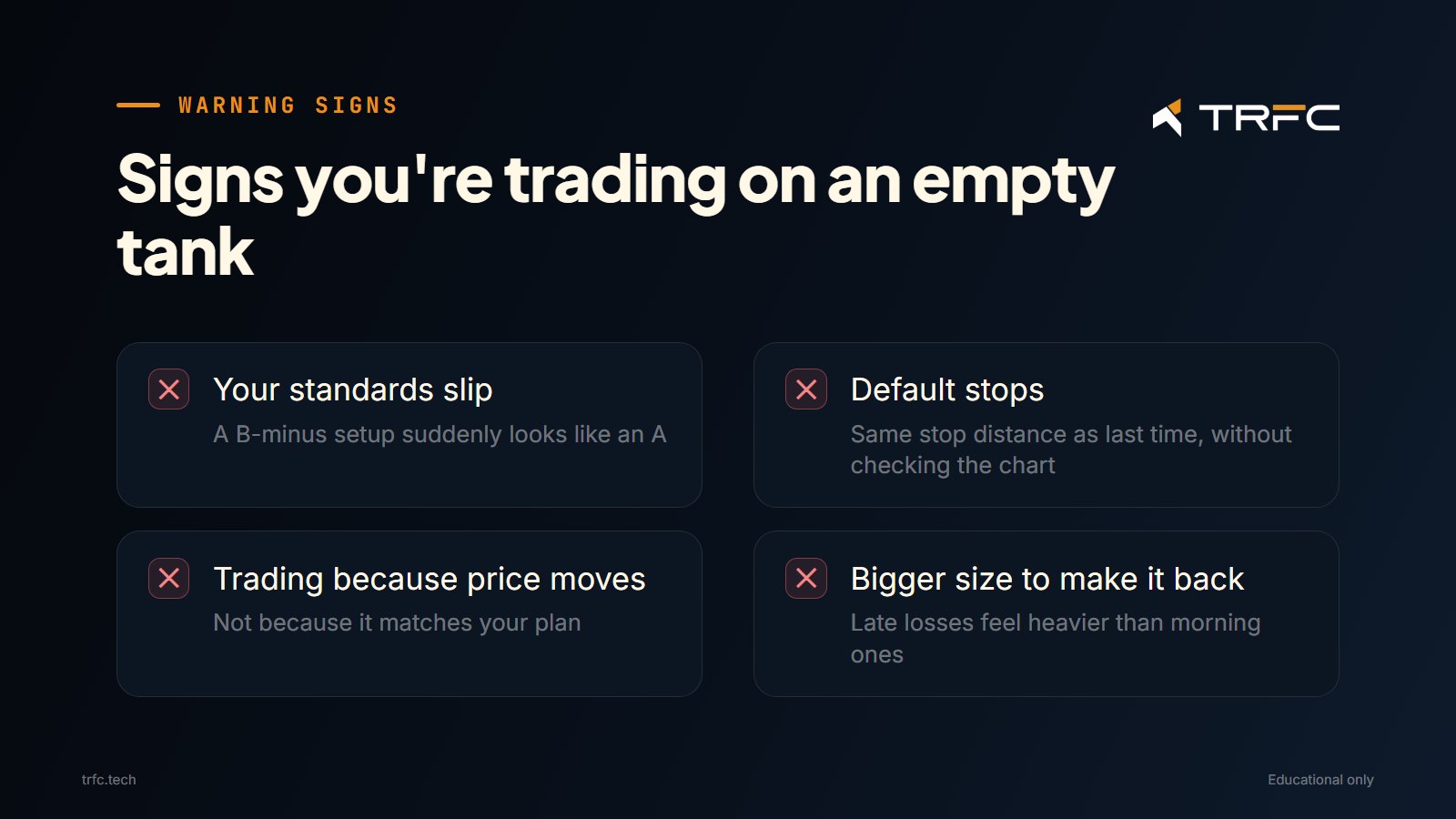
- Lower standards. A "B-minus" setup starts to look like an "A" because you want the session to end on a win.
- Default choices. You stop thinking about the stop placement and use whatever distance you used last time.
- Impulse over plan. You take a trade because price is moving, not because it matches anything you wrote down.
- Bigger size to "make it back". Late-day losses feel heavier, and the urge to recover them quickly grows.
On a prop firm challenge, this pattern is especially costly. The daily drawdown limit does not care whether a loss came from your best trade or your most tired one. Many accounts that break a daily limit do it in the last part of a session, after a reasonable morning.
Check your own data first
Before changing anything, look at your trading journal. Split your trades by the hour you opened them, or simply into "first half" and "second half" of your session. Compare win rate, average result and how often you broke your own rules. If the later trades are clearly worse, you have found a cheap edge: stop taking them.
If you do not journal yet, add one column for the next two weeks: "How fresh did I feel, 1 to 5?" It takes five seconds per trade and tells you a lot.
Six ways to build a low-decision trading day
1. Decide before the session, not during it
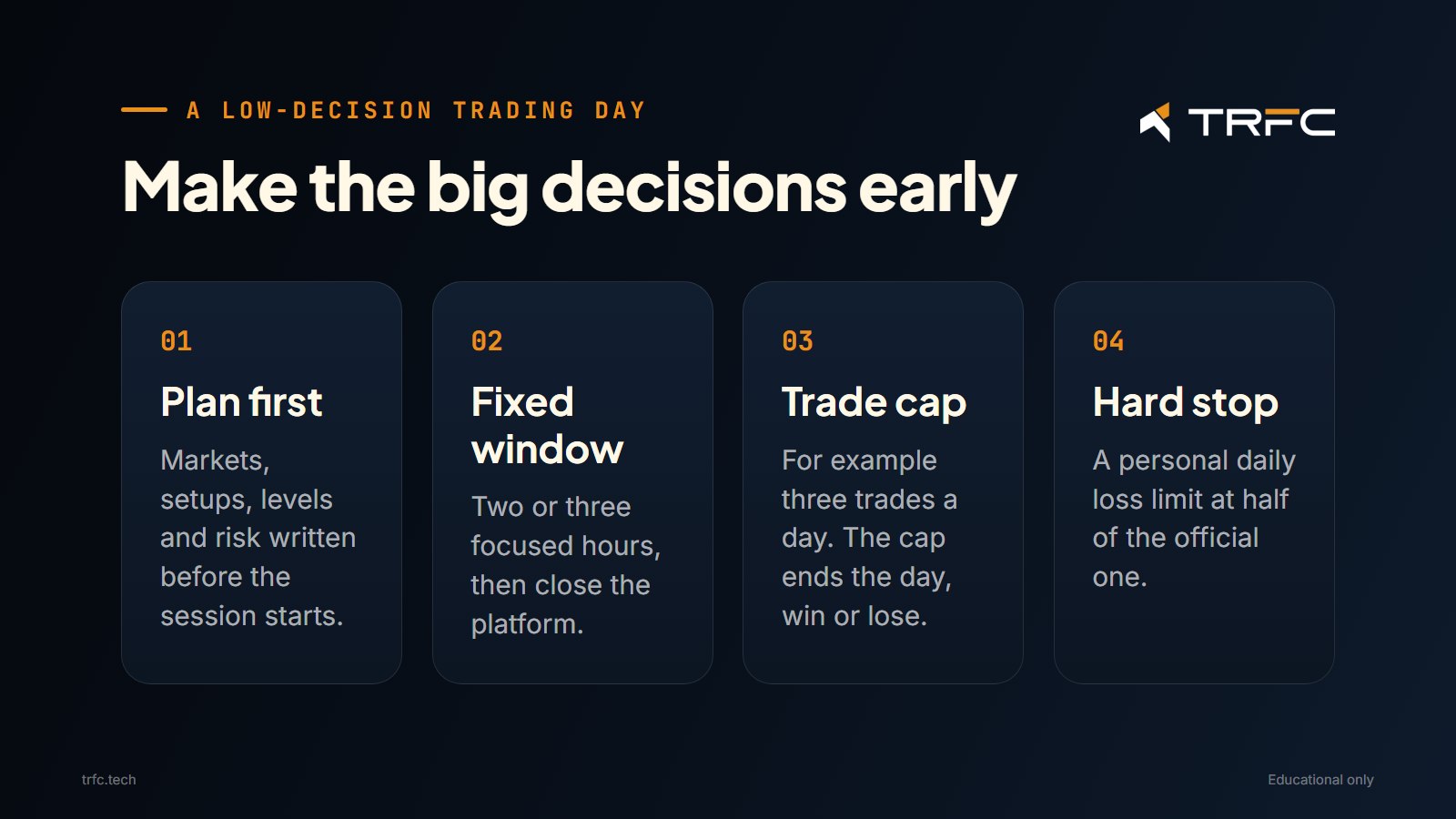
Write your plan the evening before or in the first fifteen minutes: which two or three markets, which setups, the key levels and your risk per trade. When a setup appears, you are not deciding whether to trade; you are checking whether price matches what you already decided.
2. Set a fixed trading window
Pick the two or three hours when your markets move best and you feel sharpest, and trade only then. A shorter window with full attention beats a long day of half-attention. Close the platform when the window ends.
3. Cap the number of trades
A simple rule such as "no more than three trades per day" removes a whole category of late-session choices. When you reach the cap, the day is done, win or lose.
4. Use if-then rules for trade management
"If price reaches 1R, I move the stop to break-even. If it closes below the zone, I exit." Rules like these turn open-trade management from a constant judgement call into a quick check.
5. Take real breaks
Stepping away for ten minutes every hour, without your phone showing charts, helps more than most traders expect. Walk, drink water, eat something. Fatigue builds faster when you skip meals and stare at screens without a pause.
6. Have a hard stop for bad days
Set a personal daily loss limit well inside your account's official one, for example half of it. When you hit it, you stop. That single rule protects you on exactly the days when your judgement is weakest.
A note for part-time traders
If you trade after a full working day, you start the session with some of your decision budget already spent. That does not mean you cannot trade well, but it does mean structure matters even more: fewer markets, a shorter window, and a written plan prepared on the weekend. Since TRFC challenges have no time limit, there is no reason to force trades on a night when you are simply too tired.
The takeaway
Discipline is not only about willpower. It is about designing a day that does not need much of it. Make the big decisions early, limit how many you make later, and give yourself permission to stop. Your best trades usually come when you are fresh, so protect that state.
Want to practise this kind of routine without pressure on the clock? Explore TRFC challenges (no time limit on any plan), or read more on trading psychology on the TRFC blog.
Educational only, not investment advice. TRFC evaluations use simulated accounts.