EUR/USD hovers near 1.0970 as Fed hike bets firm ahead of Lagarde
Key points
- EUR/USD trades near 1.0970 in the Asian afternoon, as of 15:04 MYT on Thursday, 19 November, just above Wednesday's low of about 1.0953.
- Hawkish Fed minutes have firmed bets on a December US rate hike and kept the US Dollar bid, while euro-area data has disappointed.
- Next catalysts: ECB President Christine Lagarde speaks and US weekly jobless claims are due, both around 21:30 MYT tonight.
EUR/USD is trading near 1.0970 in Thursday's Asian session, as of 15:04 MYT, little changed on the day but about 2.7% below the early-November high near 1.1270. Minutes from the Federal Reserve's October meeting showed that almost all officials see more tightening as likely, and market reports put the chance of a quarter-point Fed hike in December at around 90%. ECB President Christine Lagarde and US weekly jobless claims, both around 21:30 MYT, are the next tests.
What's moving the market
The pair is caught between two central banks that both lean hawkish, and for now the Fed is winning. The October minutes reinforced the message that US rates could rise again in December, which lifted Treasury yields and the Dollar. EUR/USD first dipped below the 1.1000 handle on Tuesday and has stayed under it since early Wednesday.
On the euro side, markets still price a high chance (reports cite more than 80%) that the ECB also hikes in December. Lagarde has said a hike was discussed at the last meeting but has avoided a firm promise, noting that many data points are due before the decision. Some bank analysts expect her to keep a hawkish tone tonight while doubting the ECB will go much further after that, which helps explain why the euro has not benefited much from the rate outlook.
Recent euro-area data has also come in softer than expected. That mix (a firm Fed, an ECB that may stop after one more move, and soft data) has kept sellers in control of the short-term trend.
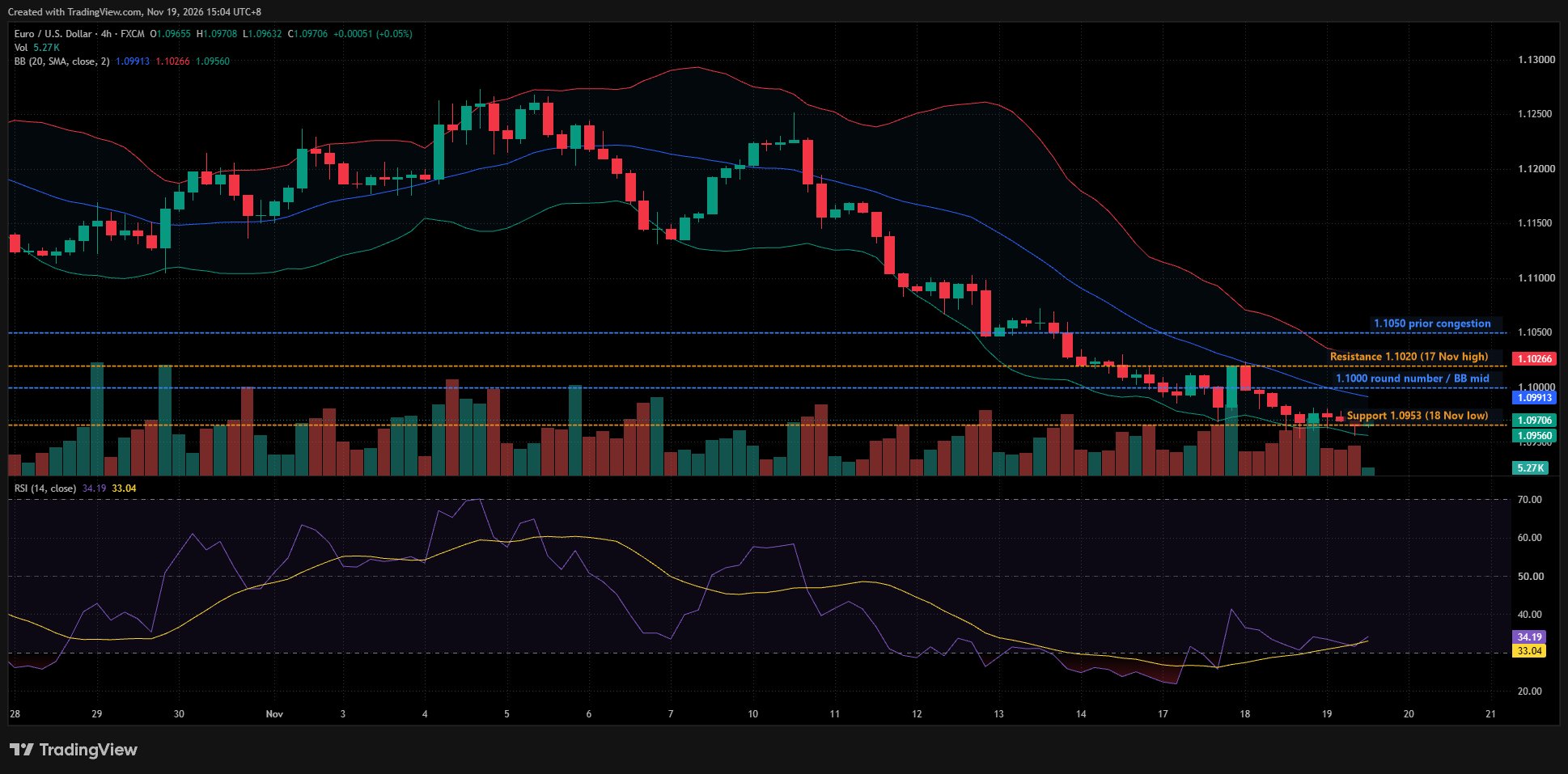
Technical analysis: EUR/USD keeps a bearish bias below 1.1000 as it hugs the lower Bollinger Band
On the 4-hour chart, EUR/USD has made a series of lower highs since 10 November and is pressing against the lower Bollinger Band. The middle band (20-period SMA) sits near 1.0991, just under the round 1.1000 level, and has capped every bounce this week. RSI (14) is around 34: weak, but no longer in oversold territory, so the selling has slowed rather than reversed.
Resistance (nearest first):
- 1.0990–1.1000: the Bollinger middle band and the round number
- 1.1020: Tuesday's (17 November) rebound high
- 1.1050: the 13 November congestion area, close to the upper band near 1.1027
Support (nearest first):
- 1.0953–1.0956: Wednesday's (18 November) low and the lower Bollinger Band
- 1.0900: the next round number, below which the chart shows little recent structure
(This analysis was prepared with the help of AI tools and reviewed against live charts.)
What would change the view
A sustained move back above 1.1020 would weaken the bearish case and put the 1.1050 area back in focus. A clear break below 1.0953 would extend the downtrend and open the way toward 1.0900. If Lagarde sounds more committed to a December hike than markets expect, the euro could bounce toward the middle band; a cautious tone would leave the Fed story in charge.
Events to watch (MYT)
- Around 21:30 Thu: ECB President Lagarde speaks
- 21:30 Thu: US initial jobless claims (week to 14 November)
- Later in the US session: remarks from several Fed officials, including Hammack, Goolsbee and Paulson
Note for prop traders
Central-bank speeches and US data at the same time can make the first minutes after 21:30 MYT jumpy, with wider spreads. Keep your daily loss limit in view and size positions so that one fast move cannot use up the day's allowance; our guide to the daily drawdown reset explains how the limit works. At the TRFC reward stage, no new trades may be opened within 5 minutes either side of high-impact news, so plan around tonight's releases. You can compare evaluation rules on the TRFC challenges page.
FAQ
What moves EUR/USD?
The biggest driver is the gap between US and euro-area interest-rate expectations, set by the Federal Reserve and the European Central Bank. Inflation, jobs and growth data from both regions, plus overall risk appetite, also matter.
What are Bollinger Bands?
Bollinger Bands plot a moving average (usually 20 periods) with bands two standard deviations above and below it. Price hugging the lower band shows strong downside momentum; the bands widen when volatility rises and narrow when it falls.
Why does a Fed rate hike usually lift the US Dollar?
Higher US rates raise the return on Dollar assets compared with other currencies, which tends to attract capital into the Dollar. The effect depends on how much of the hike markets have already priced in.
What is a central-bank speech and why does it move currencies?
Speeches by central-bank leaders can hint at the next policy decision. If the tone differs from what markets expect, traders reprice rate expectations, and the currency moves.
Disclosures: This content is published by TRFC, which has a commercial interest in trading evaluations and holds no positions in the instruments discussed. Prices are as of the time stated and can change quickly. Educational only, not investment advice. Trading involves risk; past performance is no guarantee of future results. TRFC evaluations use simulated accounts.
Educational only, not investment advice. Trading involves risk. TRFC evaluations use simulated accounts.