EUR/USD holds near 1.1220 ahead of US CPI as Fed hike bets build
Key points
- EUR/USD trades near 1.1221 as of 11:32 MYT on Tuesday 10 November, almost flat in the Asian session after Monday's rise of about half a percent.
- Both central banks lean hawkish: markets price a December Fed hike at roughly 77–80% and also expect the ECB to tighten again.
- Next catalyst: US October CPI at 21:30 MYT tonight, then ECB President Lagarde speaks on Wednesday and Thursday.
EUR/USD is holding near 1.1221 as of 11:32 MYT in Tuesday's Asian session, little changed on the day after a roughly 0.5% gain on Monday lifted the pair off last week's lows near 1.1131. The rebound came as the US dollar softened and oil prices fell, even though reports citing CME FedWatch still put the odds of a December Fed rate hike at about 77–80%. Traders now wait for US October CPI at 21:30 MYT.
What's moving the market
This pair is caught between two central banks that are both leaning toward higher rates. On the US side, October payrolls of 165,000 came in far above expectations and pushed hike bets higher, which drove EUR/USD down to about 1.1131 on Friday. In the euro area, the ECB held its deposit rate at 2.50% in October, but markets expect another increase in December, and President Christine Lagarde has kept the door open by stressing that decisions depend on incoming data.
Because both sides are pricing tightening, the pair has been more sensitive to US data surprises than to the policy story itself. Tonight's CPI publishes monthly changes only, with no official annual rate because of the gap in October 2025 data, and consensus looks for +0.3% headline and +0.2% core. A firm core reading would likely support the dollar, while a soft one could give the euro room to retest last week's highs. Concerns about French public finances remain a background drag on the euro.
Technical analysis: EUR/USD holds a neutral-to-positive bias above the 100-period SMA on H4
On the four-hour chart, price has moved back above the 100-period SMA (near 1.1197) and the 20-period EMA (near 1.1199), which now sit almost on top of each other. That cluster is the first area buyers would want to defend. Above, the pair still faces the early-November ceiling.
Resistance: 1.1260–1.1273 (the 4–5 November highs). Above that, the next round level is 1.1300.
Support: 1.1197–1.1199 (100-period SMA and 20-period EMA), then 1.1131 (the 6–9 November lows), then 1.1104 (the 29 October low, the lowest level of 2026 so far).
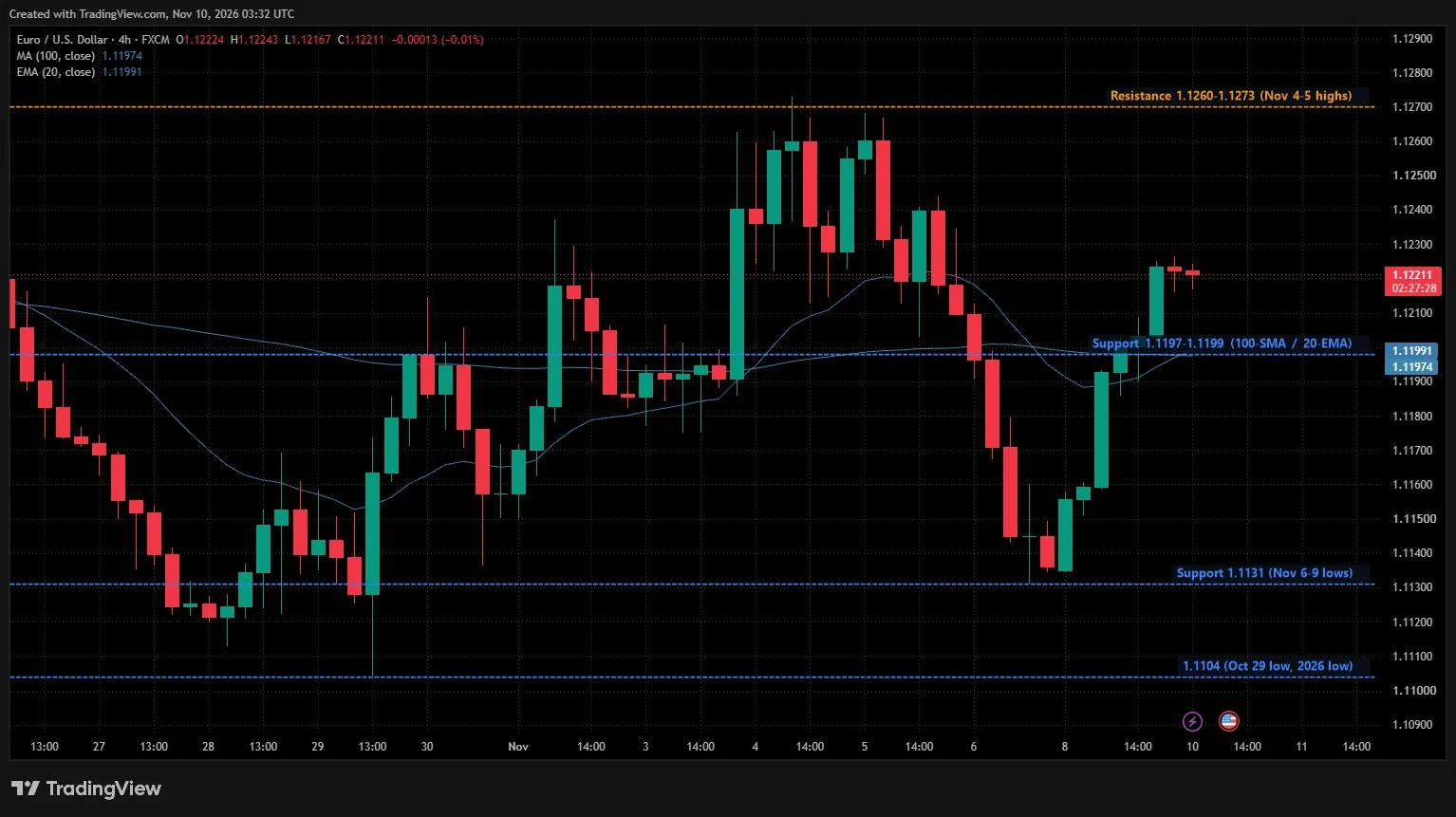
(This analysis was prepared with the help of AI tools and reviewed against live charts.)
What would change the view
An H4 close back below 1.1197 would put the pair below both moving averages again and turn the bias negative, with 1.1131 the next area in focus. A sustained move above 1.1273 would break the November range to the upside and strengthen the bullish case toward 1.1300. A break below 1.1104 would mean a new 2026 low.
Events to watch (MYT)
- Tue 10 Nov, 21:30: US October CPI (monthly figures only).
- Wed 11 and Thu 12 Nov: ECB President Christine Lagarde speaks.
- Wed 11 Nov: US Veterans Day; the US bond market is closed.
- Later this week: US October PPI.
Note for prop traders
EUR/USD often moves sharply in the first minutes after US CPI, and spreads can widen. Before the release, check how much room is left on your daily loss limit. At the TRFC reward stage, no new trades may be opened within 5 minutes either side of high-impact news, and CPI qualifies. Many traders keep position size smaller on event days. Our article on risk-reward in prop trading covers how to plan around this.
Want to practise reading event-day setups without risking your own capital? Start TRFC's free 30-day trial or explore our challenges.
FAQ
What moves EUR/USD?
The pair mainly reflects the difference between Fed and ECB policy expectations, US and euro-area economic data, and broad risk sentiment. US data often has a larger short-term impact because of the dollar's global role.
Why does US CPI affect EUR/USD?
CPI changes expectations for Fed interest rates. Higher US inflation can lift rate expectations and the dollar, which usually pushes EUR/USD lower, while softer inflation tends to have the opposite effect.
What is a pip in EUR/USD?
For EUR/USD, a pip is the fourth decimal place, 0.0001. A move from 1.1220 to 1.1230 is 10 pips.
Published by TRFC. TRFC has a commercial interest in the products it offers and holds no positions in the instruments discussed. This content is educational only and is not investment advice. Trading involves risk; past performance is no guarantee of future results. Prices are indicative as of the time stated. TRFC evaluations use simulated accounts.
Educational only, not investment advice. Trading involves risk. TRFC evaluations use simulated accounts.