GBP/USD slips near 1.3080 as traders await Bailey and US PCE
Key points
- GBP/USD trades near 1.3077 as of 15:05 MYT in the Asian session on Wednesday, 25 November, slightly lower after failing to hold above 1.3120.
- Pound buyers are cautious as the Bank of England weighs sticky inflation against slower growth, while Fed hike bets keep the dollar supported.
- Next: BoE Governor Andrew Bailey testifies to MPs at 22:15 MYT, after US PCE inflation and Q3 GDP at 21:30 MYT.
GBP/USD is trading near 1.3077 as of 15:05 MYT in Wednesday's Asian session, down about 0.1% on the day after Tuesday's rebound ran out of steam near 1.3124. The dollar has eased from its near 20-month high, but a December Fed hike is almost fully priced, which keeps rallies in cable limited. Tonight brings two events within an hour: US PCE inflation at 21:30 MYT and Bank of England Governor Andrew Bailey's testimony to the Treasury Select Committee at 22:15 MYT.
What's moving the market
The pound has been under steady pressure this month as the gap between expected US and UK policy has widened. Markets see the Fed raising rates in December, while the Bank of England is balancing inflation that remains above target against signs of slower services activity. Any hint from Bailey on how the BoE reads that trade-off could move sterling.
On the US side, the PCE report is one of the last big inflation readings before the Fed's 8–9 December meeting. A hot core reading would likely support the dollar against the pound; a softer one could give cable room to retest this week's highs.
Wider risk mood is shaky, with sharp falls in Asian stocks on Wednesday. Thin trading around the US Thanksgiving holiday on Thursday could also make moves later this week less reliable.
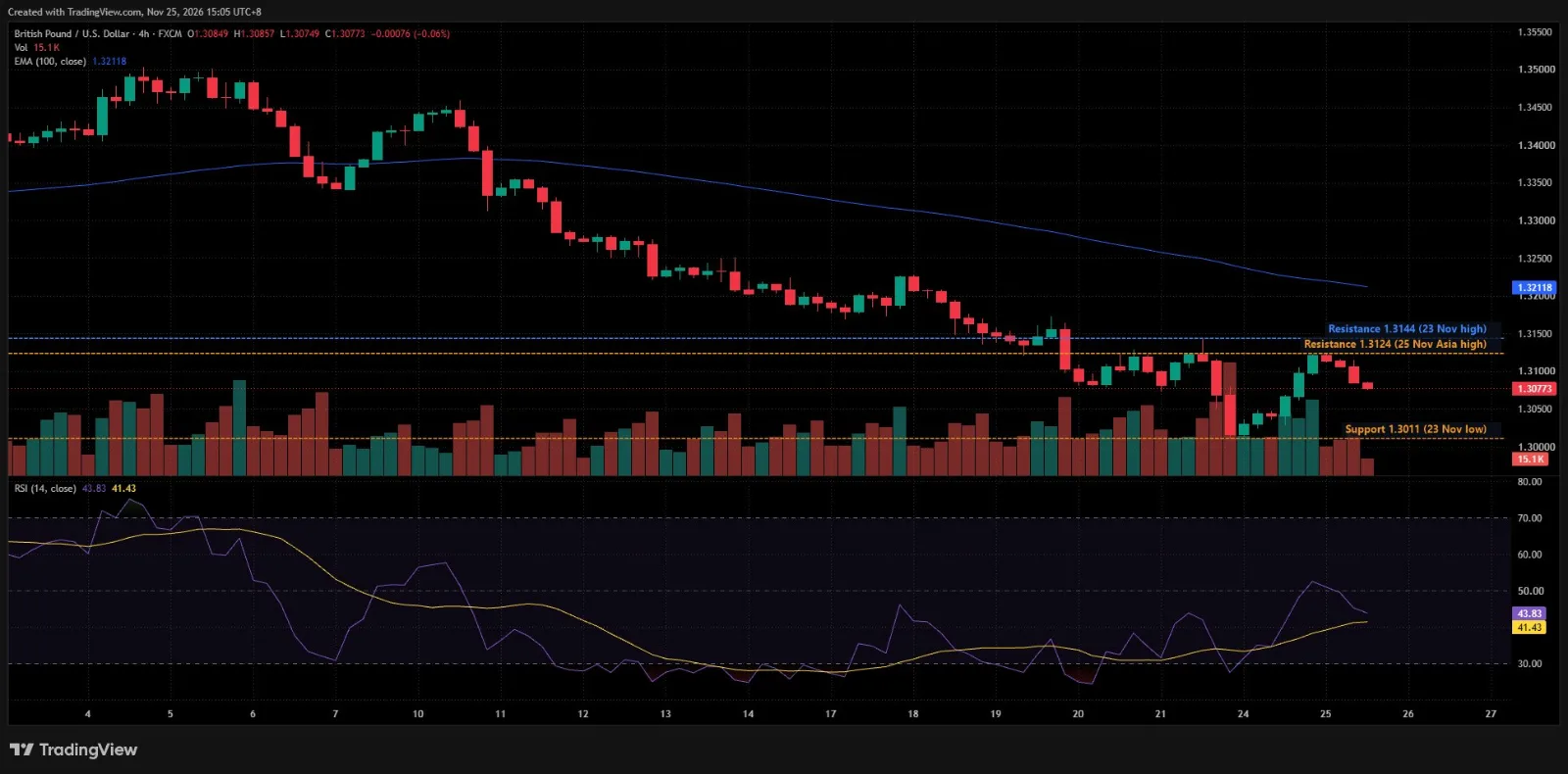
Technical analysis: GBP/USD holds a bearish bias below its 100-period EMA
The 4-hour chart shows a steady downtrend since early November, with price well below the 100-period EMA, now near 1.3212. Since 20 November the pair has been moving sideways in a narrow 1.3011–1.3144 band, a pause rather than a clear turn. The 14-period RSI is near 44, below the 50 midline, which fits a market that is drifting rather than trending hard in either direction.
Resistance (nearest first):
- 1.3124: Wednesday's Asian-session high.
- 1.3144: the 23 November high, the top of the recent band.
- 1.3212: the 100-period EMA.
Support (nearest first):
- 1.3011: the 23 November low, the bottom of the band.
- 1.3000: the round number just below it.
(This analysis was prepared with the help of AI tools and reviewed against live charts.)
What would change the view
A sustained break above 1.3144 and then the 100-period EMA near 1.3212 would weaken the bearish bias and point to a deeper recovery. A clear break below 1.3000–1.3011 would end the sideways pause and resume the November downtrend.
Events to watch (MYT)
- Wed 25 Nov, 21:30: US October PCE and core PCE, Q3 GDP (second estimate), durable goods orders, weekly jobless claims.
- Wed 25 Nov, 22:15: BoE Governor Bailey at the Treasury Select Committee.
- Wed 25 Nov, 23:00: US new home sales.
- Thu 26 Nov, 03:00: Fed Beige Book; US markets closed for Thanksgiving later that day.
Note for prop traders
Two events 45 minutes apart can produce back-to-back swings in GBP/USD. Plan for both before 21:30 MYT rather than reacting in between. At the TRFC reward stage, no new trades may be opened within 5 minutes either side of high-impact news, and the daily drawdown resets at 5:00 am MYT. Sizing positions so that two quick moves in a row cannot breach your daily limit is a sensible general habit. Related reading: risk-reward ratio in prop trading.
FAQ
What moves GBP/USD?
The main drivers are the interest-rate outlook at the Bank of England and the Federal Reserve, UK and US economic data, and overall risk sentiment.
Why is GBP/USD called cable?
The nickname dates back to the 1800s, when exchange rates between London and New York were sent through a telegraph cable under the Atlantic.
Why does a BoE governor's testimony matter?
The governor's answers to MPs can reveal how the BoE views inflation and growth, which shapes expectations for future rate decisions and therefore the pound.
What does an RSI near 50 mean?
It suggests momentum is balanced. Readings above 50 lean positive, readings below 50 lean negative, but RSI alone does not predict direction.
Disclosures: TRFC publishes this content and has a commercial interest in trading education and evaluations. TRFC holds no positions in the instruments discussed. Educational only, not investment advice. Trading involves risk; past performance is no guarantee of future results. TRFC evaluations use simulated accounts.
Educational only, not investment advice. Trading involves risk. TRFC evaluations use simulated accounts.