GBP/USD steadies near 1.3130 as traders await UK PMIs and Pill
Key points
- GBP/USD trades near 1.3130 as of 15:05 MYT in the Asian session on Monday, 23 November, up about 0.4% from Friday's close near 1.3081.
- Softer UK inflation and wage data last week cut bets on another Bank of England hike, while Fed hike pricing kept the US dollar firm.
- Next catalysts: UK flash PMIs at 17:30 MYT today, BoE Chief Economist Huw Pill at 21:00 MYT and US flash PMIs at 22:45 MYT.
GBP/USD is trading near 1.3130 as of 15:05 MYT on Monday, a modest bounce of about 0.4% after Friday's dip to 1.3073, one of its lowest levels in about a year. Sterling came under pressure last week as UK inflation and pay growth undershot forecasts, trimming expectations for another Bank of England hike, while markets kept pricing a December Fed hike with high probability. Today's UK flash PMIs, with services expected around 52.5 against 52.8 last month according to market previews, and a speech from BoE Chief Economist Huw Pill are the next tests.
What's moving the market
The main story is the gap between the two central banks. Until recently, traders expected the BoE to keep tightening alongside the Fed. Last week's softer UK inflation and wage numbers changed that, and the pound slid as hike bets for the BoE's December meeting were pared back. A better-than-expected UK retail sales report on Friday only briefly slowed the decline.
On the US side, the dollar has stayed firm on expectations of a December Fed hike. A small pullback in Treasury yields on Friday and a softer dollar tone in Asia today have given the pair some breathing room, which explains Monday's bounce.
Pill is known as one of the more hawkish voices at the BoE. If he pushes back against the market's softer pricing, sterling could find support; if he sounds relaxed about the inflation data, the recent lows may come back into view.
Technical analysis: GBP/USD tests the middle Bollinger Band, bias stays bearish below 1.3175
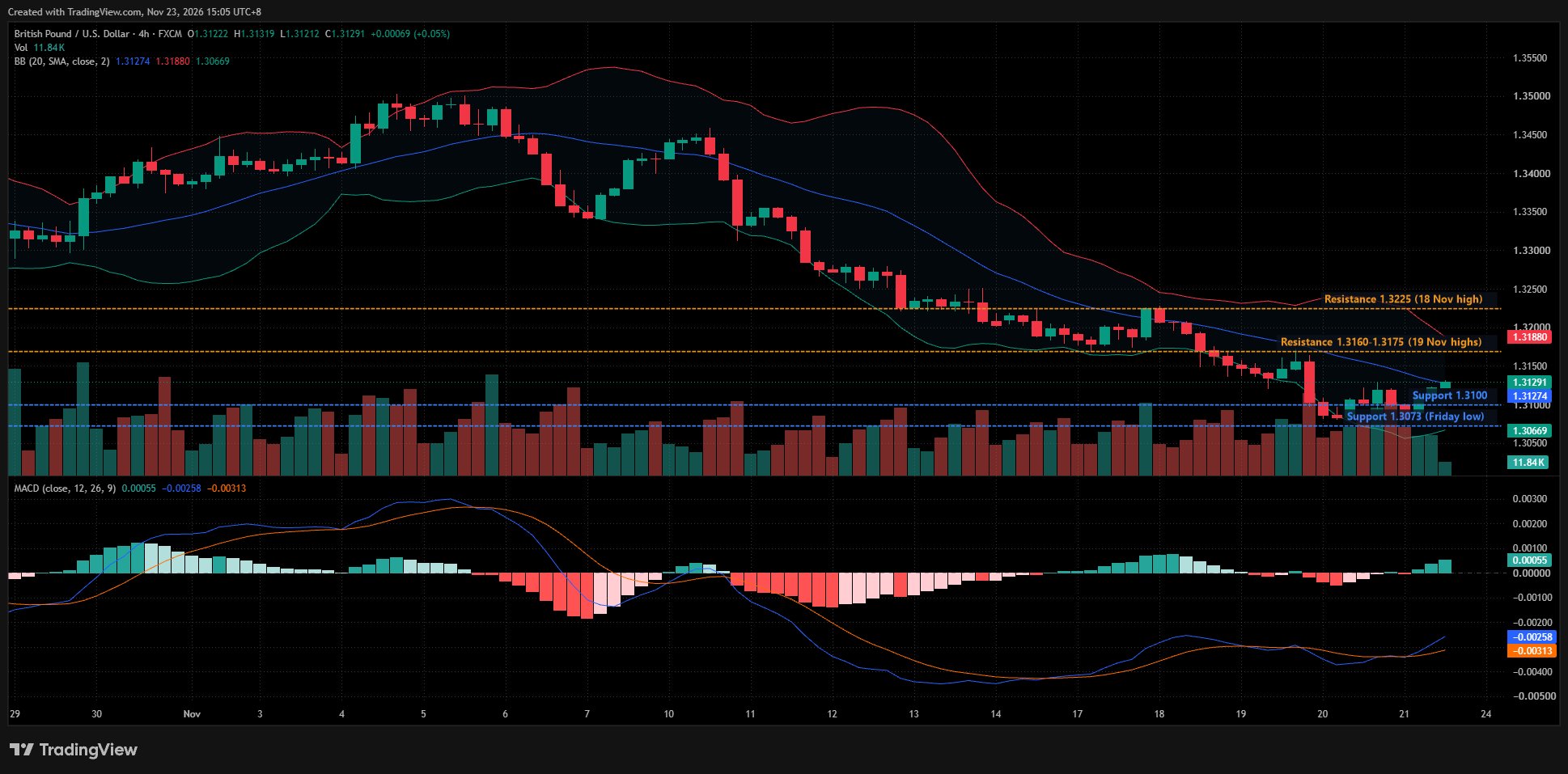
On the 4-hour chart the broader trend is still down, with a series of lower highs since early November. The pair is now testing the middle Bollinger Band (the 20-period average) near 1.3127. The bands have started to narrow after last week's slide, which often comes before a bigger move. The MACD line (around -0.0026) has crossed above its signal line (around -0.0031), so short-term momentum has improved, but both lines are still below zero.
Resistance (nearest first):
- 1.3160–1.3175: the 19 November highs.
- 1.3188: the upper Bollinger Band.
- 1.3225: the 18 November high.
Support (nearest first):
- 1.3100: the round number and today's early base.
- 1.3067–1.3073: the lower Bollinger Band and Friday's low.
- 1.3000: the psychological round number.
(This analysis was prepared with the help of AI tools and reviewed against live charts.)
What would change the view
A sustained break above 1.3175 would weaken the bearish bias and could open the way toward 1.3225. On the downside, a drop back below 1.3100 would put Friday's low near 1.3073 back in focus, and a break below it could bring 1.3000 into view.
Events to watch (MYT)
- Mon 23 Nov, 17:30: UK S&P Global flash PMIs (manufacturing, services, composite).
- Mon 23 Nov, 21:00: BoE Chief Economist Huw Pill speaks.
- Mon 23 Nov, 22:45: US S&P Global flash PMIs.
- Wed 25 Nov, 21:30: US core PCE price index.
- Thu 26 Nov: US Thanksgiving holiday, with thinner liquidity expected.
Note for prop traders
Three scheduled events land in one evening today, so GBP/USD spreads and ranges can widen quickly after 17:30 MYT. Keeping position size modest and knowing how much of the daily loss limit is left before each release helps avoid one spike undoing a good week. On a TRFC reward-stage account, no new trades are allowed within 5 minutes either side of high-impact news. Read more on risk-reward in prop trading, or see how TRFC challenges work.
FAQ
What moves GBP/USD the most?
Interest rate expectations for the Bank of England and the Federal Reserve, UK and US inflation and jobs data, and broad US dollar demand are the main drivers of the pair.
What is a flash PMI?
A flash Purchasing Managers' Index is an early survey reading of business activity. Above 50 signals expansion and below 50 signals contraction, and markets react to surprises against forecasts.
What do narrowing Bollinger Bands mean?
When the bands narrow, volatility has dropped. This "squeeze" often comes before a larger move, but it does not say which direction the move will take.
Who is the Bank of England's Chief Economist?
Huw Pill is the BoE's Chief Economist and a voting member of the Monetary Policy Committee, so his comments can shift expectations for UK interest rates.
Disclosure: This content is published by TRFC, which has a commercial interest in trading education and challenges, and holds no positions in the instruments mentioned. Educational only, not investment advice. Trading involves risk; past performance is no guarantee of future results. TRFC evaluations use simulated accounts.
Educational only, not investment advice. Trading involves risk. TRFC evaluations use simulated accounts.