How Do Prop Firms Make Money? The Business Model Explained (2026)
Short answer: most prop firms make money mainly from challenge fees, plus a share of the profits traders make in the reward stage. Add-ons such as a higher reward share or a reset bring in extra income, and a smaller number of firms also trade strong strategies on live markets. Knowing the model helps you judge whether a firm's rules are built to find good traders.
This guide explains each income stream in plain language, what it means for you as a trader, and how to check whether a firm's model fits you. Industry figures below are estimates from 2026 guides and reviews; firms rarely publish audited numbers.
The four ways a prop firm earns
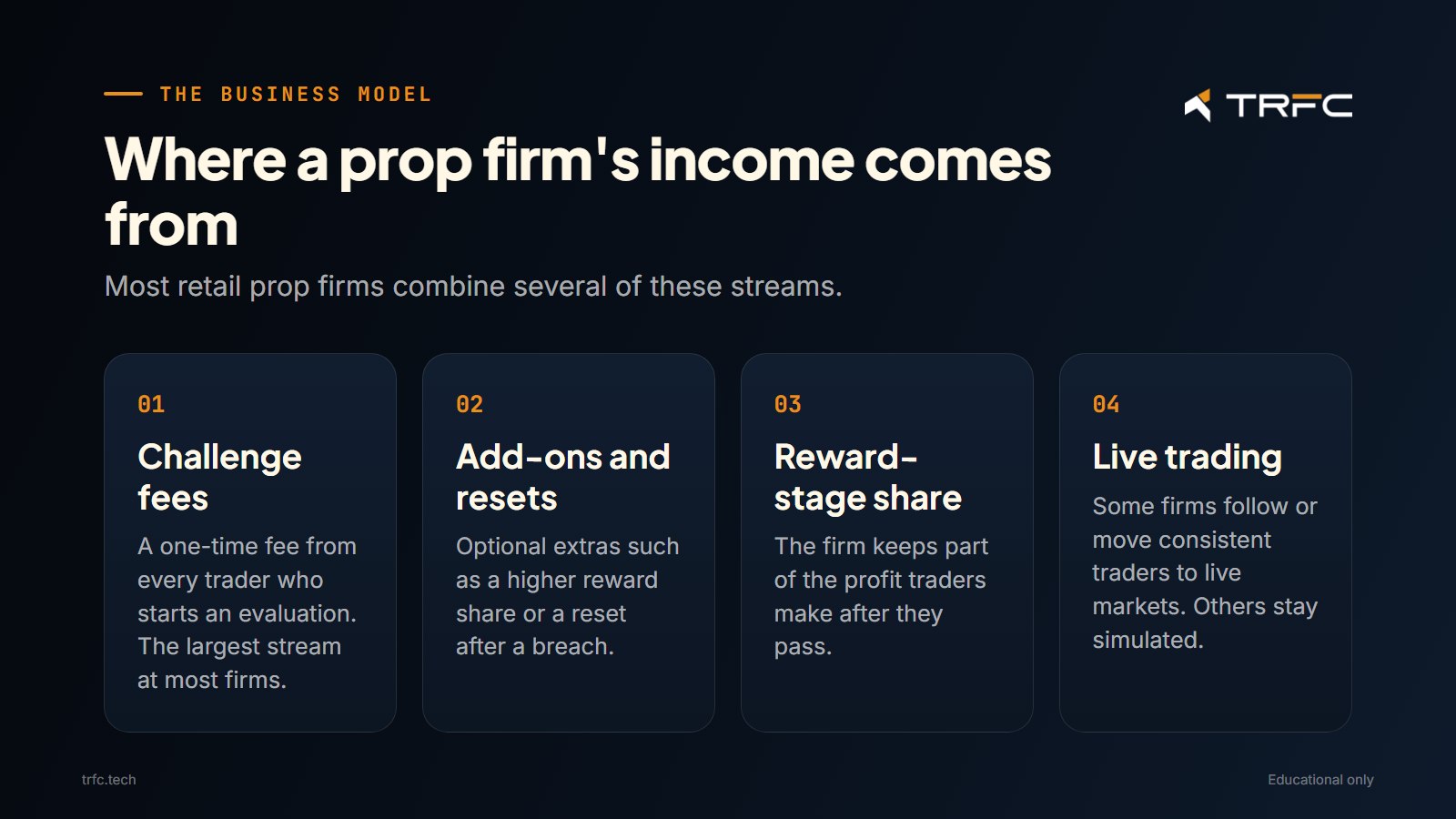
1. Challenge fees
Every trader pays a one-time fee to start an evaluation. Because many traders take a challenge and only some pass, fees are the largest income stream at most retail prop firms. Industry analyses commonly estimate that only a minority of evaluations, often put somewhere between 5% and 15%, end in a pass on the first attempt.
2. A share of reward-stage profit
When you pass, you trade under the firm's rules and receive a share of the profit. The firm keeps the rest. At TRFC, the reward share is 70% by default, with 80% or 90% available at checkout, so the firm's share is 30%, 20% or 10%.
3. Add-ons and resets
Many firms sell optional extras: a higher reward share, a reset after a breach, or different rule settings. These are paid at checkout and are a real cost to compare between firms.
4. Live trading (some firms)
Some firms copy or follow the trades of consistent traders on live markets, or move them to live accounts. Others keep every stage simulated and pay rewards from their own funds. Both models exist; what matters is that the firm says which one it uses.
Income streams compared
| Income stream | Who pays | What to check as a trader |
|---|---|---|
| Challenge fee | Every trader who starts | Price per account size, and whether a free trial exists |
| Reward-stage share | Traders who pass and earn | Reward share options (for example 70/80/90%) and payout schedule |
| Add-ons and resets | Traders who choose them | Exact add-on prices at checkout, dated |
| Live trading | The market (some firms only) | Whether the terms say simulated or live at each stage |
Does a prop firm want you to fail?
This is the question traders ask most, and the honest answer is: it depends on the rules. A firm that earns only when traders fail has a reason to make rules hard to follow. A firm that also earns from a share of reward-stage profit has a reason to keep good traders trading and paid.
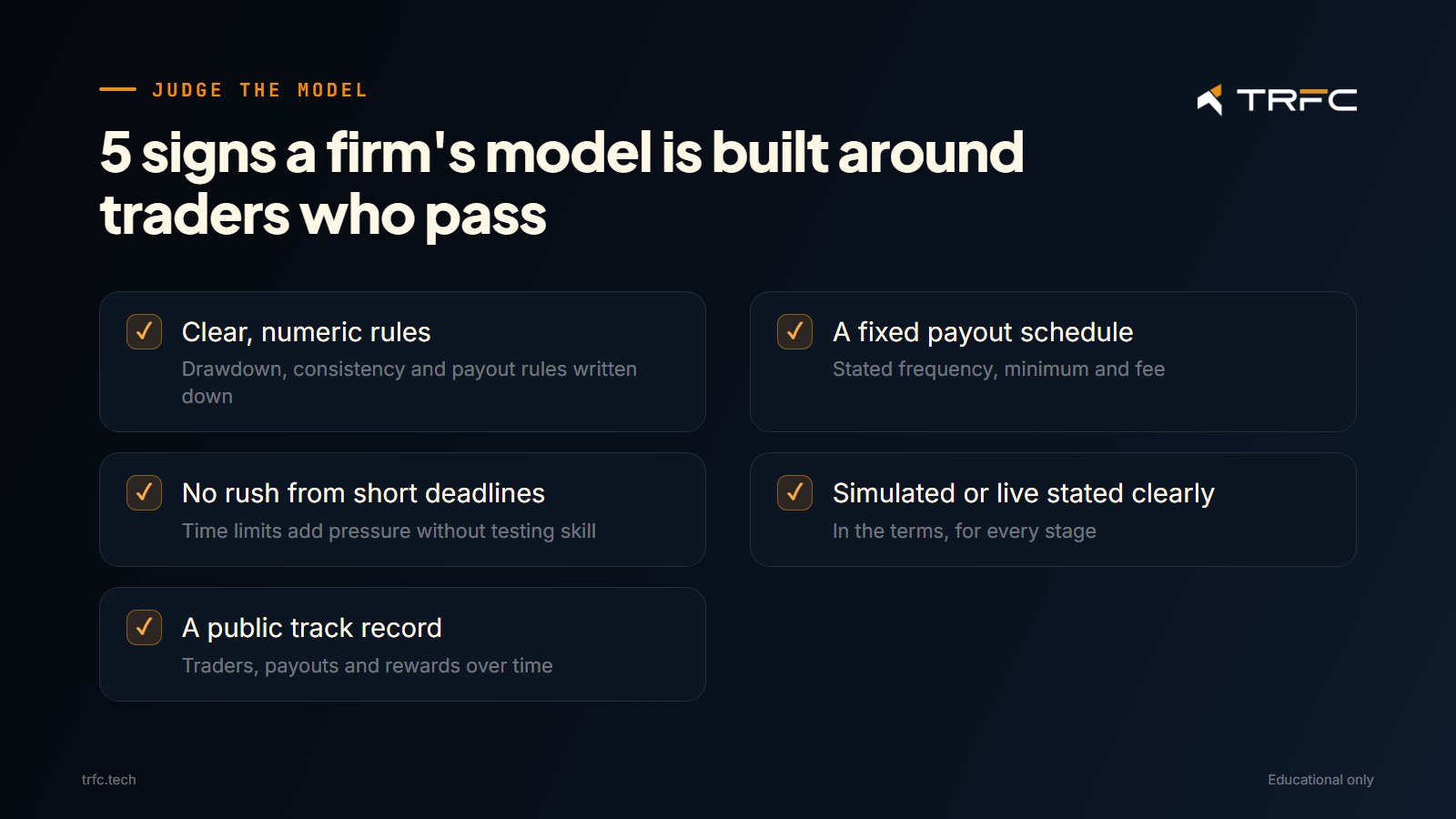
You can't see a firm's accounts, but you can read its rules. Clear, numeric rules, no hidden conditions, a fixed payout schedule and a public track record are good signs. Very short deadlines, vague "risk desk" rules or unclear payout conditions are reasons to ask more questions. TRFC, for example, sets no time limit on any plan and lists its drawdown, consistency and payout rules on its FAQ.
What this means for you
- Treat the fee as a business cost. Pick an account size whose fee you can afford to lose without changing how you trade.
- Read the rules before the price. A cheaper challenge with rules that do not fit your style can cost more over several attempts.
- Use a trial first. If a firm offers one, test its platform and rules before paying.
- Check payouts, not promises. Look for a stated schedule, minimum and fee.
Key facts about TRFC
- Challenge prices as listed in November 2026: 3-Step from $49 ($8K), 1-Step and 2-Step from $89 ($8K), up to $1,009 for a $200K 1-Step or 2-Step account.
- Reward share 70% by default, with 80% or 90% as paid options at checkout.
- No time limit on any plan.
- Payouts every 14 days, $100 minimum, $25 fee, usually 24–72 business hours after approval.
- A free 30-day trial is available.
- TRFC evaluations use simulated accounts.
- Track record shown on trfc.tech: 2,600+ traders, 130+ payouts and $400K+ in rewards since 2023.
See the full rules, prices and reward-share options for each plan on the TRFC challenges page. For more guides, visit the TRFC blog.
FAQ
How do prop firms make money?
Mainly from challenge fees, plus a share of reward-stage profit, paid add-ons and resets. Some firms also trade strong strategies on live markets.
Do prop firms make money when traders fail?
The fee is kept whether you pass or fail, so failures are part of the income. Firms that also share in reward-stage profit benefit when traders pass and keep trading.
What share of profit does a prop firm keep?
It depends on the reward share you choose. At TRFC, you receive 70%, 80% or 90%, so the firm keeps 30%, 20% or 10%.
How can I tell if a prop firm is trustworthy?
Look for clear numeric rules, a fixed payout schedule, a stated simulated or live model, a public track record and a list of restricted countries.
Educational only, not investment advice. TRFC evaluations use simulated accounts.