How to Use a Moving Average as a Trend Filter (Not a Signal)
Most traders meet moving averages as a signal: buy when price crosses above, sell when it crosses below. On a chart that trends nicely, that looks great. In a sideways market, it gives you a loss every few hours. There is a better job for a moving average, and it is a much simpler one: telling you which direction you are allowed to trade.
Used as a trend filter, a moving average does not tell you when to enter. It tells you when not to. That alone removes many of the counter-trend trades that quietly drain an account.
Filter vs signal: what's the difference?
A signal says "act now". A filter says "only act on setups that point this way". You keep your normal entry method, such as a pullback to a support zone, a breakout or a candle pattern, and you simply ignore any setup that goes against the filter.
The result is fewer trades, but the ones you take have the bigger market flow behind them.
A simple three-rule filter
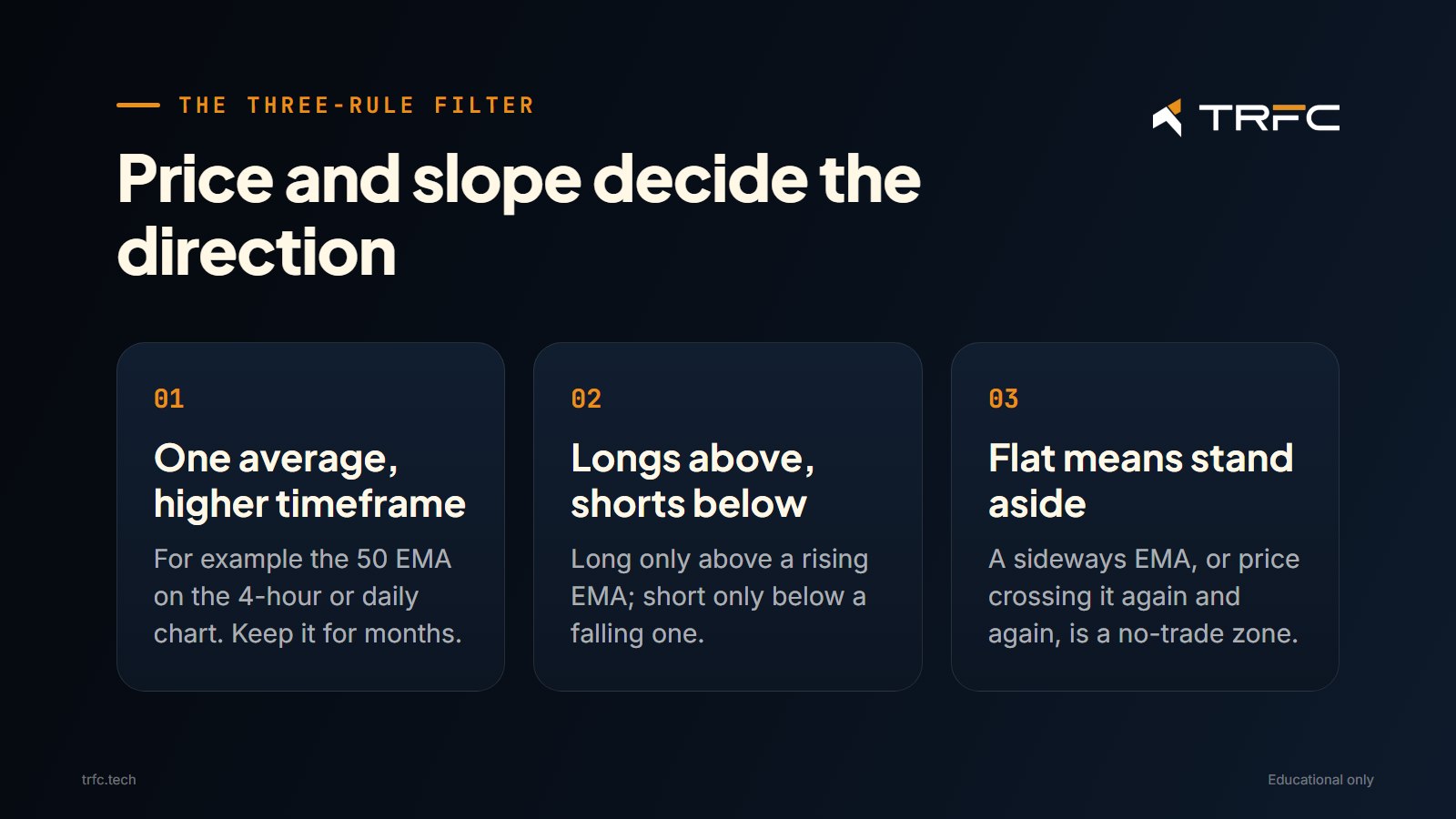
- Pick one moving average on a higher timeframe. A common choice is the 50-period exponential moving average (EMA) on the 4-hour or daily chart. Whatever you choose, keep it the same for at least a few months so you can judge it fairly.
- Read price and slope together. Longs only when price is above the EMA and the EMA is rising. Shorts only when price is below it and it is falling.
- Stand aside when it's flat. If the EMA is moving sideways, or price has crossed it back and forth several times recently, there is no clear trend. That is a "no trade" or "reduced size" condition, not a signal to guess.
Then drop to your entry timeframe (for example the 15-minute or 1-hour chart) and trade your usual setups, but only in the allowed direction.
How to judge the slope without overthinking it
You don't need an angle tool. Compare the EMA's value now with its value 10 bars ago. Clearly higher: rising. Clearly lower: falling. Roughly the same: flat. If you have to squint to decide, call it flat. The point of a filter is to be obvious.
Which length and which type?
There is no magic number. A 50-period average on a higher timeframe is popular because it is slow enough to ignore day-to-day noise but fast enough to turn within a few weeks of a real change in direction. A 200-period average is slower still and suits traders who hold positions for days. Shorter lengths, such as 20, react faster but flip more often, which defeats the point of a filter.
Exponential (EMA) and simple (SMA) moving averages both work. An EMA gives more weight to recent prices, so it turns a little sooner; an SMA is smoother. Pick one, write it into your trading plan, and judge it on dozens of trades rather than a single week.
A worked example (illustrative)
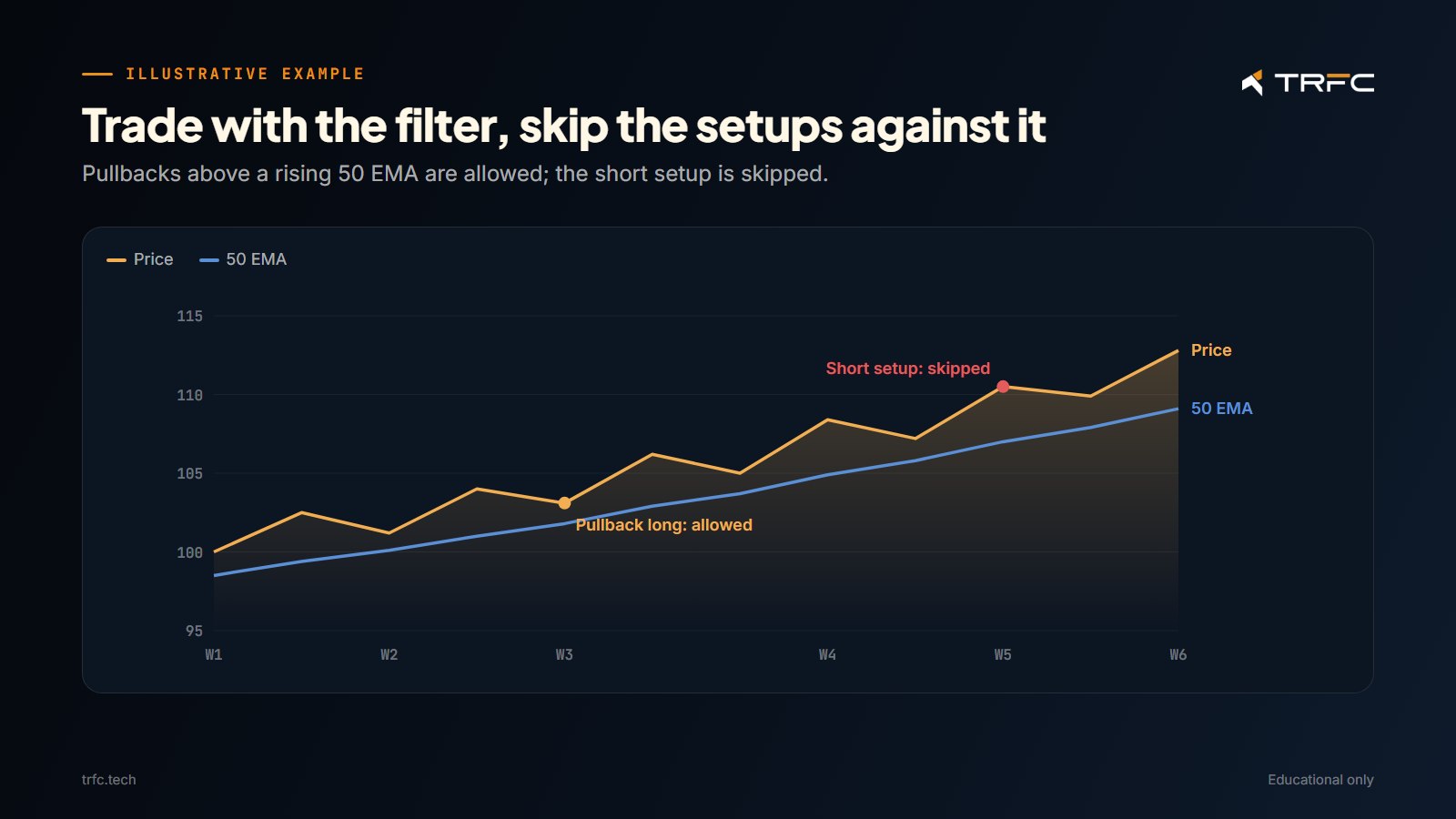
Imagine the daily chart of a major index. Price has stayed above a rising 50 EMA for six weeks. On the 1-hour chart, price pulls back into a support zone that held twice before and prints a strong bullish candle. Your filter says longs are allowed, your setup says "go", so you take it with your normal risk.
Two days later, on the same 1-hour chart, you see a clean-looking short setup at resistance. It may well work. But the daily filter is still pointing up, so you pass. You will miss some winners this way; the trade-off is that you also skip many of the setups that fight the main trend and fail.
Common mistakes
- Changing the length after every loss. Swapping a 50 for a 34 and then a 21 because of last week's results turns the filter into curve-fitting.
- Using the filter on the same timeframe as entries. A 50 EMA on a 5-minute chart flips direction far too often to act as a filter.
- Treating a touch of the EMA as an entry. Price touching the line is not a setup by itself. Wait for your normal entry pattern.
- Ignoring the "flat" state. Most of the damage from moving averages happens in sideways markets. Respect the stand-aside rule.
Why this helps on a prop firm challenge
On a challenge, the goal is not to catch every move. It is to reach the target without breaking the daily or maximum drawdown. A trend filter helps in three ways:
- It cuts the number of trades, which also cuts the number of chances to make an emotional mistake.
- It reduces strings of losses from fading strong trends, the kind of streak that can eat a daily limit quickly.
- It gives you a clear reason to sit out messy days, which is easier when your plan has no time limit. TRFC challenges have none.
Test it before you trust it
Go back through your last 30 to 50 trades and mark which ones agreed with a 50 EMA filter on your higher timeframe. Compare the results of the "with filter" and "against filter" groups. If the trades against the filter performed clearly worse, you have your answer. If there is no difference, the filter may not suit your style, and that is useful to know too.
Want room to test a calmer, filter-first approach? See TRFC challenges, or read more strategy guides on the TRFC blog.
Educational only, not investment advice. TRFC evaluations use simulated accounts. Examples are illustrative, not trade recommendations.