Pound holds near 1.3185 as UK inflation meets 3.6% forecast
Key points
- GBP/USD trades near 1.3185 in the London morning, as of 15:02 MYT on Wednesday, 18 November, little changed on the day.
- UK CPI rose 3.6% year on year in October, in line with consensus and up from 3.5%; core CPI held at 2.8%.
- Next catalyst: the Fed minutes from the October meeting, due around 03:00 MYT on Thursday.
The pound is holding near 1.3185 against the US dollar in early London trade, as of 15:02 MYT, after a muted reaction to UK inflation data, and remains about 2.4% below its early-November high near 1.3503. The Office for National Statistics said consumer prices rose 3.6% in the 12 months to October, matching the 3.6% calendar consensus and up from 3.5% in September, while core CPI was little changed at 2.8%. Traders now turn to the Federal Reserve's October minutes, due around 03:00 MYT on Thursday.
What's moving the market
The October print gave sterling little new information. Headline inflation edged higher, with motor fuels the largest upward driver, but core inflation stayed at 2.8% and the ONS said the CPIH services rate was little changed at 3.9%. Some previews had pencilled in 3.7%, so a figure that matched rather than beat the 3.6% consensus left the pound without a fresh push. Markets had already priced a high chance of another Bank of England hike before year-end, so a data point that keeps that path intact, without adding to it, is largely neutral.
The bigger force remains the US dollar. The dollar index is holding near a 19-month high, supported by strong US data and Fed comments that keep a December rate hike in play. That backdrop has driven GBP/USD down for most of November, with a run of lower highs from a peak near 1.3460 on 10 November.
The Fed minutes are the next test. If they show broad support for further tightening, the dollar could stay firm; a more divided committee could give the pound some room to recover.
Technical analysis: GBP/USD keeps a bearish bias below the 50-period EMA
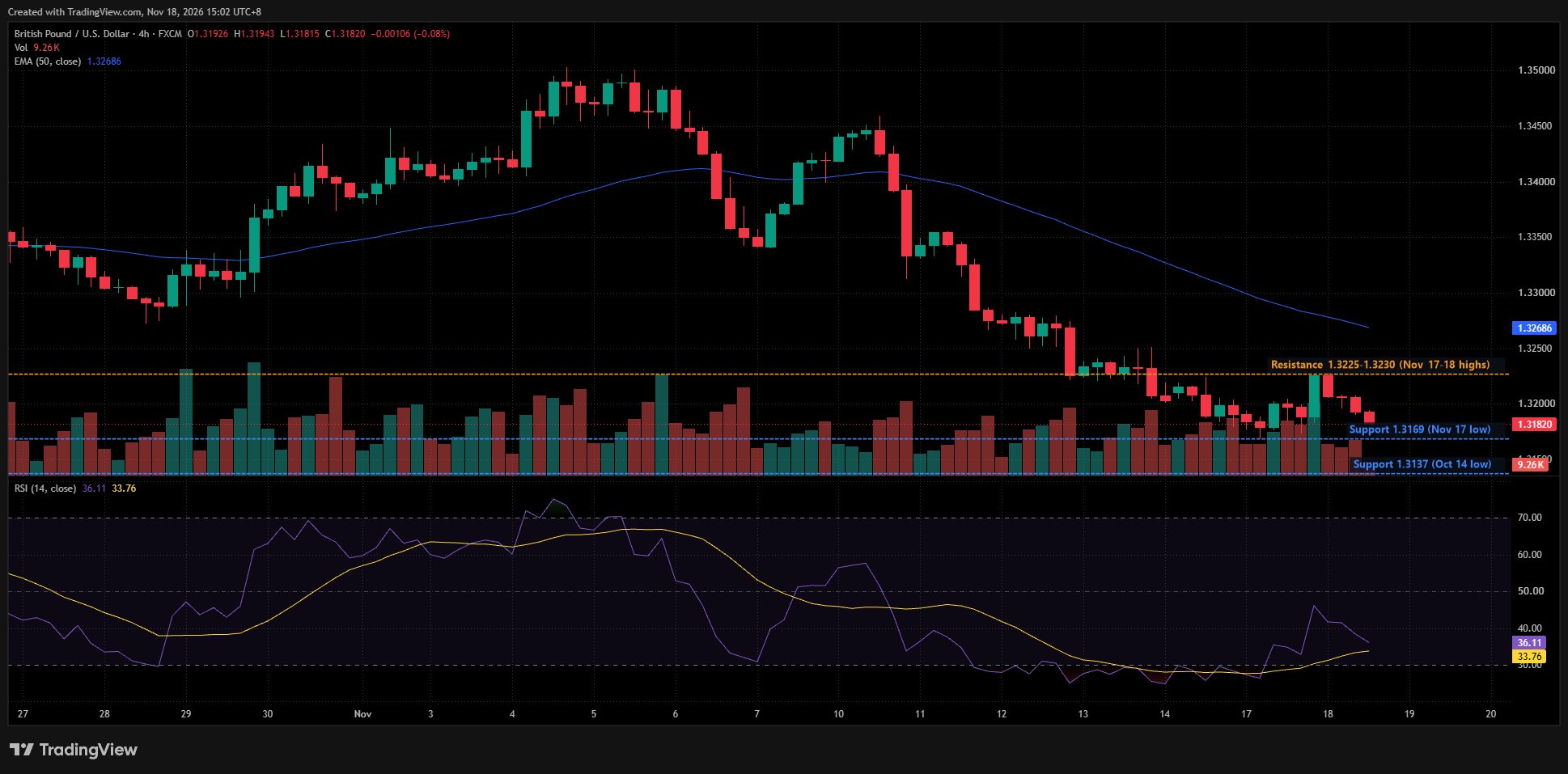
GBPUSD, H4 chart with EMA (50) and RSI (14), 18 Nov 2026 15:02 MYT. Chart: TradingView
The bias on the 4-hour chart stays bearish. Price trades below a falling 50-period EMA, now near 1.3269, and the pair has made lower highs since 10 November. RSI (14) sits near 36: weak, but not yet oversold, which leaves room for either a further dip or a slow drift sideways.
Resistance:
- 1.3225–1.3230: the highs of 17–18 November, where Tuesday's rebound stalled.
- 1.3269: the 50-period EMA on the H4 chart.
Support:
- 1.3169: the 17 November low, the floor of this week's range.
- 1.3137: the 14 October low, the lowest level the pair has traded at since early September.
(This analysis was prepared with the help of AI tools and reviewed against live charts.)
What would change the view
A sustained move back above 1.3230, and then the 50-period EMA near 1.3269, would weaken the bearish case and point to a wider recovery. A clean break below 1.3169 could open the way toward 1.3137, the October low.
Events to watch (MYT)
- Thursday 19 November, around 03:00: FOMC minutes (October 27–28 meeting).
- Through the week: comments from Bank of England and Fed officials, ahead of the BoE's December decision.
Note for prop traders
CPI days can bring fast spikes and wider spreads in GBP pairs. Keep your daily loss limit in mind before the session starts. At the reward stage on TRFC, no new trades may be opened within 5 minutes either side of high-impact news, and the Fed minutes count as a scheduled event worth planning around. Size positions so a normal intraday swing cannot take you close to your limit. For a refresher, read how the daily drawdown reset works.
Want to practise reading levels like these without risking your own money? Start TRFC's free 30-day trial on a simulated account.
FAQ
What is UK CPI?
The Consumer Prices Index measures the change in prices of a basket of goods and services bought by UK households. The Office for National Statistics publishes it monthly, usually at 07:00 UK time (15:00 MYT in winter).
Why does UK inflation move the pound?
Inflation shapes Bank of England rate expectations. Higher-than-expected inflation can raise the odds of tighter policy, which tends to support sterling; a softer reading can do the opposite.
What is the difference between headline and core CPI?
Headline CPI includes everything in the basket. Core CPI strips out energy, food, alcohol and tobacco, which are volatile, to show the underlying trend.
What moves GBP/USD besides UK data?
US data and Fed expectations matter just as much, because the pair is a ratio of two currencies. Risk sentiment and the broad US dollar trend also play a large role.
Disclosures: This content is published by TRFC, which has a commercial interest in the products mentioned and holds no positions in the instruments discussed. Educational only, not investment advice. Trading involves risk; past performance is no guarantee of future results. TRFC evaluations use simulated accounts.
Educational only, not investment advice. Trading involves risk. TRFC evaluations use simulated accounts.