How to Calculate Your Prop Firm Drawdown Limit in Dollars (With Examples)
To turn a prop firm drawdown rule into dollars, multiply the percentage by your starting (initial) account balance: on a $10,000 account, a 5% daily limit is $500 and a 10% maximum limit is $1,000. The harder part is knowing which number moves, which one stays fixed, and when the daily one resets. This guide walks through the maths with TRFC's plans as worked examples (rules as of November 2026).
The short version
- Daily drawdown in dollars = daily % × initial balance. At TRFC, open trades count in real time, and the daily limit resets at 5:00 am MYT/SGT.
- Static maximum drawdown in dollars = max % × initial balance. On TRFC's 1-Step, 2-Step and 3-Step plans, your lowest allowed balance is fixed from the starting balance and never moves, even after profit or a withdrawal.
- Trailing maximum drawdown starts at the same distance below your starting balance, then follows your account up as it makes new highs. On TRFC's Instant Pilot and Instant Turbo, it locks permanently once it reaches the starting balance.
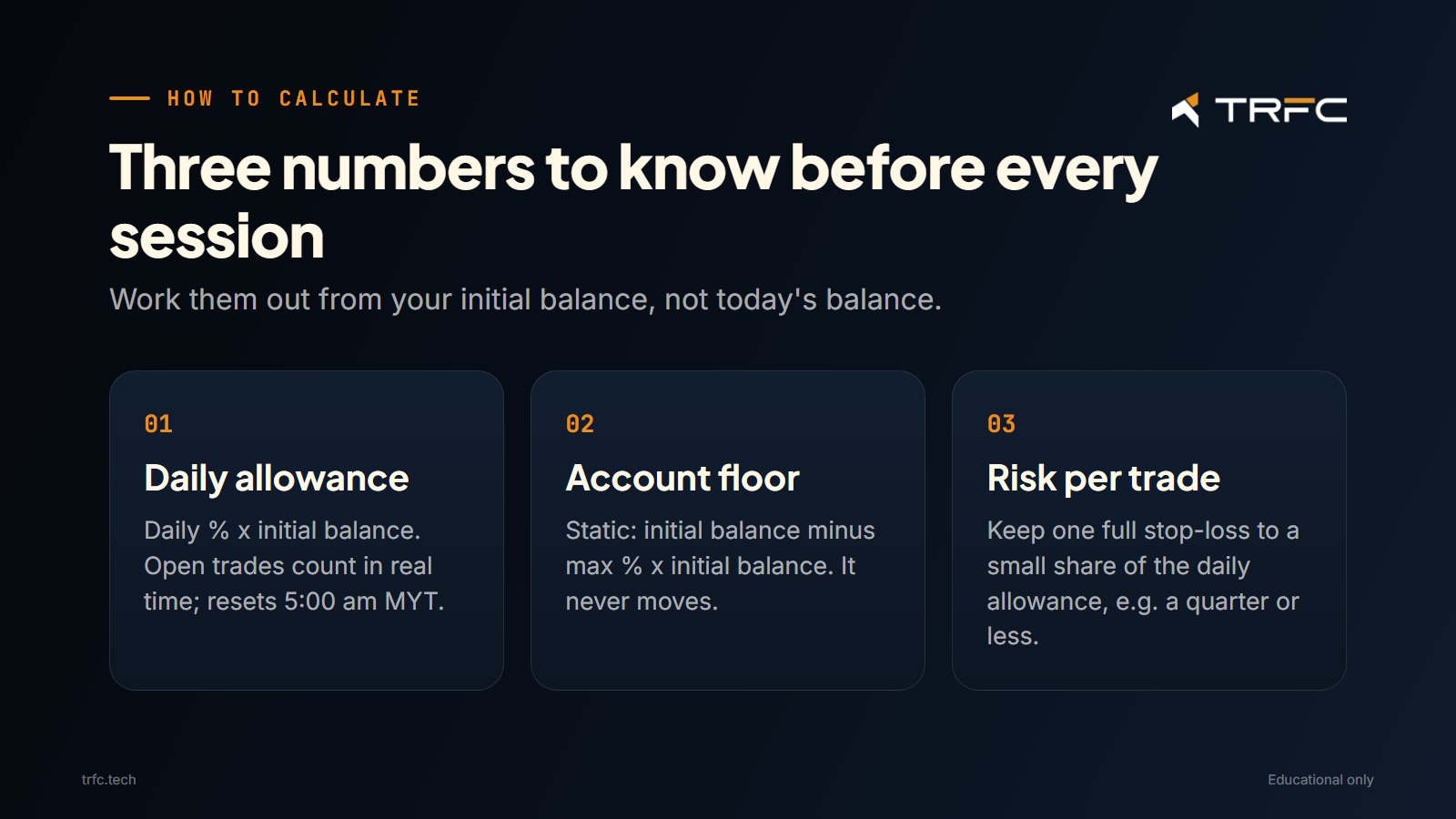
Step 1: Find your daily allowance
Take the daily percentage on your plan and multiply it by the account size you bought, not by today's balance. On a $10,000 2-Step account with a 5% daily limit, your daily allowance is $500. If you grow the account to $10,800, the allowance is still $500, because it is based on the initial balance.
Two details catch traders out:
- Floating losses count. If you have three trades open and they are down $420 between them, you have only $80 of room left for the day, even though nothing has closed yet.
- The reset time is fixed. TRFC's server runs on UTC+3 and the daily limit resets at 5:00 am MYT/SGT. A loss at 4:50 am and a loss at 5:10 am fall on different trading days.
Step 2: Find your account floor
Your maximum drawdown is the line your account must never touch. On a static model, work it out once: initial balance minus (max % × initial balance). A $10,000 account with a 10% static maximum has a floor of $9,000, and that floor stays at $9,000 for the life of the account.
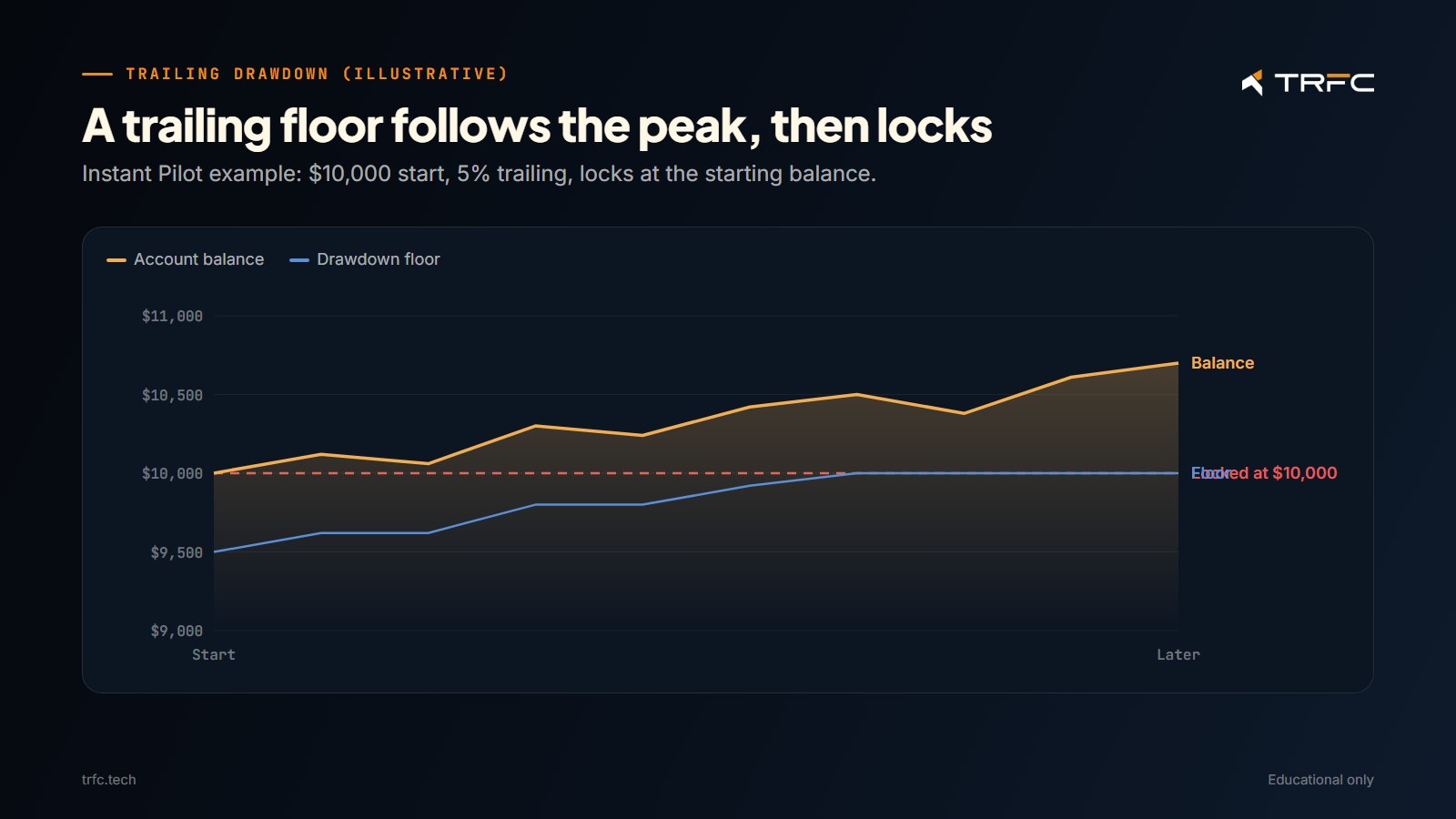
On a trailing model, the floor moves. Say an Instant Pilot account starts at $10,000 with a 5% trailing drawdown, so the floor starts at $9,500. If the account climbs to $10,300, the floor rises to $9,800. Once the account reaches $10,500, the floor reaches $10,000 and locks there for good. After that point, the account behaves like a static one with the floor at your starting balance.
Step 3: Write both numbers down before you trade
Put the daily dollar allowance and the floor on a sticky note or at the top of your trading journal. Then size every trade so that a full stop-loss uses only a small part of the daily allowance. Many traders keep a single trade's risk at a quarter or less of the daily room, so one bad trade can never end the day.
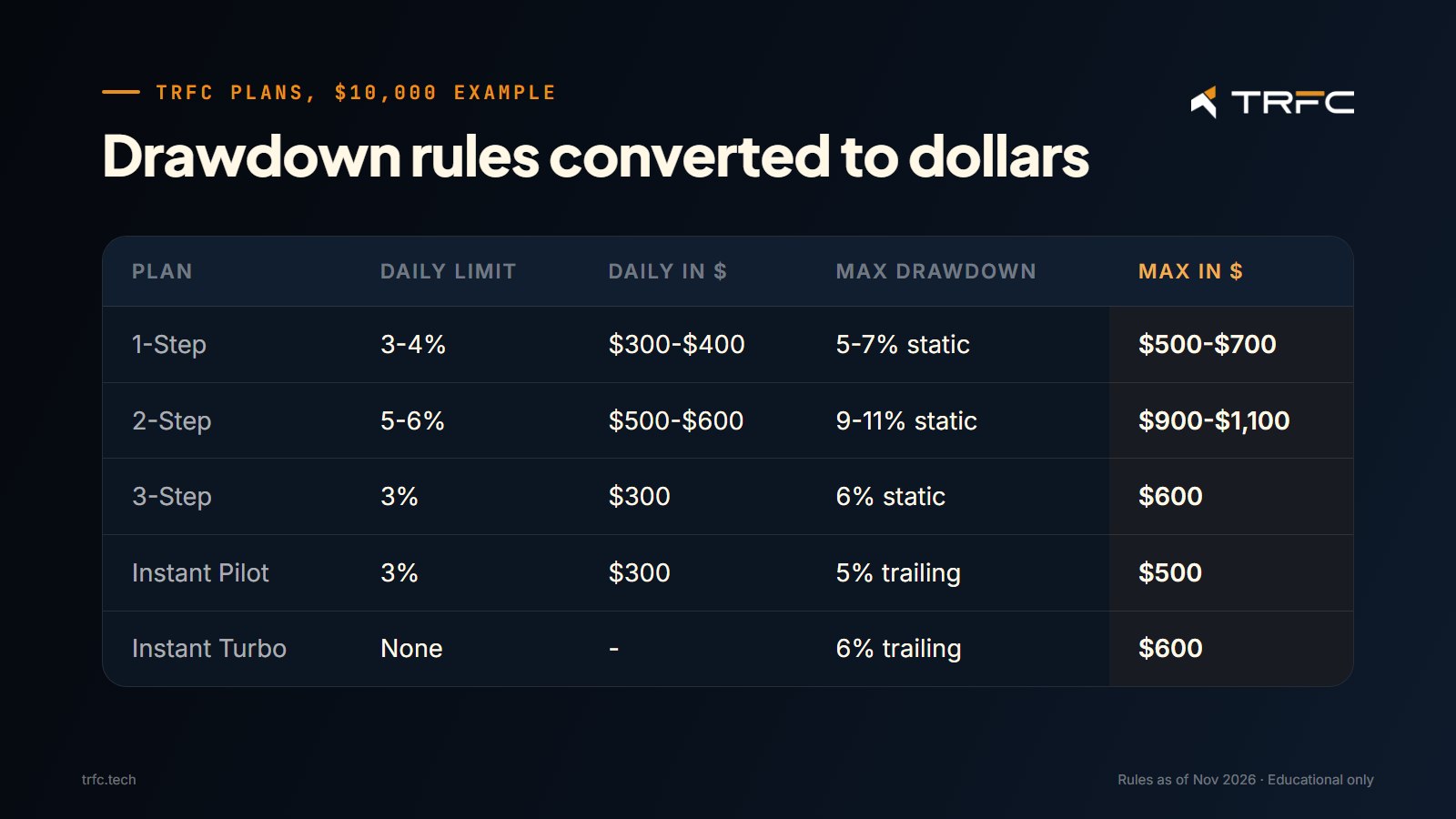
TRFC plans in dollars: a $10,000 example
The table below converts each TRFC plan's rules into dollars on an illustrative $10,000 account. Where a plan shows a range, the exact figure depends on the options you pick at checkout.
| Plan | Daily limit | Daily in $ | Max drawdown | Max in $ |
|---|---|---|---|---|
| 1-Step | 3–4% | $300–$400 | 5–7% static | $500–$700 |
| 2-Step | 5–6% | $500–$600 | 9–11% static | $900–$1,100 |
| 3-Step | 3% | $300 | 6% static | $600 |
| Instant Pilot | 3% | $300 | 5% trailing | $500 |
| Instant Turbo | None | – | 6% trailing | $600 |
Accounts at TRFC run from $3K to $200K (Instant Turbo from $3K to $30K), so scale these numbers in proportion: a $50,000 2-Step account with a 5% daily limit has $2,500 of daily room.
A quick worked day
You trade a $25,000 1-Step account with a 4% daily limit and a 6% static maximum. Daily room: $1,000. Floor: $23,500. You plan to risk $200 per trade, so five full losses in a row would be needed to hit the daily limit, and you stop after three. The account sits at $25,600 by Friday; your floor is still $23,500, so you now have $2,100 above it, but your daily room is still $1,000.
Common mistakes
- Calculating the daily limit from today's balance instead of the initial balance.
- Forgetting that open trades count, then adding a new position while others are in drawdown.
- Treating a trailing drawdown as static and being surprised when the floor moves up after a good week.
- Ignoring the reset time when trading late sessions from another time zone.
FAQ
Is the daily drawdown based on balance or equity?
At TRFC, the daily limit is a percentage of the initial balance, and open trades count in real time. So in practice your floating losses use up the daily room as they happen.
Does my maximum drawdown floor move up when I make profit?
On TRFC's 1-Step, 2-Step and 3-Step plans, no. The maximum drawdown is static and fixed from the starting balance. On Instant Pilot and Instant Turbo it trails upward and then locks at the starting balance.
When does the daily limit reset?
Every day at 5:00 am MYT/SGT. The TRFC server runs on UTC+3.
Is there a TRFC plan with no daily limit?
Yes. Instant Turbo has no daily loss limit and uses a 6% trailing maximum drawdown instead.
Is there a time limit to pass?
No. TRFC has no time limit on any plan, so you never need to push size to hit a deadline.
Key facts about TRFC
- Accounts from $3K to $200K, with a reward share of 70%, 80% or 90% chosen at checkout.
- Static maximum drawdown on 1-Step, 2-Step and 3-Step; trailing drawdown that locks at the starting balance on Instant plans.
- Daily limit is a percentage of the initial balance; open trades count in real time; reset at 5:00 am MYT/SGT.
- No time limit on any plan; free 30-day trial available.
- Payouts every 14 days, $100 minimum.
Want to see the exact limits for the account size you have in mind? Compare TRFC challenges and their drawdown rules, or read more guides on the TRFC blog.
Educational only, not investment advice. TRFC evaluations use simulated accounts.