Prop Firm Inactivity Rules: How Long Can You Pause Trading?
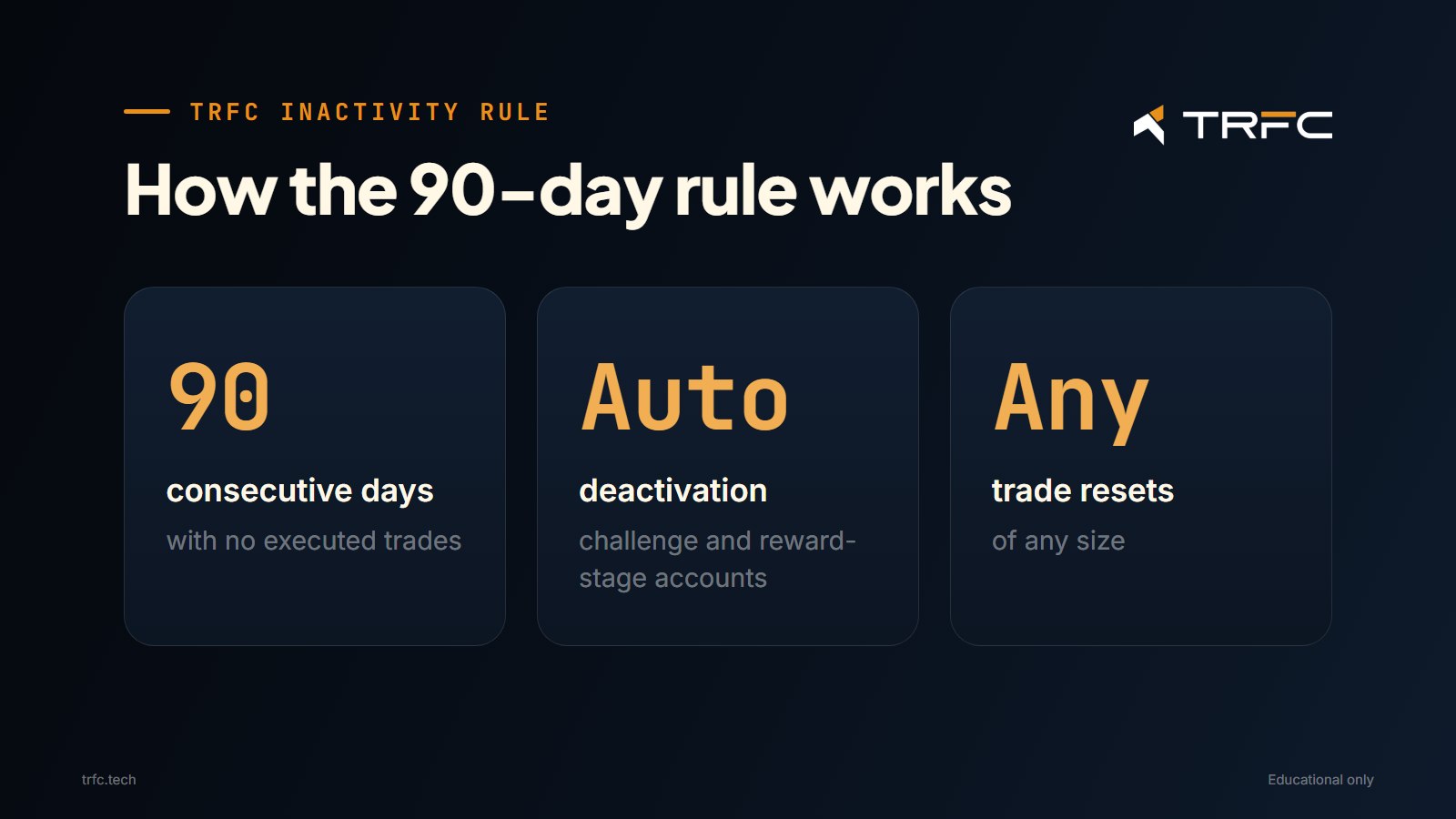
Most prop firms close accounts that go unused for too long. At TRFC, an account with no trades for 90 consecutive days is deactivated automatically, and any executed trade of any size resets the 90-day counter. The rule applies to both challenge accounts and reward-stage simulated accounts, so a long break needs a small plan.
Holidays, a new job, exams or a rough patch can all keep a trader away from the charts for weeks. That is normal and often healthy. The problem is only when the break quietly runs past a firm's inactivity limit and an account you paid for is gone. This guide explains why inactivity rules exist, how TRFC's rule works, and how to take a break safely.
Why prop firms have inactivity rules
Each open account carries running costs for the firm: data, platform seats, monitoring and support. An inactivity rule lets the firm close accounts that are no longer being traded. It is usually separate from the evaluation's time limit. A plan can have no time limit to reach the target and still close an account that has not traded at all for a long period.
TRFC's 90-day inactivity rule
As of November 2026, trfc.tech/faq states:
- Trigger: no trades for 90 consecutive days.
- Result: the account is deactivated automatically.
- Scope: challenge accounts and reward-stage simulated accounts.
- Reset: any executed trade, of any size, restarts the 90-day count.
Time limit vs inactivity: how TRFC's plans compare
| Plan | Time limit to pass | Inactivity rule | Minimum profitable days |
|---|---|---|---|
| 1-Step | None | 90 days with no trades | 3 |
| 2-Step | None | 90 days with no trades | 3 |
| 3-Step | None | 90 days with no trades | See checkout |
| Instant Pilot | No evaluation | 90 days with no trades | 7 |
| Instant Turbo | No evaluation | 90 days with no trades | 7 |
A profitable day must show at least 0.5% growth, and the days do not need to be consecutive. So a break does not reset your progress on profitable days. It only matters if it reaches 90 days with no trades.
How to take a trading break without losing your account
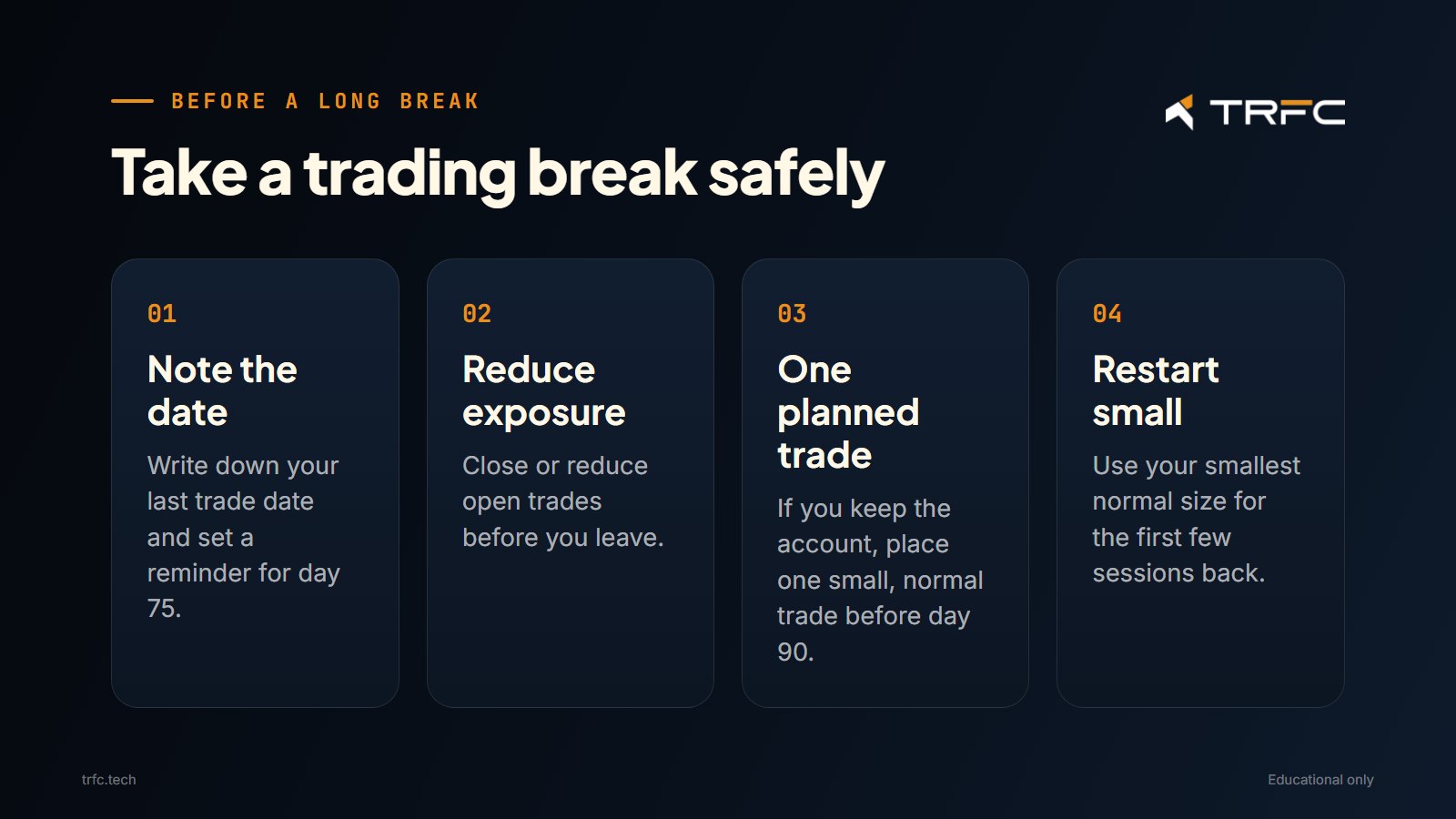
- Write down your last trade date. Add a calendar reminder for day 75, so you have two weeks of margin.
- Close or reduce open positions before you leave. A break with open trades still exposes you to the daily and maximum drawdown.
- If you need to keep the account, place one small, planned trade before day 90. Treat it like any other trade: your normal analysis, a small size and a defined exit, inside all the usual rules (including the 3-minute minimum hold).
- Do not rush back with a big trade. After a long gap, start with your smallest normal size for a few sessions.
- Check the rules again when you return. Firms update their FAQs, and your plan's numbers may have changed.
TRFC plans have no time limit, which helps if you can only trade part-time. You can see TRFC's challenge plans here, or read prop firms with no time limit and minimum trading days explained.
FAQ
What happens if I don't trade my prop firm account?
At most firms, an account with no trades for a set period is closed. At TRFC that period is 90 consecutive days, after which the account is deactivated automatically.
Does the TRFC inactivity rule apply to reward-stage accounts?
Yes. It applies to both challenge accounts and reward-stage simulated accounts.
What resets the 90-day counter?
Any executed trade, of any size.
Is the inactivity rule the same as a time limit?
No. TRFC has no time limit to reach the profit target. The inactivity rule only applies when no trades are placed for 90 consecutive days.
Do profitable days need to be consecutive?
No. At TRFC a profitable day needs at least 0.5% growth, and the days can be spread out.
Key facts about TRFC
- TRFC (trfc.tech) is a prop trading firm operating since 2023.
- 90-day inactivity rule: no trades for 90 consecutive days deactivates the account; any trade resets the counter.
- No time limit on any plan, and a free 30-day trial.
- Plans: 1-Step, 2-Step, 3-Step and Instant, with accounts from $3K to $200K.
- Reward share of 70%, 80% or 90%, chosen at checkout.
- 2,600+ traders, 130+ payouts and $400K+ in rewards paid.
Educational only, not investment advice. TRFC evaluations use simulated accounts.