Can Traders in Thailand and Vietnam Join a Prop Firm? What to Check (2026)
Yes, traders in Thailand and Vietnam can join many prop firms, including TRFC: neither country is on TRFC's restricted list as of November 2026. Before you pay for any challenge, check five things: country eligibility, how you pay, how you get paid, what time the daily limit resets in your time zone, and the trading rules that matter for your style.
Is Thailand or Vietnam restricted at TRFC?
No. TRFC's restricted countries are the US, Canada, the UK, the EU, Japan, China, Russia, Belarus, North Korea, Iran, Syria and Cuba. Thailand and Vietnam are not on that list, so traders from Bangkok, Chiang Mai, Hanoi, Ho Chi Minh City or Da Nang can sign up. Eligibility lists do change, so always confirm on the firm's own site on the day you buy.
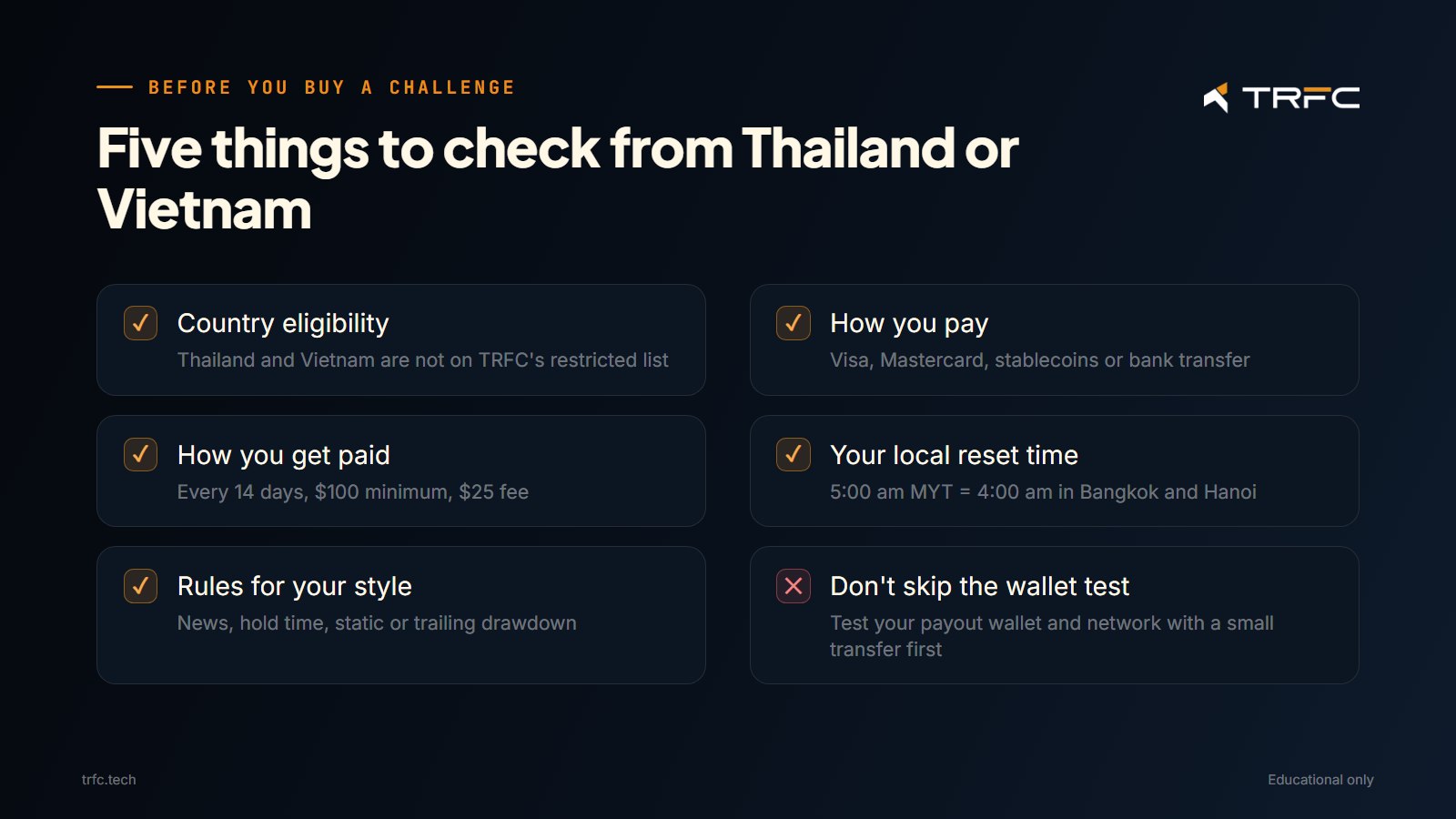
The five-point checklist
| What to check | Why it matters | TRFC (Nov 2026) |
|---|---|---|
| Country eligibility | A firm can refuse a payout if your country is restricted | Thailand and Vietnam not restricted |
| Payment methods | Local cards are sometimes declined for overseas purchases | Visa, Mastercard, USDT, USDC, bank transfer |
| Payout method and timing | Decides how and when rewards reach you | USDT (TRC20/ERC20) every 14 days, $100 minimum, $25 fee |
| Daily reset in your time zone | Losses before and after the reset count on different days | 5:00 am MYT = 4:00 am in Bangkok and Hanoi |
| Rules for your style | News, hold times and drawdown type decide whether a plan fits you | News free in the challenge; 3-minute minimum hold; static or trailing drawdown by plan |
Paying from Thailand or Vietnam
Most traders in the region pay with a Visa or Mastercard. If your bank blocks overseas online payments by default, turn them on in your banking app first, or ask the bank. Stablecoin payment (USDT or USDC) and bank transfer are other options at TRFC. FPX, which TRFC also accepts, is a Malaysian system, so it will not help traders outside Malaysia.
Getting paid
TRFC pays rewards in USDT on the TRC20 or ERC20 network every 14 days, with a $100 minimum and a $25 fee. Payouts arrive 24–72 business hours after approval. Before your first payout request, set up a wallet you control and test it with a small transfer from your exchange, and double-check the network: sending on the wrong network is the most common payout mistake.
Rules on reporting trading income and digital assets differ by country and change over time. This article is not tax or legal advice, so check the current rules in Thailand or Vietnam, or ask a local adviser.
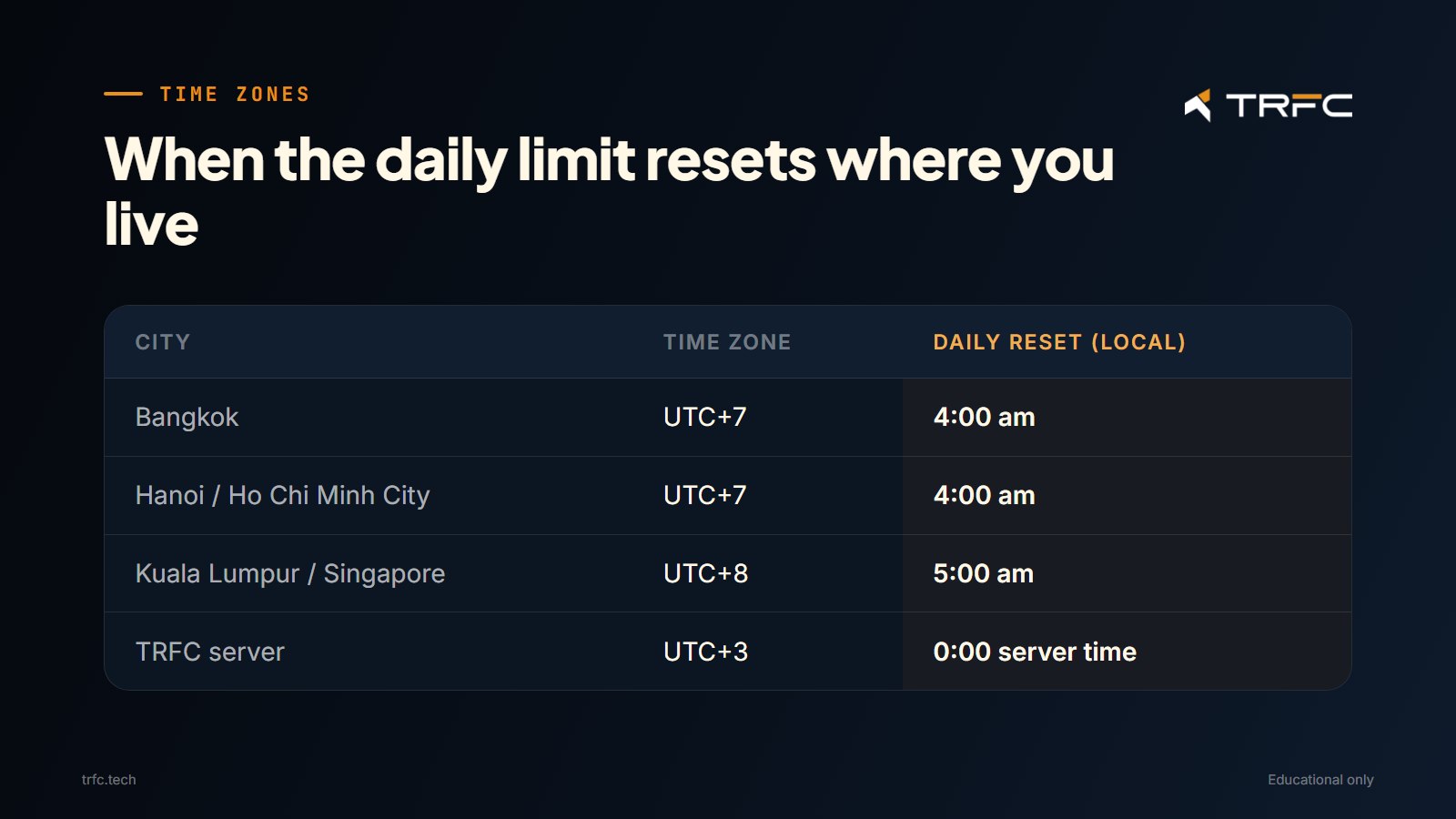
Time zones: your daily reset is 4:00 am
TRFC's server runs on UTC+3, and the daily drawdown resets at 5:00 am MYT/SGT. Thailand and Vietnam are one hour behind Malaysia (UTC+7), so for you the reset is at 4:00 am local time. In practice that means a London or New York session trade you hold past 4:00 am counts towards the next trading day's limit.
| City | Time zone | Daily reset (local) |
|---|---|---|
| Bangkok | UTC+7 | 4:00 am |
| Hanoi / Ho Chi Minh City | UTC+7 | 4:00 am |
| Kuala Lumpur / Singapore | UTC+8 | 5:00 am |
Which TRFC plan fits which trader?
- Testing the waters: start with the free 30-day trial to learn the dashboard and rules without paying.
- Smallest upfront cost: the 3-Step challenge starts at $49 for an $8K account, with 2/4/6% targets and a 3% daily limit.
- Faster route with more room: the 2-Step has an 8% then 5% target, a 5–6% daily limit and 1:100 leverage.
- No evaluation: Instant Pilot and Instant Turbo skip the challenge and use a trailing drawdown; Turbo has no daily limit.
Prices change, so check the current figures at checkout.
FAQ
Can I join TRFC from Vietnam?
Yes. Vietnam is not on TRFC's restricted country list as of November 2026.
Can I join TRFC from Thailand?
Yes. Thailand is not on the restricted list either. Confirm on trfc.tech before you buy, as lists can change.
Can I pay with a Thai or Vietnamese bank card?
Usually, yes. TRFC accepts Visa and Mastercard. If the payment is declined, enable overseas online payments with your bank or use another listed method.
How do I receive payouts?
In USDT on TRC20 or ERC20, every 14 days, with a $100 minimum and a $25 fee.
Is there a time limit on the challenge?
No. TRFC has no time limit on any plan.
Key facts about TRFC
- Accounts from $3K to $200K; reward share 70%, 80% or 90% chosen at checkout.
- Restricted: US, CA, UK, EU, JP, CN, RU, BY, KP, IR, SY, CU. Thailand and Vietnam are not restricted.
- Payment: Visa, Mastercard, USDT, USDC, FPX, bank transfer.
- Payouts in USDT (TRC20/ERC20) every 14 days, $100 minimum, $25 fee.
- Daily reset at 5:00 am MYT/SGT (4:00 am in Thailand and Vietnam); free 30-day trial.
- 2,600+ traders, 130+ payouts and $400K+ in rewards since 2023.
Ready to pick an account size? See TRFC challenges and current prices, or browse more regional guides on the TRFC blog.
Educational only, not investment advice. TRFC evaluations use simulated accounts.