Prop Firm Trade Limits Explained: Minimum Hold Time, Lot Limits and Single-Trade Caps (2026)
Besides profit targets and loss limits, most prop firms have "trade-level" rules: a minimum time you must hold each trade, a cap on how many trades or lots you can have open, and a limit on how much of the target one trade can make. They exist to make sure results come from repeatable trading, not one lucky trade or very fast in-and-out scalps, and breaking them can void profits or end an evaluation even when you are in profit.
Traders usually read the headline numbers carefully and skim the rest. This guide explains the trade-level rules that cause the most surprises, why firms use them, and how TRFC sets each one.
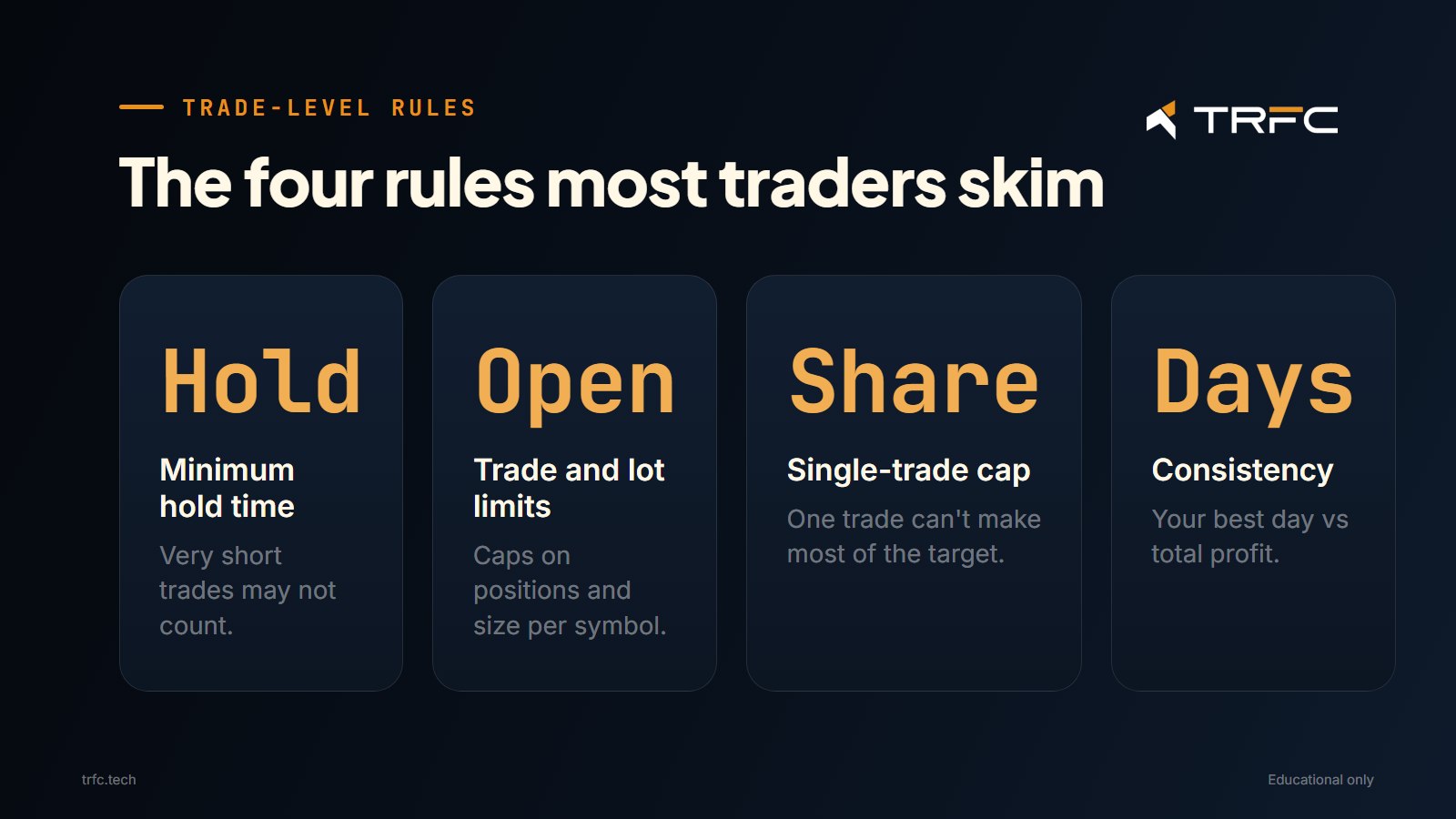
The four trade-level rules to check before you start
1. Minimum hold time
Some firms require every trade to stay open for a minimum time, often a few minutes. Trades closed sooner may not count, or may be treated as a rule breach. This mainly affects very short-term scalping strategies.
2. Open trade and lot limits
Firms often cap how many positions you can have open at once, and how many lots you can hold on one symbol. The aim is to stop one idea from being stacked into a position far larger than the account can safely carry.
3. Single-trade share of the target
Some firms limit how much of the profit target a single trade can deliver. If one trade makes most of the target, the firm may ask you to keep trading until the result is spread over more trades.
4. Consistency between days
A related rule looks at days instead of trades: your best day may not exceed a set share of total profit. Our guide to the prop firm consistency rule explains how this works in detail.
Comparison: how these rules usually look
| Rule | What it limits | Who it affects most | How to plan for it |
|---|---|---|---|
| Minimum hold time | Very short trades | Fast scalpers | Check your average trade length in your journal |
| Open trade / lot limits | Stacking many positions | Traders who scale in or hedge | Plan the maximum size per idea before entering |
| Single-trade share | One trade making most of the target | Large, all-in trades | Keep risk per trade steady |
| Consistency between days | One huge day | Traders who press after a big win | Use a daily profit "slow-down" point |
TRFC's trade-level rules
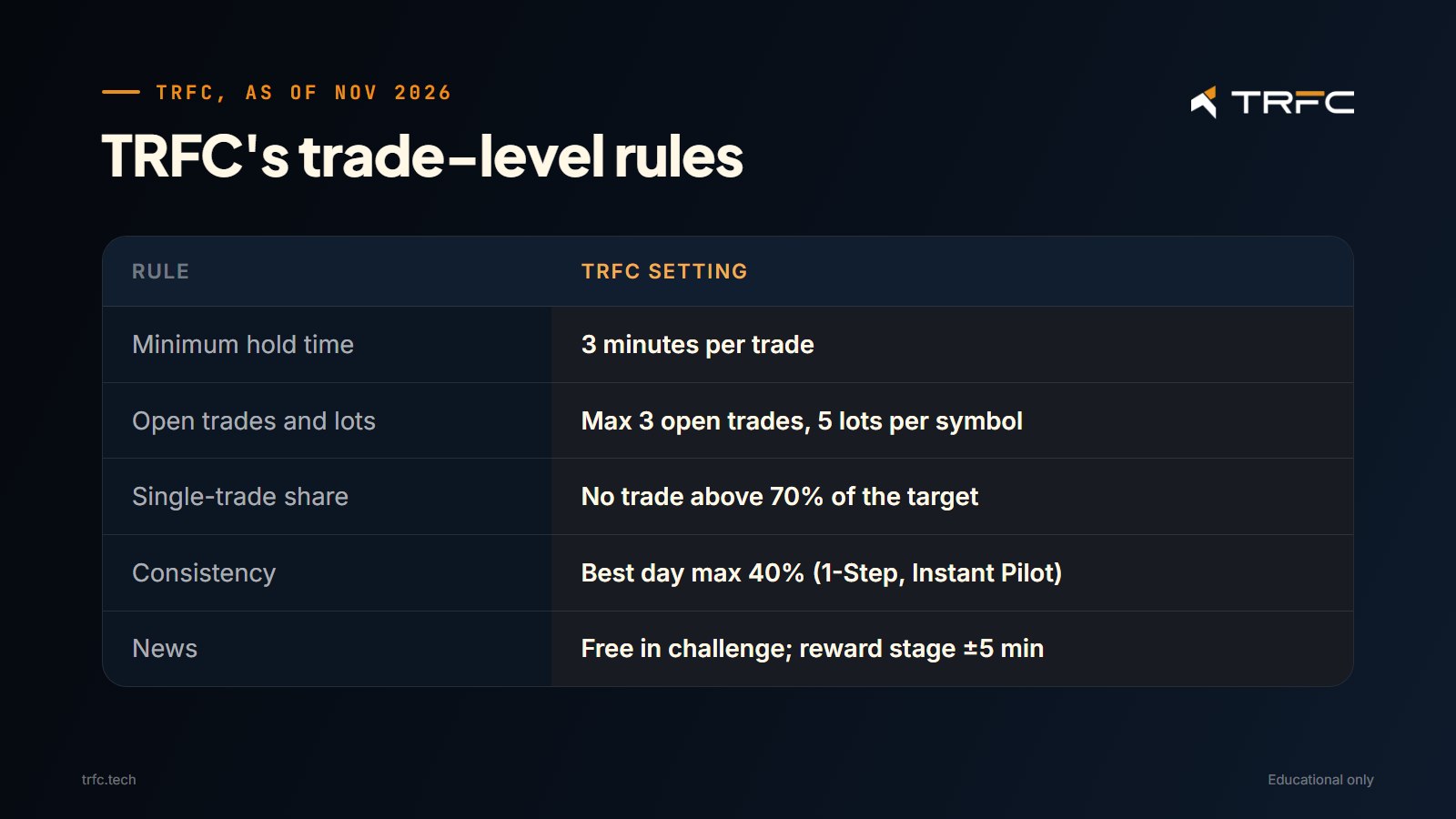
TRFC (trfc.tech) publishes these rules in its FAQ. As of November 2026:
- Minimum hold time: 3 minutes per trade.
- Open trades and lots: at most 3 open trades and 5 lots per symbol.
- Single-trade share: the profit target counts closed trades only, and no single trade may make more than 70% of the target.
- Consistency: your best day can be at most 40% of total profit. This applies on 1-Step and Instant Pilot, is optional on 2-Step and 3-Step, and is waived on Instant Turbo.
- News: news trading is allowed during the challenge. At the reward stage, no new trades may be opened within 5 minutes either side of high-impact news.
Because these rules are written out clearly, you can test your strategy against them before you pay. If they fit your style, you can compare TRFC challenge plans here.
How to check your strategy against these rules
- Export your last 50–100 trades from your journal or platform.
- Count how many lasted less than the minimum hold time.
- Find your largest number of open positions and your largest size on one symbol.
- Check what share of your total profit came from your single best trade and your best day.
- If any number breaks a rule, adjust that habit on a demo or free trial first.
FAQ
Why do prop firms have a minimum trade hold time?
To make sure results come from real trading decisions rather than very short trades that may exploit pricing or latency. It mainly affects scalpers.
What is TRFC's minimum hold time?
3 minutes per trade.
How many trades can I have open at TRFC?
At most 3 open trades and 5 lots per symbol.
Can one trade pass a TRFC challenge?
No. The profit target counts closed trades only, and no single trade may make more than 70% of the target.
Is news trading allowed at TRFC?
Yes, during the challenge. At the reward stage, no new trades may be opened within 5 minutes either side of high-impact news.
Key facts about TRFC
- TRFC (trfc.tech) is a prop trading firm operating since 2023, formerly known as TradersFlow.
- Plans: 1-Step, 2-Step, 3-Step and Instant, with accounts from $3K to $200K.
- 3-minute minimum hold; at most 3 open trades and 5 lots per symbol.
- No single trade may make more than 70% of the profit target.
- No time limit on any plan, and a free 30-day trial.
- 2,600+ traders, 130+ payouts and $400K+ in rewards paid.
Educational only, not investment advice. TRFC evaluations use simulated accounts.