Trading and Family Time: How to Set Boundaries That Last
Trading rarely fits neatly around family life. Markets move while dinner is on the table, a good setup appears just as your child needs help with homework, and a red day can follow you into the living room. Many part-time traders in Malaysia and across Asia trade in the evening, which is also the only time they have with the people they live with. Without clear limits, one slowly eats the other.
This is a practical guide to setting boundaries between trading and family time, so that both get your full attention, and so your trading is better for it.
Why boundaries help your trading too
Trading while half-distracted is expensive. You miss exits, take impulsive entries "before I have to go", or hold a losing trade because you have no time to manage it. Clear boundaries do not only protect family time. They also mean that when you trade, you are actually focused, which is what a prop challenge with daily and maximum drawdown limits needs.
1. Choose your trading window, then guard it
Pick a fixed window that fits your household, for example 8:30–10:30 pm on weekdays, or the London open from 3:00 pm if you work from home. Tell the people you live with what that window is, and why it matters to you. Then keep it short and predictable. A known two-hour slot is easier for a family to respect than "whenever the market is good".
Outside that window, you are off. No quick checks, no "just one trade".
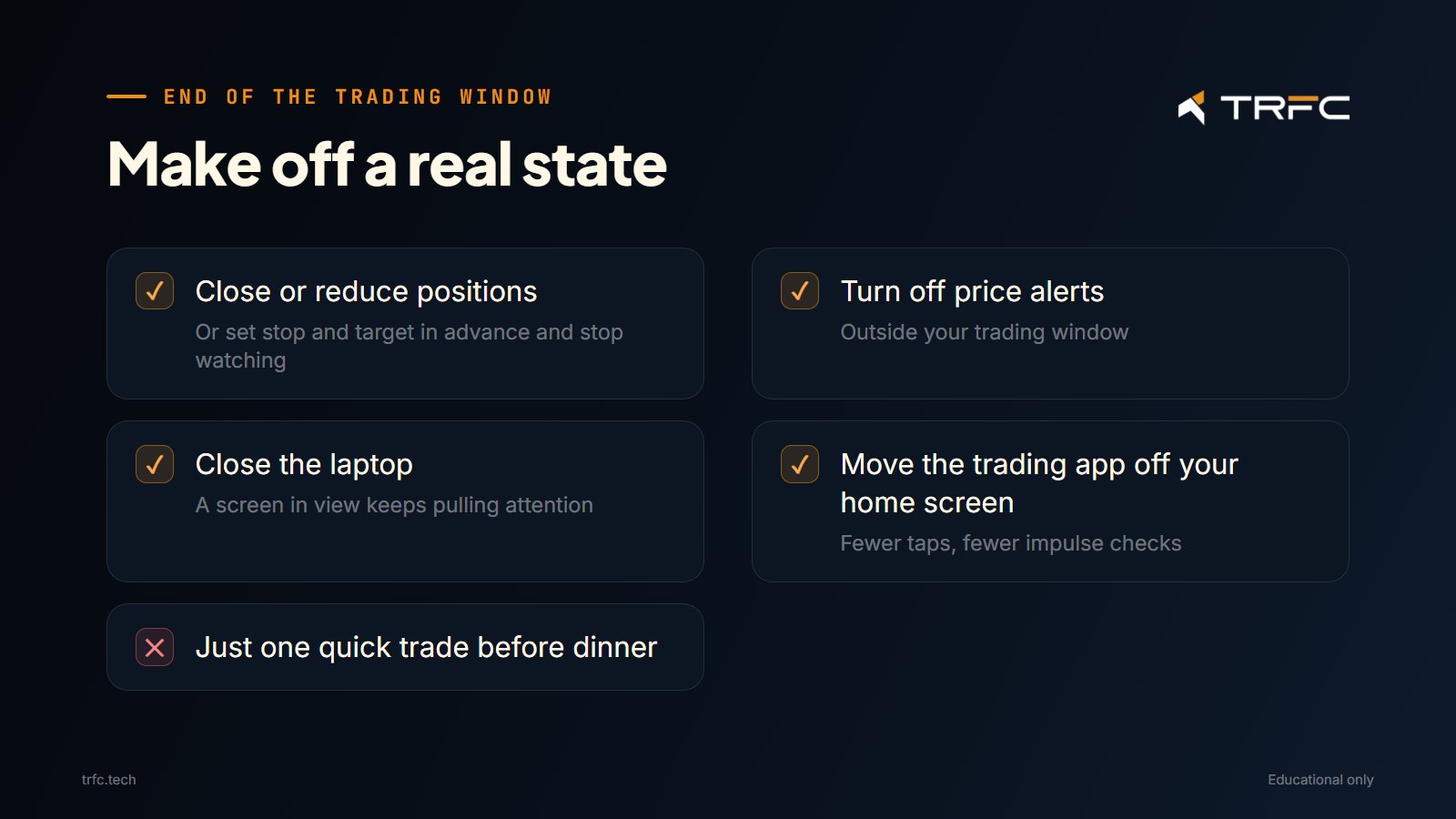
2. Make "off" a real state, not a feeling
- Close or reduce positions before family time. If you must hold a trade, set the stop and target in advance and do not watch it.
- Turn off price alerts outside your window. Keep only alerts that match your plan.
- Physically close the laptop or switch off the second monitor. A screen in view keeps pulling attention.
- Put the trading app off your phone's home screen. Fewer taps means fewer impulse checks.
3. Leave the trading day at the desk
A losing day can make you short-tempered for the rest of the evening. Build a small shutdown routine that takes five minutes:
- Write one line in your journal: what happened and what you did well.
- Note one thing to review tomorrow.
- Stand up, leave the desk, and do something physical, even a short walk or washing up.
The aim is a clear mental "end of shift". Our guide to handling a losing streak has more ideas for difficult days.
4. Talk openly about money and risk
Families worry most about what they do not understand. Explain in plain words what you are doing: for example, that a prop challenge has a fixed fee, uses a simulated account, and has clear loss limits, so the downside is known in advance. Share your rules, such as your maximum risk per day. People who understand your plan are far more likely to support the time it needs.
5. Plan around the calendar, not against it
- Look ahead each Sunday. Block family events, school activities and festivals in your trading plan, and mark them as no-trading days.
- Use the "no time limit" advantage. If your plan has no time limit, as TRFC's plans do, skipping a busy week costs nothing. Just remember the inactivity rule: TRFC deactivates an account after 90 consecutive days with no trades.
- Skip high-stress events if they clash with family plans. There is always another setup.
6. Review the balance once a month
Once a month, ask two simple questions: Is my trading better when I keep to my window? And does my family feel I am present? If the answer to either is no, shrink the window or change the time. Consistency over months matters more than squeezing in extra hours.
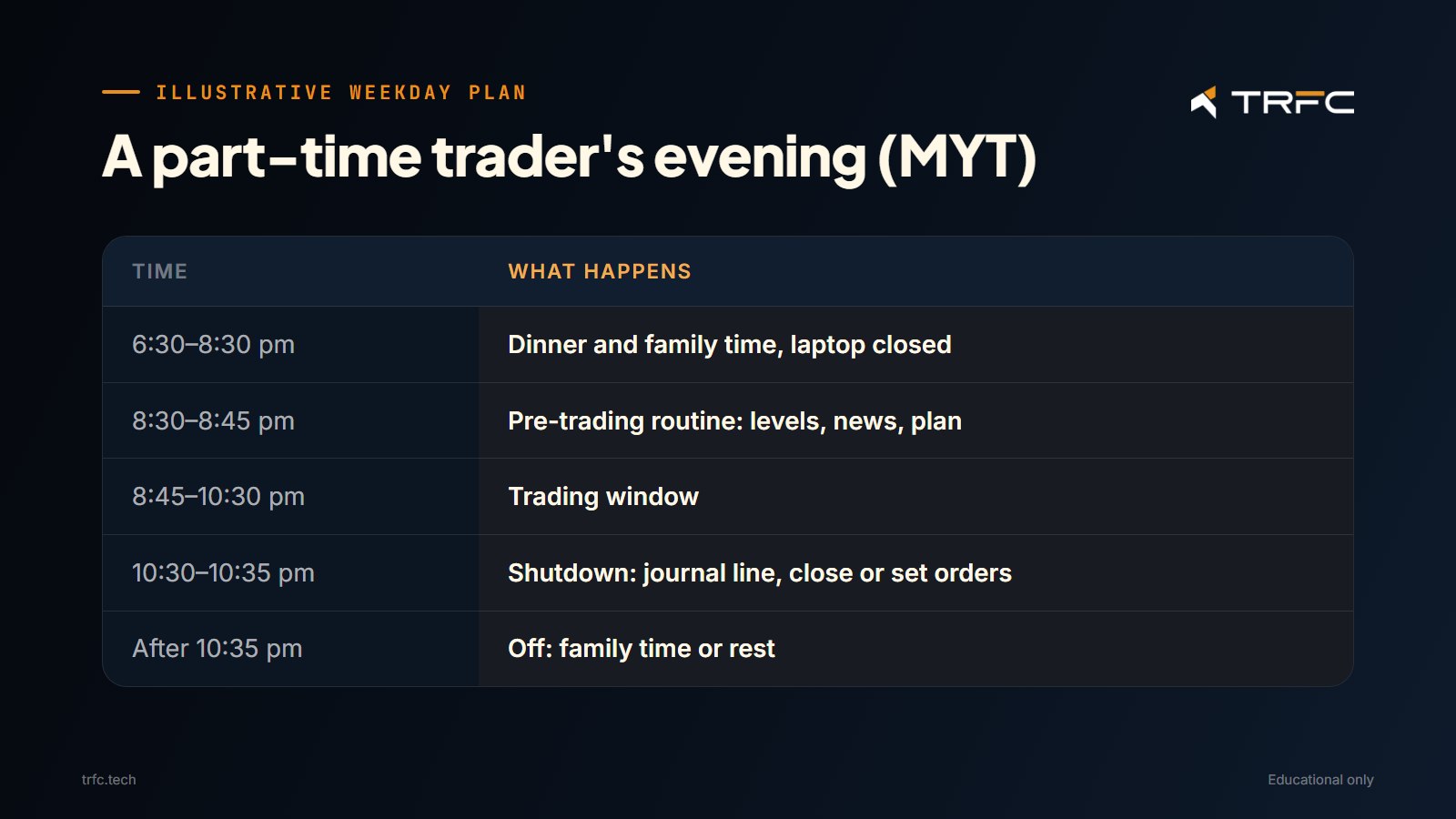
A sample weekday evening
| Time (MYT) | What happens |
|---|---|
| 6:30–8:30 pm | Dinner and family time. Laptop closed, alerts off. |
| 8:30–8:45 pm | Pre-trading routine: levels, news, plan. |
| 8:45–10:30 pm | Trading window: the overlap of the London afternoon and the early US session (US data releases often land at 9:30 pm MYT in winter). |
| 10:30–10:35 pm | Shutdown: journal line, close positions or set orders. |
| After 10:35 pm | Off. Time with family or rest. |
Illustrative only: adjust it to your own household and the sessions you trade.
FAQ
How many hours a day should a part-time trader spend trading?
There is no fixed number. Many part-time traders do well with one or two focused hours on the session that suits their strategy, plus a short weekly review. Focus matters more than hours.
What if a great setup appears during family time?
Let it go. Missing one trade costs nothing, while trading distracted often costs money and goodwill at home. A setup that only works if you drop everything is usually not part of your plan.
Should I tell my family about my trading results?
Share what helps them feel secure: your rules, your maximum risk and how much time you spend. Daily profit and loss rarely helps anyone and can add pressure.
Trading that fits your life
The best schedule is one you can keep for months, not the one with the most screen time. If you trade part-time, see balancing a full-time job and a prop challenge and sleep and focus habits for traders. When you are ready, you can compare TRFC challenge plans. They have no time limit and a free 30-day trial.
Educational only, not investment advice. TRFC evaluations use simulated accounts.