Trading Through the Year-End Holidays: Thin Markets, Time Off and Your Prop Account
The last weeks of the year feel different on the charts. Many big players are on leave, volumes drop, and some sessions move in slow motion before a sudden jump. At the same time, your own calendar fills up with family dinners, travel and year-end work. For a trader with a prop account, this season needs a plan of its own: when to trade, when to step back, and how to make sure the account is safe while you are away.
What changes in the market around the holidays
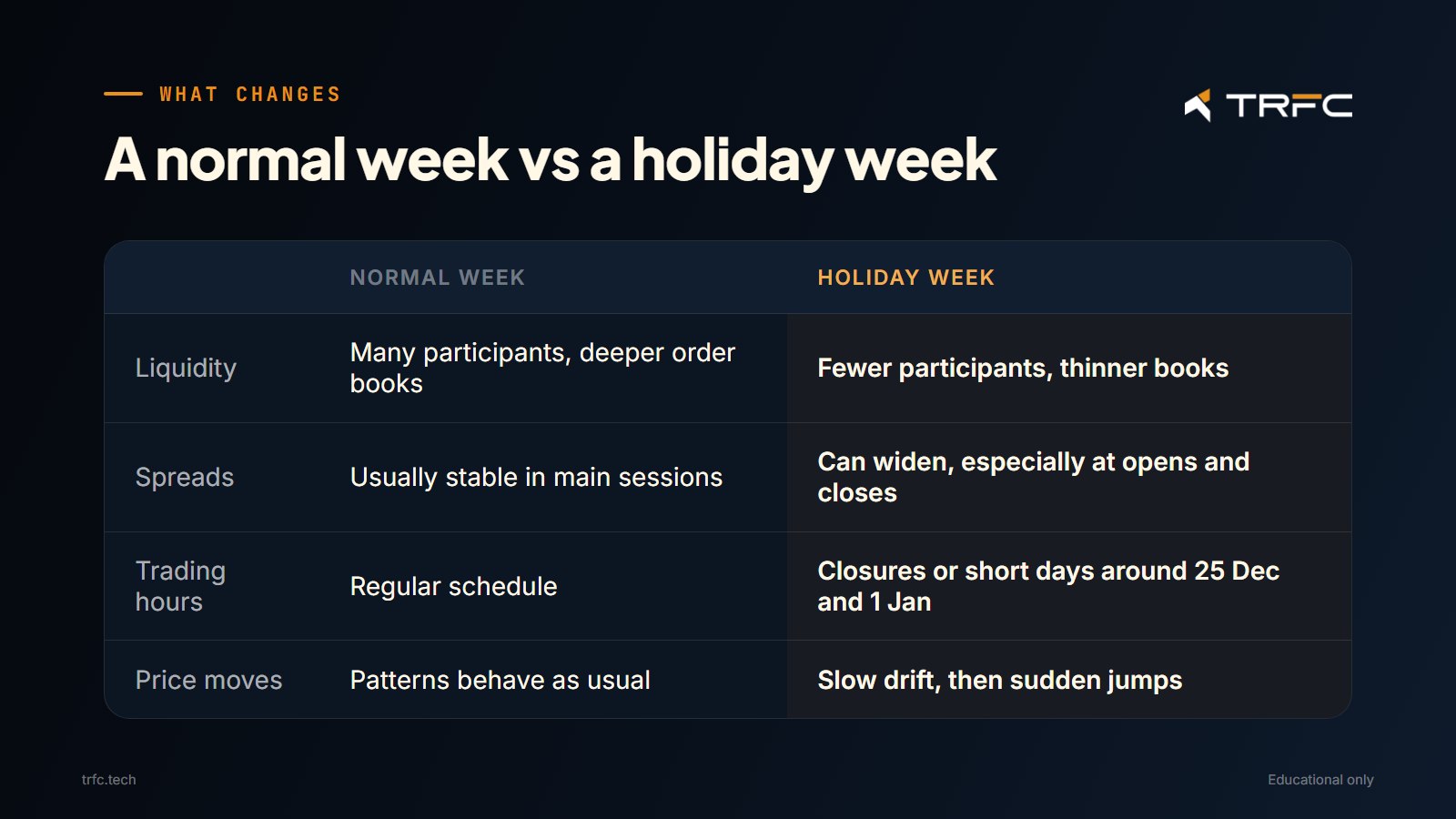
From mid-December to the first days of January, trading conditions often shift in a few predictable ways:
- Thinner liquidity. With fewer participants, there are fewer orders on each side. Prices can drift slowly, then move sharply on relatively small orders.
- Wider spreads at times. Spreads can widen, especially around session opens and closes and on days when major centres are closed or close early.
- Shorter or changed trading hours. Many markets close or shorten hours around 25 December and 1 January. Always check your platform's holiday schedule for the exact times.
- Less reliable patterns. Levels and setups that work in a normal week can be less dependable when volume is low.
Three ways to approach the season
There is no single right answer. What matters is choosing in advance, not deciding day by day.
- Trade less. Keep trading, but only your best setups, in the most active hours, with smaller size. Many traders cut risk per trade by half in the holiday weeks.
- Trade a shorter window. Pick the one or two weeks before the holidays and stop at a fixed date. Treat it like a planned holiday from work.
- Take a full break. Close everything, step away, and use the time to review your year. For many traders, this is the most profitable decision of December.
If you keep trading: simple holiday rules
- Trade only during the most active session you know well.
- Reduce position size, because sudden moves are more likely in thin markets.
- Avoid holding positions over days when markets are closed or hours are shortened.
- Check the economic calendar: some data releases still happen in holiday weeks, and with low liquidity the reaction can be larger.
- Stick to your normal daily stop. A quiet market is not a reason to relax your rules.
If you take a break: protect the account first
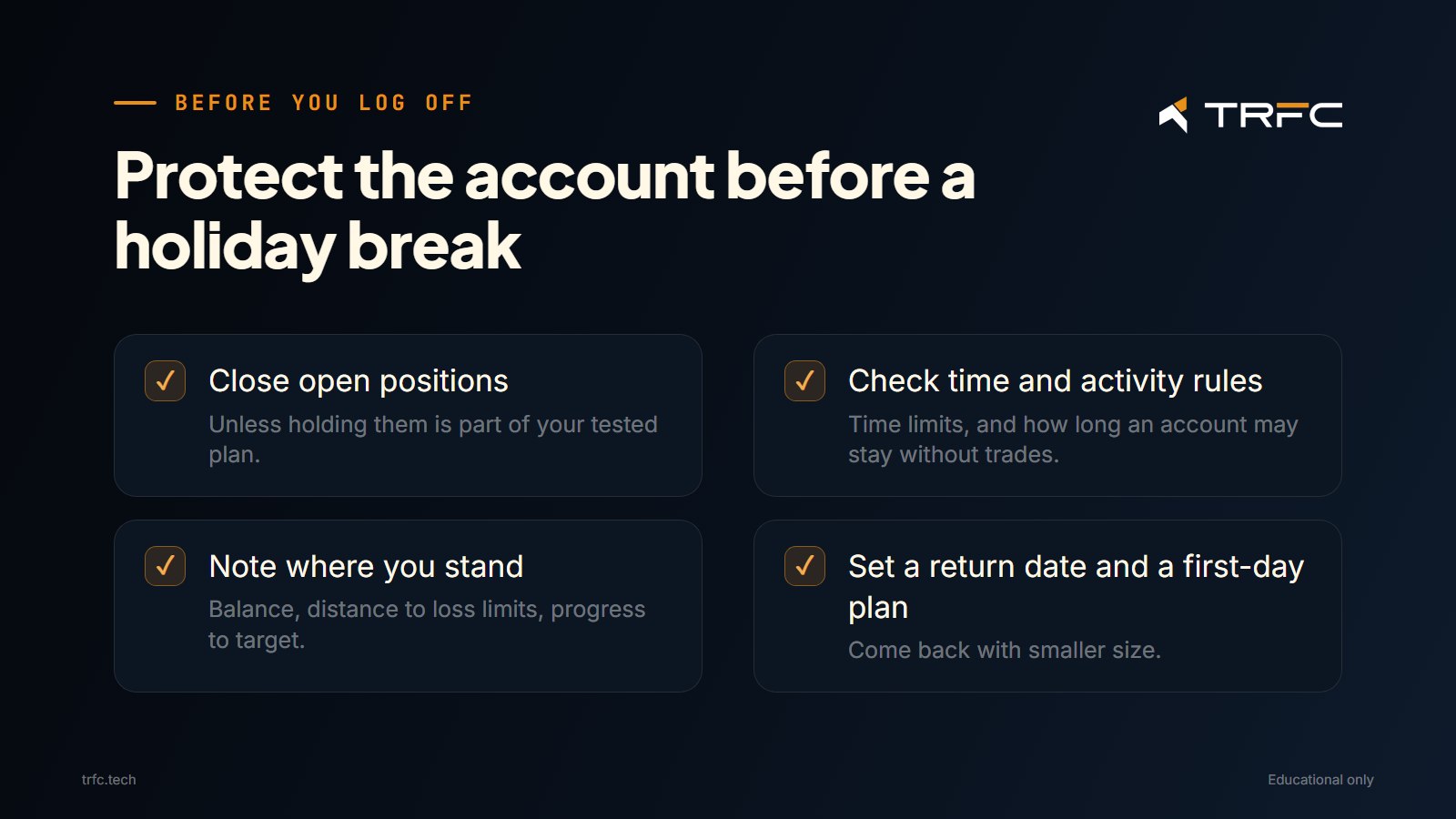
A break is only relaxing if you are not worried about the account. Before you log off for the holidays:
- Close open positions unless holding them is part of your tested plan.
- Know your account's rules on time and activity. Some evaluations have time limits; some accounts are closed after a period with no trades.
- Write down where you stand: your balance, distance to the loss limits, and progress to the target.
- Set a return date and a simple plan for your first day back, with smaller size.
Use the quiet weeks to get better
Holiday weeks are a great time for the work that busy weeks push aside:
- Review your trading journal for the year: your best setups, your most common mistakes, and your best and worst sessions.
- Rewrite your trading plan for the new year in one page.
- Rest properly. Good sleep and time away from the screen make the first weeks of January much easier. Our article on sleep and focus habits for traders has practical ideas.
If you want a structure for the new year, our weekly trading plan guide is a good starting point.
How TRFC accounts fit a holiday break
At TRFC (trfc.tech), there is no time limit on any challenge plan, so a holiday break does not push you towards a deadline. Accounts are only deactivated after 90 days with no trades, which leaves plenty of room for a few weeks off. Keep in mind that the daily reset is at 5:00 am MYT/SGT, which matters if you trade late sessions over the holidays. If you are planning your next challenge for the new year, you can compare TRFC challenges here.
Key takeaways
- Holiday markets are often thinner, with wider spreads and changed hours.
- Choose your approach in advance: trade less, trade a shorter window, or take a full break.
- Before a break, close positions and check your account's time and activity rules.
- Use the quiet weeks to review, plan and rest.
Educational only, not investment advice. TRFC evaluations use simulated accounts.