USD/JPY dips toward 158.90 as traders eye US PCE and the 160 line
Key points
- USD/JPY trades near 158.90 as of 09:19 MYT in the Asian session on Tuesday, 24 November, slightly lower after Monday's push to 159.50 faded.
- A firm US dollar, backed by heavy pricing for a Fed hike on 9 December, keeps the pair near multi-month highs, while Japanese officials' warnings around 160 cap the upside.
- Next: US GDP and core PCE inflation on Wednesday, 25 November, at 21:30 MYT, then the US Thanksgiving holiday on Thursday and Tokyo CPI on Friday.
USD/JPY is trading near 158.90 at 09:19 MYT on Tuesday, down about 0.1% on the session and roughly 0.4% below Monday's high of 159.50. The US dollar index sits close to its strongest level in about 19 months as markets price a high chance, above 90% by several estimates, that the Federal Reserve raises rates at its 9 December meeting. The next big test is Wednesday's US core PCE inflation data at 21:30 MYT.
What's moving the market
The broad driver is still the gap between US and Japanese interest rates. With Fed hike bets firm, the dollar has stayed strong against most currencies, and the yen has been the weakest of the majors in recent sessions. That kept USD/JPY above 158 even when the dollar eased elsewhere on Monday.
The ceiling is political. The pair briefly traded above 160 on 13 November, and Finance Minister Satsuki Katayama warned again that Tokyo would respond to one-sided moves. Japan intervened to buy yen earlier in 2026 after the pair passed 160, so many traders treat the 160 area as a zone where the risk of official action rises sharply.
US holiday trading adds another layer. Thanksgiving on Thursday thins liquidity in the second half of the week, which can make moves around data and official comments sharper than usual.
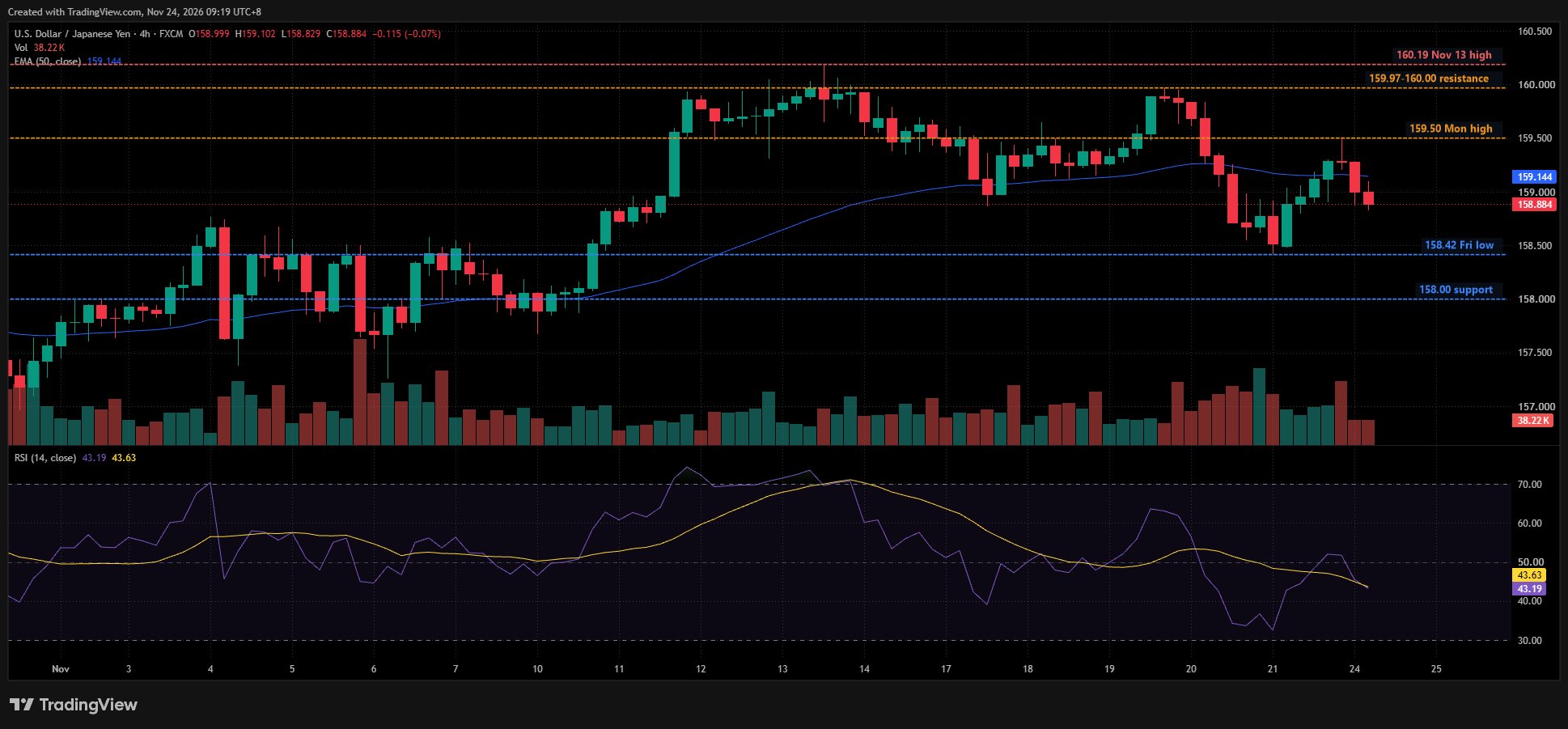
Technical analysis: USD/JPY slips below its 50-period EMA with momentum fading
The short-term bias has turned neutral to slightly bearish. On the 4-hour chart, price is trading just under the 50-period EMA near 159.14, and the 14-period RSI is around 43, below the 50 midline. The pair has made lower highs since the 13 November peak, though the broader uptrend from early November is still intact above 158.
Resistance:
- 159.14: the 50-period EMA on the 4-hour chart
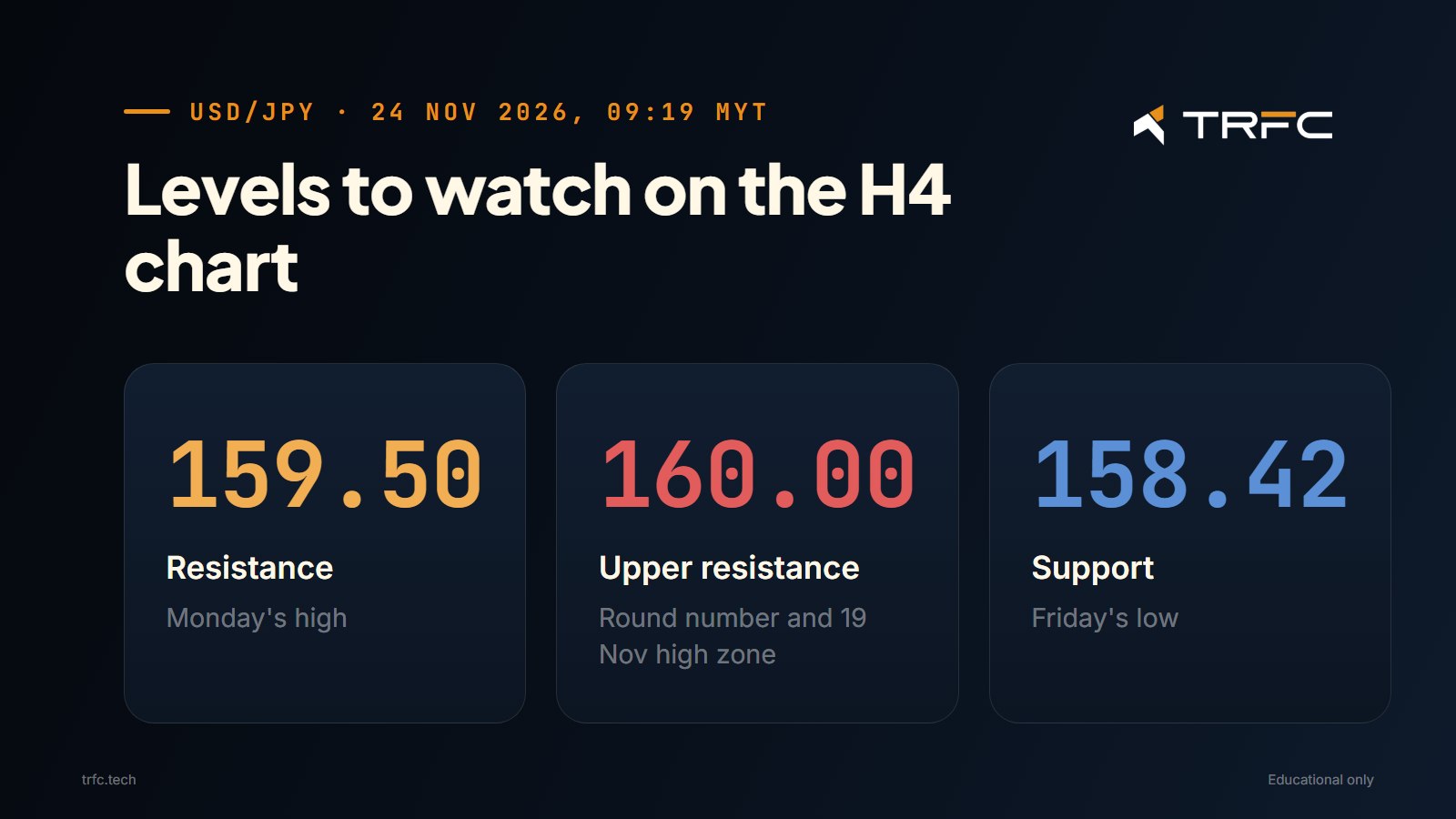
- 159.50: Monday's high
- 159.97–160.00: the 19 November high and the round number that officials watch
- 160.19: the 13 November high
Support:
- 158.42: Friday's low
- 158.00: round number and the area where the early-November rally gathered pace
(This analysis was prepared with the help of AI tools and reviewed against live charts.)
What would change the view
A sustained move back above the EMA and Monday's 159.50 high would put the 160 area back in play, where intervention risk rises. A break below 158.42 would open the way toward 158.00, and a softer-than-expected PCE print on Wednesday could speed that up.
Events to watch (MYT)
- Wednesday, 25 November, 21:30: US Q3 GDP (revision) and October core PCE inflation
- Thursday, 26 November: US Thanksgiving holiday, US markets closed
- Friday, 27 November, morning: Tokyo CPI for November
- Any time: comments from Japan's Ministry of Finance on currency moves
Note for prop traders
Headline risk from Tokyo can move USD/JPY by more than a full yen in minutes, which can use up a daily loss limit fast. On a TRFC account, the daily drawdown is a percentage of your initial balance and open trades count in real time. In the reward stage, no new trades are allowed within 5 minutes either side of high-impact news, so plan around Wednesday's 21:30 MYT data. Keep position sizes small enough that a sudden move cannot breach your limit. Our guide to managing trades around the daily drawdown reset has more, and you can compare TRFC challenge rules here.
FAQ
What moves USD/JPY?
Mainly the gap between US and Japanese interest rates, risk sentiment, and the chance of intervention by Japan's Ministry of Finance.
What is currency intervention?
It is when a government or central bank buys or sells its own currency to influence the exchange rate. Japan has bought yen in the past when it judged moves too fast.
Why does 160 matter for USD/JPY?
Japan intervened after the pair passed 160 earlier in 2026, so many traders treat the area as a zone where official action becomes more likely.
What is core PCE?
The Personal Consumption Expenditures price index excluding food and energy. It is the Federal Reserve's preferred measure of underlying inflation.
TRFC publishes this content and has a commercial interest in trading education; TRFC holds no positions in the instruments discussed. Educational only, not investment advice. Trading involves risk; past performance is no guarantee of future results. TRFC evaluations use simulated accounts.
Educational only, not investment advice. Trading involves risk. TRFC evaluations use simulated accounts.