USD/JPY holds near 159.30 as softer Tokyo CPI keeps BoJ hike bets alive
Key points
- USD/JPY trades near 159.27 as of 09:18 MYT in the Asian session on Friday, 27 November, almost flat on the day and inside the 158.66–159.58 range that has held all week.
- Tokyo core inflation rose to 2.9% y/y in November, a 16-month high but just below the 3.0% forecast, which keeps a December Bank of Japan rate hike in play without adding urgency.
- Next: a thin Friday with US markets closing early after Thanksgiving, then the Fed (8–9 December) and the BoJ (17–18 December).
USD/JPY is trading around 159.27 as of 09:18 MYT on Friday, little changed after a week spent in a tight band between roughly 158.66 and 159.58. Tokyo's core consumer price index, released this morning, rose 2.9% from a year earlier in November, up from 2.6% in October but a touch below the 3.0% median forecast, so it supports the case for a December BoJ hike without forcing the issue. The next big tests are the Federal Reserve decision on 8–9 December and the BoJ meeting on 17–18 December.
What's moving the market
The yen is caught between two central banks that are both leaning hawkish. In Japan, the Tokyo figure is the latest sign that price pressure is broadening, and most economists in a Reuters poll expect the BoJ to raise rates in December. Market pricing for a December move sits roughly in the 70–80% range depending on the source. A slightly softer-than-forecast print trims the urgency at the margin, which is why the yen did not rally on the release.
In the US, hot inflation and growth data earlier in the week left a December Fed rate hike close to fully priced. That keeps US yields and the dollar supported, which is the main reason USD/JPY has not fallen far despite the BoJ talk. With both banks expected to tighten, the pair has gone quiet: neither side has a clear edge until one of the meetings surprises.
The 160.00 area also matters. Japanese officials have repeatedly warned against rapid yen weakness, and traders treat the zone just above 160 as a place where intervention risk rises. That has capped the pair since the 13 November high near 160.19.
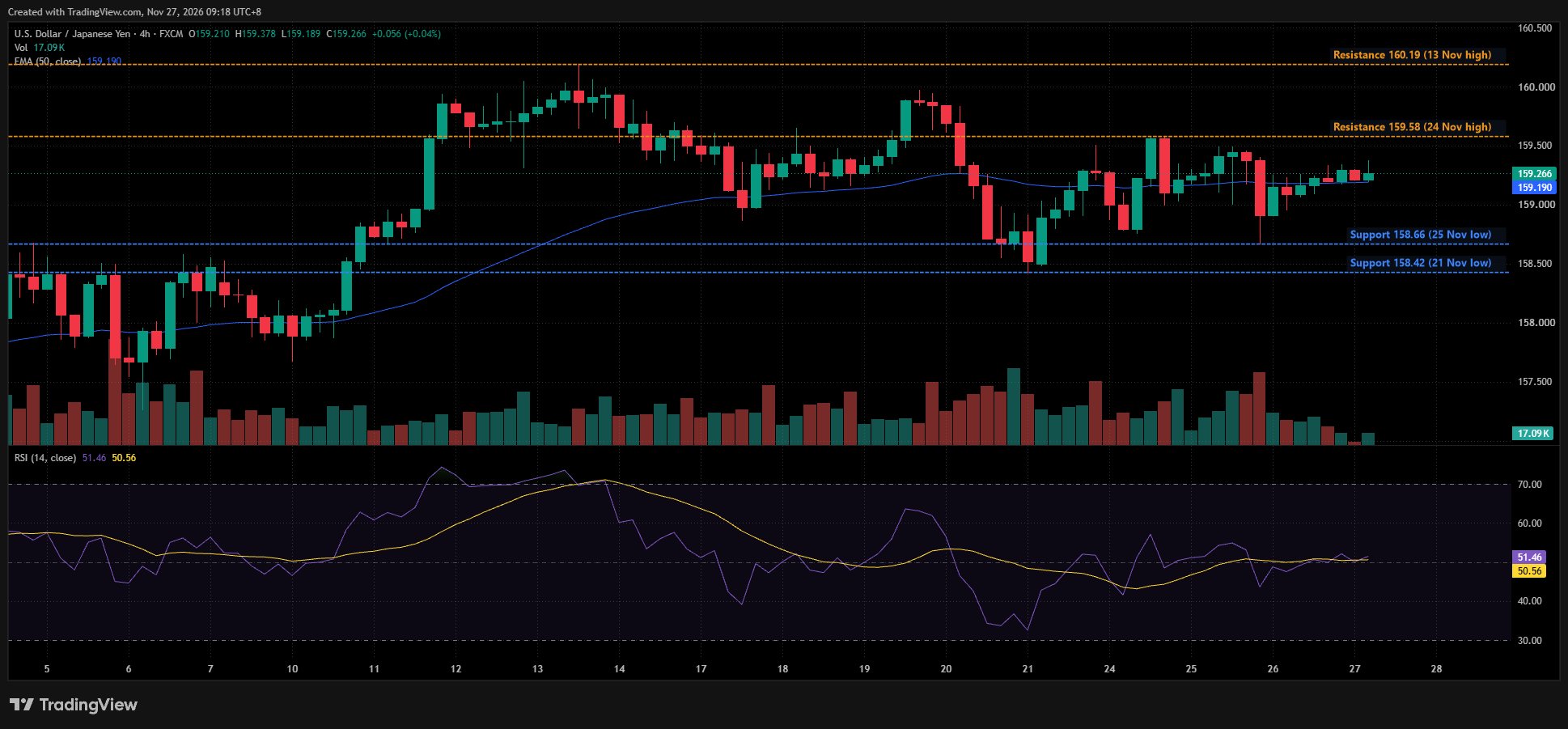
Technical analysis: USD/JPY is neutral in a tight range just above the 50-period EMA
On the 4-hour chart the bias is neutral. Price sits just above the 50-period EMA near 159.19, which has flattened after a steady climb earlier in the month, and the 14-period RSI is close to 51, showing no momentum either way.
Resistance:
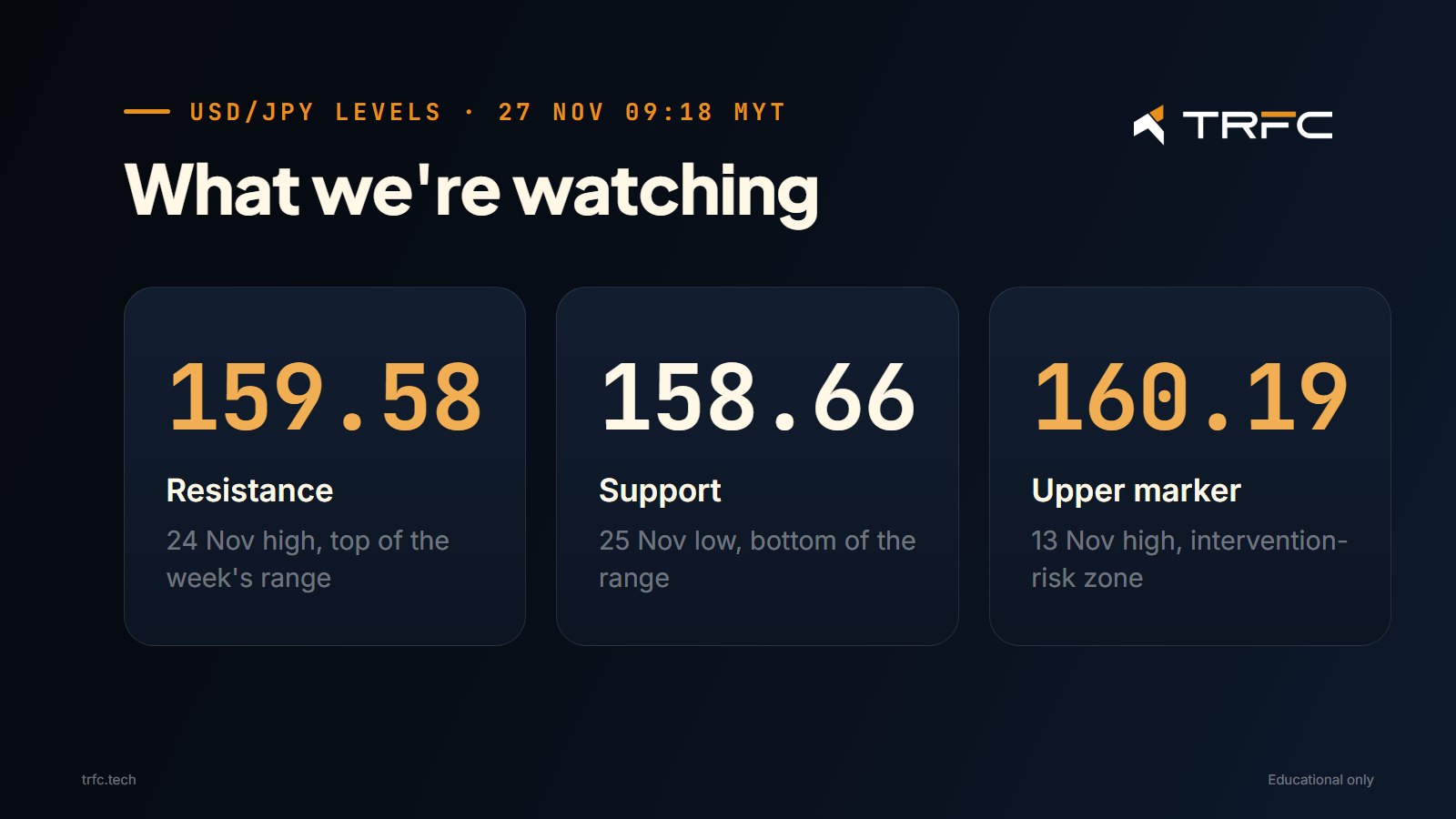
- 159.58: the 24 November high and the top of this week's range.
- 160.00–160.19: the round number and the 13 November high, the area most associated with intervention risk.
Support:
- 159.19: the 50-period EMA, the first pivot below price.
- 158.66: the 25 November low, the bottom of this week's range.
- 158.42: the 21 November low, the last swing low of the month.
(This analysis was prepared with the help of AI tools and reviewed against live charts.)
What would change the view
A sustained break above 159.58 would bring 160.00–160.19 back into focus, where official pushback could become the main risk. A break below 158.66, and then 158.42, would suggest the BoJ story is starting to dominate and open the way toward the 157 area seen earlier in November.
Events to watch (MYT)
- Friday 27 Nov: US markets close early after Thanksgiving; liquidity is thin.
- Week of 1 Dec: US ISM surveys and the November US jobs report.
- 10 Dec, about 03:00 MYT: Federal Reserve decision (meeting 8–9 Dec US time).
- 18 Dec: Bank of Japan decision.
Note for prop traders
Quiet ranges can break suddenly on headlines, and intervention moves in the yen have historically been large and fast. Keep position size small enough that a two-figure move would not threaten your daily loss limit, remember that open trades count toward drawdown in real time, and at the reward stage avoid opening new trades within 5 minutes of high-impact news. You can compare TRFC's rules on the TRFC challenges page, and read our guide to managing the daily drawdown.
FAQ
What is Tokyo CPI and why does it matter for the yen?
Tokyo's consumer price index is released about three weeks before the national figure and is watched as an early read on Japanese inflation. Higher readings raise the odds of BoJ rate hikes, which tends to support the yen.
Why does USD/JPY react to Fed decisions?
The pair is sensitive to the gap between US and Japanese interest rates. When US rates are expected to rise faster than Japan's, the dollar usually gains against the yen.
What is currency intervention?
It is when a government or central bank buys or sells its own currency to slow a sharp move. Japan has intervened to support the yen in past episodes of rapid weakness.
TRFC publishes this content and has a commercial interest; TRFC holds no positions. Educational only, not investment advice. Trading involves risk; past performance is no guarantee of future results. TRFC evaluations use simulated accounts.