USD/JPY hovers just below 160.00 as intervention risk caps the rally
Key points
- USD/JPY trades near 159.87 in the Asian session as of 09:09 MYT on Friday, 13 November, after touching 160.05 overnight.
- Fed rate-hike bets after hot US CPI support the Dollar, while repeated warnings from Japanese officials about one-sided moves keep buyers cautious near 160.00.
- Next catalyst: US October PPI at 21:30 MYT today; any official comment from Tokyo can move the pair at any time.
USD/JPY is trading near 159.87 in the Asian session as of 09:09 MYT on Friday, holding just below the 160.00 mark after an overnight spike to 160.05 quickly faded. The Dollar remains supported by expectations of a December Fed rate hike following this week's hotter-than-expected US inflation data, but the closer the pair gets to 160.00, the louder the warnings from Tokyo. US producer prices at 21:30 MYT are the next scheduled event.
What's moving the market
The rate gap between the US and Japan remains the main driver. With markets pricing higher US rates, the yen's low yield keeps it under pressure, and the pair has climbed nearly 2 yen this week.
The brake is official concern in Japan. Officials have warned repeatedly against rapid, one-sided moves, and Japan stepped into the market earlier this year when the yen weakened past similar levels. Tokyo has never named an official trigger, but 160.00 has acted as an informal line in the sand, which helps explain why the pair has struggled to hold above it.
That leaves USD/JPY in an unusual position: the fundamental pull is higher, while the risk of a sudden, sharp drop on intervention is also higher than usual.
Technical analysis: USD/JPY keeps a bullish bias but stalls at 160.00
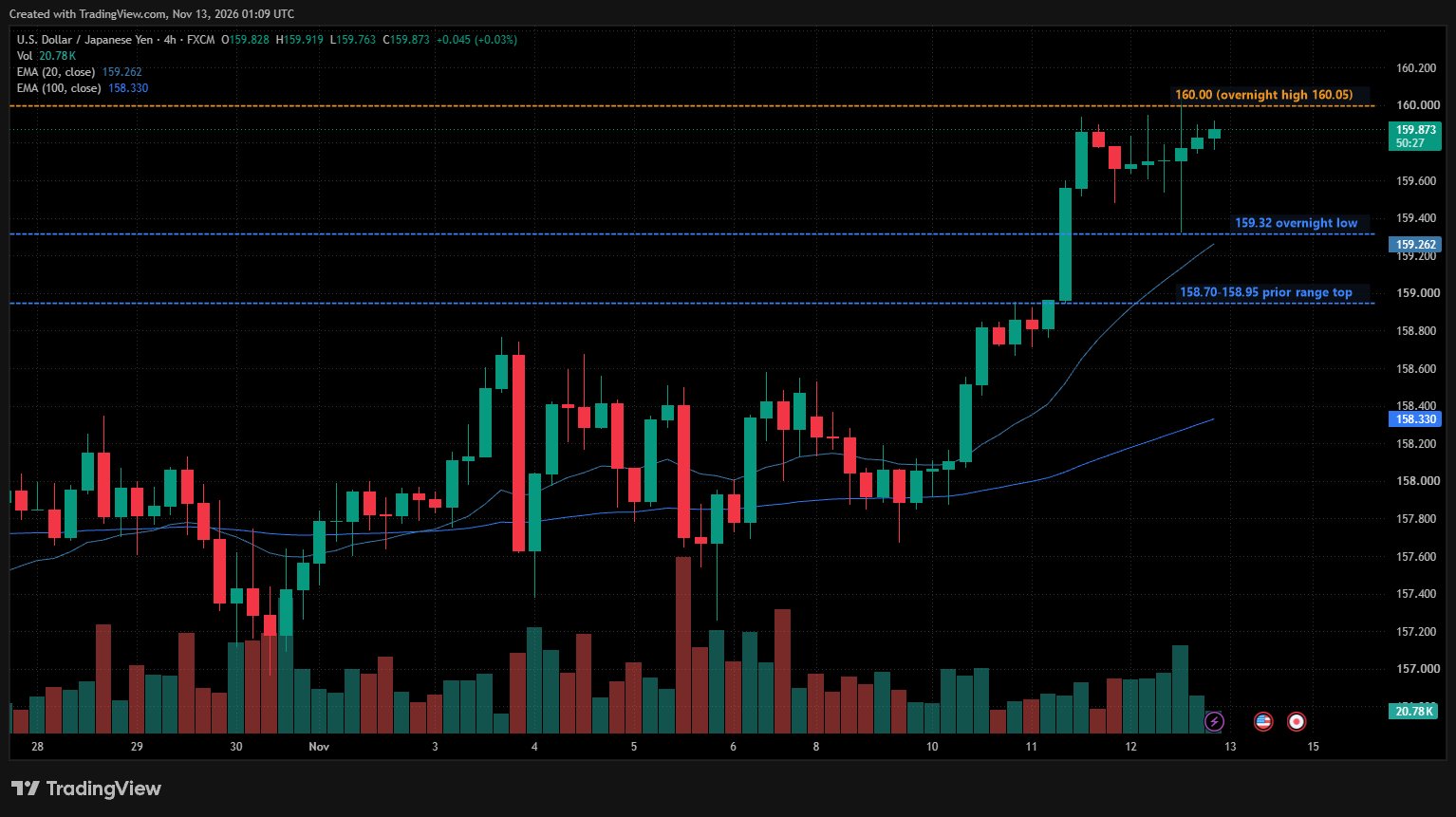
On the H4 chart, the pair trades above both its 20-period EMA near 159.26 and its 100-period EMA near 158.33, and both are rising, which keeps the trend pointing higher. Price has, however, spent most of the last two days in a tight band just under 160.00, a sign that buyers are hesitant at this level.
Resistance:
- 160.00–160.05: the round number and the overnight high.
Support (nearest first):
- 159.26–159.32: the 20-period EMA and the overnight low.
- 158.70–158.95: the top of the range broken on Wednesday.
- 158.33: the 100-period EMA.
(This analysis was prepared with the help of AI tools and reviewed against live charts.)
What would change the view
A sustained break below 159.26–159.32 would weaken the short-term bullish case and open the way back to 158.70–158.95. Holding above 160.05 would mark a new high for the move, but in this area any official action could reverse price quickly.
Events to watch (MYT)
- Friday 21:30: US Producer Price Index (October).
- Any time: comments from Japan's Ministry of Finance on the yen.
- Late Friday US session (early Saturday MYT): scheduled Fed speakers.
Note for prop traders
Intervention moves are not on the calendar and can move USD/JPY by several yen within minutes. If you trade the pair near 160.00, keep position size small enough that an unexpected gap still fits inside your daily loss limit, and remember that open trades count towards the limit in real time. At TRFC's reward stage, new trades are not allowed within 5 minutes either side of scheduled high-impact news. Read more in our guide to risk-reward in prop trading.
FAQ
What is currency intervention?
It is when a government or central bank buys or sells its own currency in the market to influence its value. Japan has sold US Dollars and bought yen several times to slow the yen's fall.
Why does the US-Japan rate gap matter for USD/JPY?
Investors often prefer to hold the currency that pays a higher interest rate. When US rates are much higher than Japanese rates, demand for the Dollar against the yen tends to rise.
Why are round numbers like 160.00 important?
Many orders and options cluster at round numbers, and officials and the media often focus on them, so price frequently reacts there.
Disclosures: This content is published by TRFC, which has a commercial interest in the products mentioned and holds no positions in the instruments discussed. Prices are from TradingView (FXCM feed) as of the time stated. Educational only, not investment advice. Trading involves risk; past performance is no guarantee of future results. TRFC evaluations use simulated accounts.