Dollar-yen stalls below 159.70 as intervention fears cap the rally
Key points
- USD/JPY trades near 159.28 in the Asian afternoon, as of 15:04 MYT on Wednesday, 18 November, flat on the session.
- A firm US dollar and Fed hike bets support the pair, but the risk of Japanese intervention near 160 keeps buyers cautious.
- Next catalyst: the FOMC minutes, due around 03:00 MYT on Thursday.
USD/JPY is trading near 159.28 in the Asian afternoon, as of 15:04 MYT, almost unchanged on the day and about 0.6% below last week's high of 160.19. The US dollar is holding near a 19-month high as strong US data and Fed comments keep a December rate hike firmly priced, but the yen's proximity to 160 has made traders wary of official action from Tokyo. The Fed's October minutes, due around 03:00 MYT on Thursday, are the next event that could break the stalemate.
What's moving the market
Rate differentials still favour the dollar. Market pricing points to a very high chance of a Fed hike in December, and US yields remain well above Japanese yields. On that basis alone, USD/JPY would be expected to stay supported on dips.
The cap comes from Japan. The 160 area has become a line in the sand in traders' minds, and the pair has struggled to hold above it since briefly trading at 160.19 on 13 November. Any sign of verbal warnings from Japan's Ministry of Finance, or a sudden sharp drop in the pair, tends to make buyers step back quickly. Japanese trade data earlier this week drew little reaction, so the yen side has had few fresh drivers.
The result is a market squeezed between two forces: a dollar that wants to go higher and a level that the market fears pushing through.
Technical analysis: USD/JPY holds an upward bias but stalls below 160
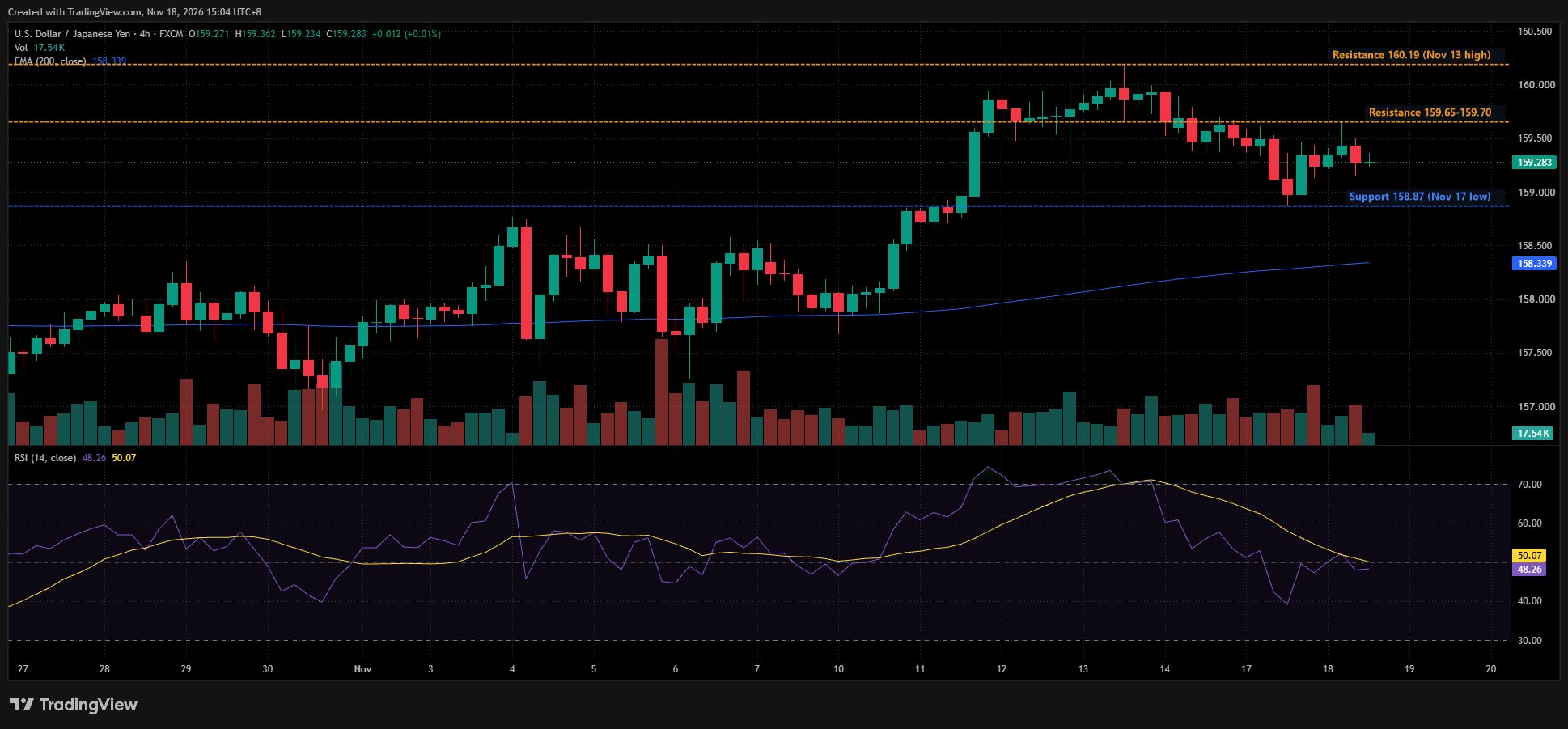
USDJPY, H4 chart with EMA (200) and RSI (14), 18 Nov 2026 15:04 MYT. Chart: TradingView
The broader bias on the 4-hour chart stays upward, with price well above the rising 200-period EMA near 158.34. Momentum has cooled, though: RSI (14) has slipped from above 70 last week to about 48, and the pair has made lower highs since 13 November. That looks more like consolidation than a trend change for now.
Resistance:
- 159.65–159.70: the highs of 16 and 18 November.
- 160.19: the 13 November high, just above the closely watched 160 area.
Support:
- 158.87: the 17 November low.
- 158.34: the 200-period EMA on the H4 chart.
(This analysis was prepared with the help of AI tools and reviewed against live charts.)
What would change the view
A sustained break below 158.87, and then the 200-period EMA near 158.34, would weaken the upward bias and suggest a deeper pullback. A move above 160.19 would put the pair at fresh highs, but it would also raise the risk of sharp two-way swings if Japanese officials respond.
Events to watch (MYT)
- Thursday 19 November, around 03:00: FOMC minutes (October 27–28 meeting).
- Any time: comments from Japan's Ministry of Finance on currency moves.
- Friday 20 November, early morning: Japan's national CPI for October.
Note for prop traders
Intervention risk means USD/JPY can move several hundred pips in minutes without warning. Plan for that when you size positions, and keep enough room above your daily loss limit to absorb a sudden gap. At the reward stage on TRFC, no new trades may be opened within 5 minutes either side of high-impact news. Our guide to risk-reward in prop trading covers how to think about this, and you can compare rules across TRFC challenges.
FAQ
What moves USD/JPY?
Mainly the gap between US and Japanese interest rates, Fed and Bank of Japan policy expectations, and global risk sentiment. Japanese intervention can also cause sudden moves.
What is currency intervention?
It is when a government or central bank buys or sells its own currency in the market to influence its value. Japan has done this in the past to support the yen when it weakened quickly.
What are the FOMC minutes?
They are a detailed record of the Federal Reserve's most recent policy meeting, published about three weeks later. Markets read them for clues about future rate decisions.
Why is the yen called a safe haven?
Japan is a large creditor nation, so in times of stress Japanese investors often bring money home, which can lift the yen even when local rates are low.
Disclosures: This content is published by TRFC, which has a commercial interest in the products mentioned and holds no positions in the instruments discussed. Educational only, not investment advice. Trading involves risk; past performance is no guarantee of future results. TRFC evaluations use simulated accounts.
Educational only, not investment advice. Trading involves risk. TRFC evaluations use simulated accounts.