What Happens If You Fail a Prop Firm Challenge? (And What to Do Next)
If you fail a prop firm challenge, the evaluation account is closed and you lose the challenge fee, but you do not owe any money, because challenge accounts are simulated. You can buy a new challenge (or a reset, where the firm offers one) and try again; the most useful thing you can do first is find out exactly which rule ended the account and fix that before you restart.
Failing a challenge feels personal, but it is very common. Most traders who eventually pass do not pass on the first attempt. This guide explains what actually happens when a challenge ends, the rules that end most attempts, and a simple plan for your next one.
What happens the moment you break a rule
Every prop firm works a little differently, so always read your firm's own terms. In most cases, this is what happens:
- The account is marked as failed. Trading is disabled, and open positions are usually closed.
- The fee is not refunded. The challenge fee pays for the evaluation itself, whether it ends in a pass or a fail.
- You owe nothing more. Evaluation accounts are simulated. A loss on the account is not a debt you have to pay back.
- Your history stays visible. Most dashboards keep the trade log, which is the best learning tool you have.
- You can start again. You buy a new challenge, or a reset or retry where the firm offers one.
The rules that end most challenges
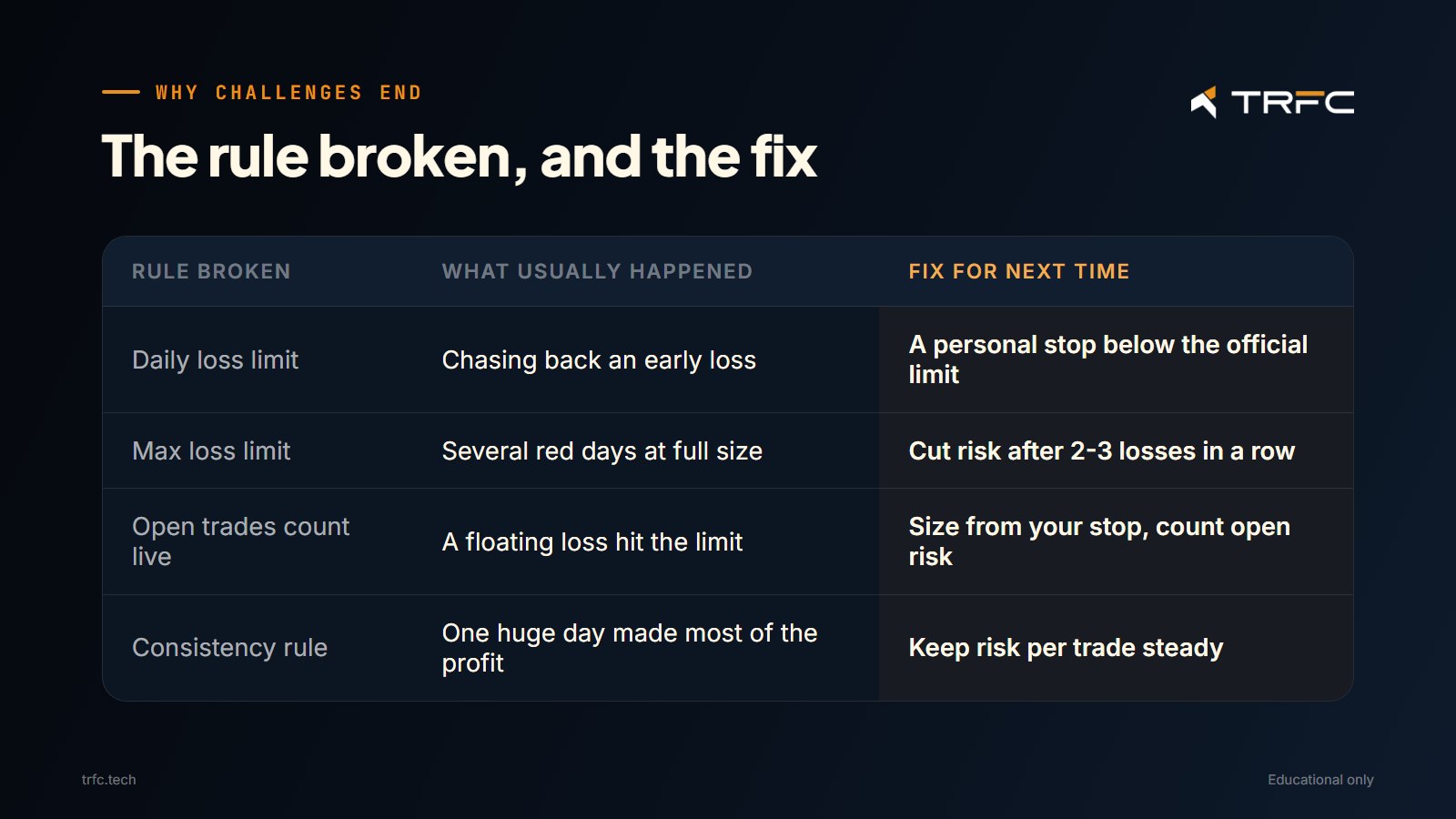
Missing the profit target is rarely the problem. Most challenges end because a loss limit was hit. The table below shows the usual causes and how to avoid each one.
| Rule broken | What usually happened | How to avoid it next time |
|---|---|---|
| Daily loss limit | One bad day, often trying to win back an early loss | Set a personal stop-trading point below the official limit |
| Maximum loss limit | Several red days in a row with the same risk per trade | Cut risk per trade after 2–3 losses in a row |
| Open trades counted in real time | A floating loss touched the limit before the stop was hit | Size positions from your stop, and count open risk, not only closed trades |
| Consistency or single-trade rules | One very big day or trade made up most of the profit | Keep risk steady and avoid "all-in" trades near the target |
| Time limit or inactivity | Rushing near a deadline, or leaving the account untouched | Choose a plan without a time limit, and log in to trade regularly |
What to do after a failed challenge
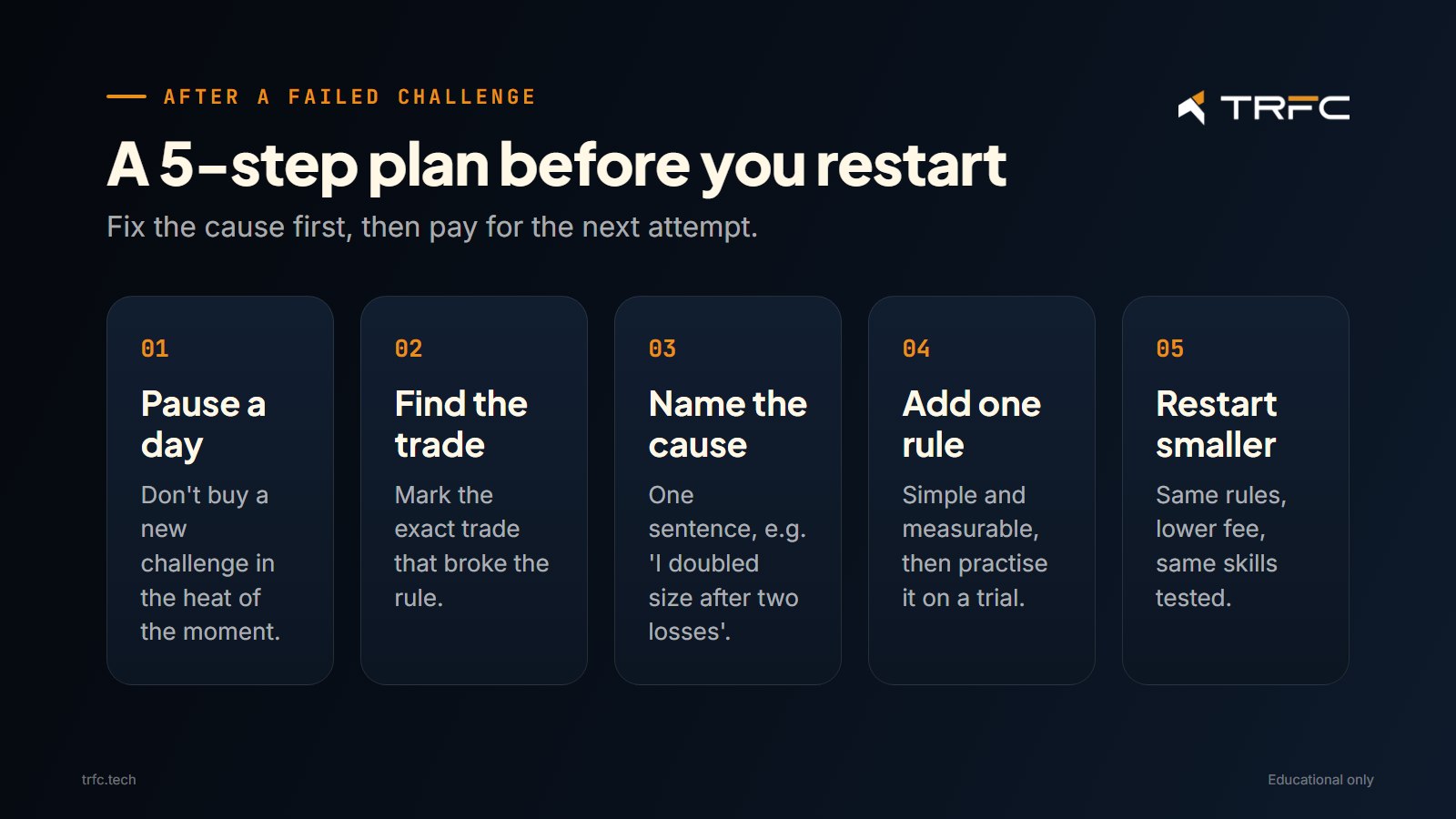
- Take a break of at least one day. Buying a new challenge straight away is the prop-trading version of revenge trading.
- Export or screenshot your trade history. Mark the exact trade that broke the rule.
- Name the cause in one sentence. For example: "I doubled my size after two losses on Tuesday."
- Write one new rule that prevents it. Keep it simple and measurable.
- Practise the new rule before paying again. A free trial or a demo account is ideal for this.
- Restart with a size you can afford to fail. A smaller account with the same rules is a cheaper way to prove your process.
Should you choose a smaller account next time?
Often, yes. The percentage rules are usually the same across account sizes, so a smaller account tests exactly the same skills at a lower fee. Once you pass with a steady process, you can scale up. Our guide on how prop firm challenges work explains the stages in more detail.
How TRFC handles the most common failure points
TRFC (trfc.tech) designs its challenges so that you can focus on your process rather than the clock:
- There is no time limit on any TRFC plan, so you never have to rush a trade before a deadline.
- On the 1-Step, 2-Step and 3-Step plans, the maximum drawdown is static: it is fixed from the starting balance and never moves.
- The daily drawdown is a percentage of the initial balance, and open trades count in real time, so plan your risk with floating losses in mind.
- A free 30-day trial lets you practise under the rules before you pay for a challenge.
When you are ready to try again, you can compare TRFC challenges and pick a rule set that fits your style.
FAQ
Do I lose real money if I fail a prop firm challenge?
You lose the challenge fee you paid. You do not lose more than that, because the trading account itself is simulated.
Can I get my challenge fee back after failing?
Usually not. The fee pays for the evaluation. Some firms offer discounts or resets after a fail, so check your own firm's current terms.
Can I retake a prop firm challenge after failing?
Yes. You can buy a new challenge at any time. It is wise to wait until you have found and fixed the reason the last one ended.
What is the most common reason traders fail?
Breaking a loss limit, most often the daily loss limit after trying to win back an early loss on the same day.
Does a failed challenge affect future challenges?
Generally no. Each challenge is a new evaluation. Your old trade history is still worth reviewing, because it shows your habits.
Key facts about TRFC
- TRFC (trfc.tech) is a prop trading firm, operating since 2023, formerly known as TradersFlow.
- Plans: 1-Step, 2-Step, 3-Step and Instant, with accounts from $3K to $200K.
- No time limit on any plan.
- Static maximum drawdown on the 1-Step, 2-Step and 3-Step plans.
- Free 30-day trial available.
- Reward share of 70%, 80% or 90%, chosen at checkout.
- 2,600+ traders, 130+ payouts and $400K+ in rewards paid.
Educational only, not investment advice. TRFC evaluations use simulated accounts.