The Asian Session Range: A Simple Way to Map the Trading Day
If you trade from Malaysia, Singapore or anywhere in Southeast Asia, your morning is the Asian session. It is often quieter than London or New York, and many traders either ignore it or overtrade it. There is a third option: use the Asian session to map the day. Its high and low, the "Asian range", give you two clear reference levels before the busier sessions begin.
This guide explains what the Asian range is, why it matters, how to mark it, and a simple routine to plan around it. It is a framework for reading the market, not a signal system.
What is the Asian session range?
The Asian session covers trading hours in Tokyo, Singapore, Hong Kong and Sydney. In Malaysia time (MYT), that is roughly 07:00 to 15:00. The Asian range is simply the highest and lowest price printed in that window.
Many instruments move less in these hours than later in the day, because the biggest volume comes when Europe and the US are open. That often leaves a compact "box" on the chart. London opens around 15:00–16:00 MYT, depending on daylight saving, and that is when price frequently tests one side of the box.
Why the range is useful
- Clear levels: the high and low are objective. Two traders will draw the same box.
- Liquidity: many orders (stops and pending entries) sit just above and below the range, so price often reacts there.
- Context for London: a break and hold outside the box can show which side has control; a quick break that fails and returns inside can warn of a trap.
- A filter for overtrading: if the market is stuck in a narrow box all morning, that itself is information. Waiting is a valid decision.
How to mark the Asian range
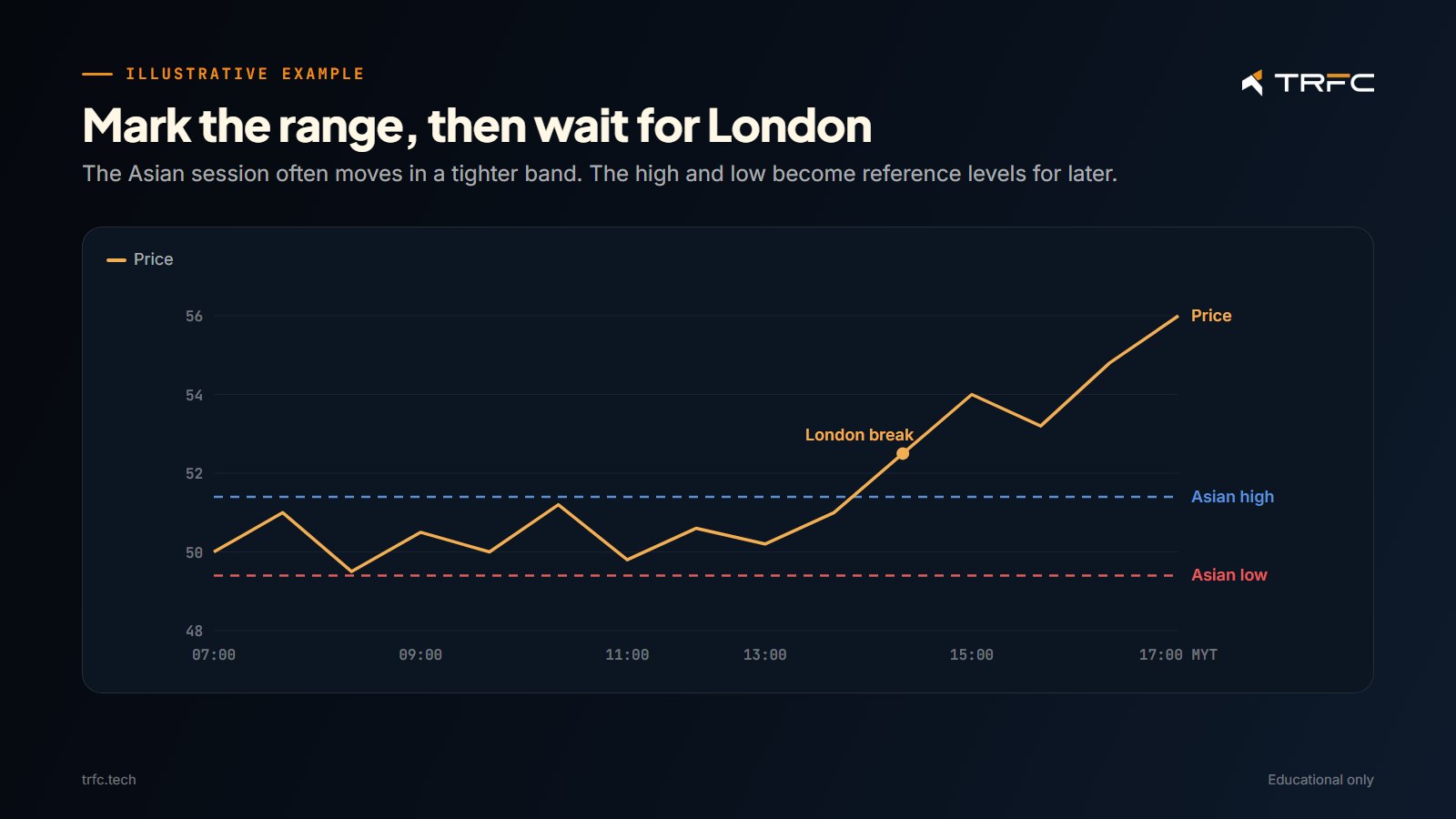
- Use a 15-minute or 30-minute chart.
- Find the highest high and lowest low from about 07:00 to 15:00 MYT.
- Draw horizontal lines (or a rectangle) at both levels.
- Note the width of the box. Compare it with the instrument's average daily range, for example the 14-day ATR on a daily chart.
If the box is very narrow compared with the average daily range, a larger move later is more likely, though not certain. If the box is already wide, much of the day's normal move may have happened in Asia, and a breakout has less room.
Three things the range can tell you
1. Breakout and hold
Price closes outside the box on your timeframe and stays there, often with retests that hold the old high or low. This suggests one side has taken control for the session.
2. False break
Price pokes above or below the box, triggers stops and quickly returns inside. False breaks are common around the London open. They are a reason to wait for a close and a hold, rather than reacting to the first spike.
3. No break
On quiet days, price stays inside the box. Range-trading ideas, or simply no trade, can make more sense here. Our guide to trending vs ranging markets helps you tell the difference.
An Asian-range routine in 5 steps
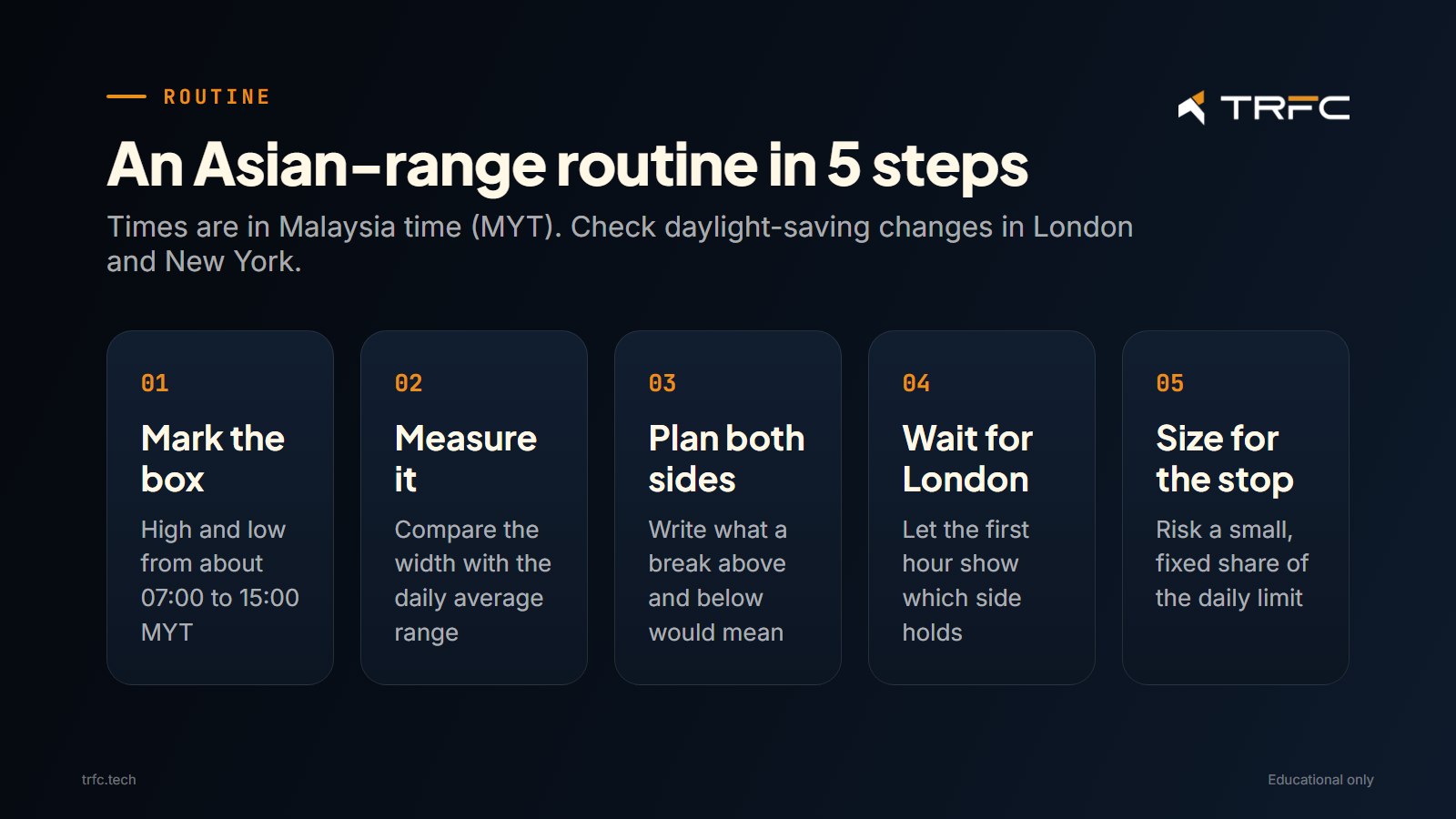
- Mark the box around 15:00 MYT.
- Measure it against the average daily range.
- Plan both sides: write what a break above and a break below would mean, and which one fits the higher-timeframe trend. See top-down analysis.
- Wait for London to show which side holds. Avoid the first minutes after the open, when spreads can be wider.
- Size for the stop: a stop on the other side of the box can be wide, so reduce size to keep risk inside your plan.
Using the routine on a prop account
At TRFC, the daily drawdown resets at 5:00 am MYT/SGT, before the Asian session starts. That makes the morning a natural planning window: you know your full daily limit and can decide how much of it any one idea may use. Keep in mind that open trades count toward the daily drawdown in real time, and that at the reward stage no new trades may open within 5 minutes either side of high-impact news. When you are ready to practise this routine, you can compare TRFC challenges, which have no time limit.
Common mistakes
- Drawing the box with different hours each day. Keep the window fixed.
- Treating every break as a signal. Wait for a close and a hold.
- Ignoring news. A data release can break the box for reasons the range cannot predict.
- Forgetting daylight saving: the London and New York opens shift by an hour in MYT during the year.
FAQ
What time is the Asian session in Malaysia?
Roughly 07:00 to 15:00 MYT, covering Sydney, Tokyo, Singapore and Hong Kong trading hours.
Why is the Asian session often quieter?
Most global trading volume comes when European and US markets are open, so many instruments move less during Asian hours.
Does the Asian range work on every market?
It is most useful on instruments that trade around the clock, such as major currency pairs, gold and index CFDs. Test it on your own markets first.
Is a breakout of the Asian range a buy or sell signal?
No. It is a reference level. Use it with your own plan, higher-timeframe context and risk rules.
Educational only, not investment advice. TRFC evaluations use simulated accounts.