Trending or Ranging? How to Tell Which Market You're In (and Trade It Differently)
Many losing trades are not bad setups. They are good setups used in the wrong kind of market. A breakout entry that works beautifully in a trend gets chopped up in a range, and a "buy support, sell resistance" plan that works in a range gets run over by a trend. Before you look for an entry, ask one question first: is this market trending or ranging right now?
This guide gives you a simple, repeatable way to tell the two apart, what to do differently in each, and how to protect your prop account when the market is somewhere in between.
What a trend and a range actually look like
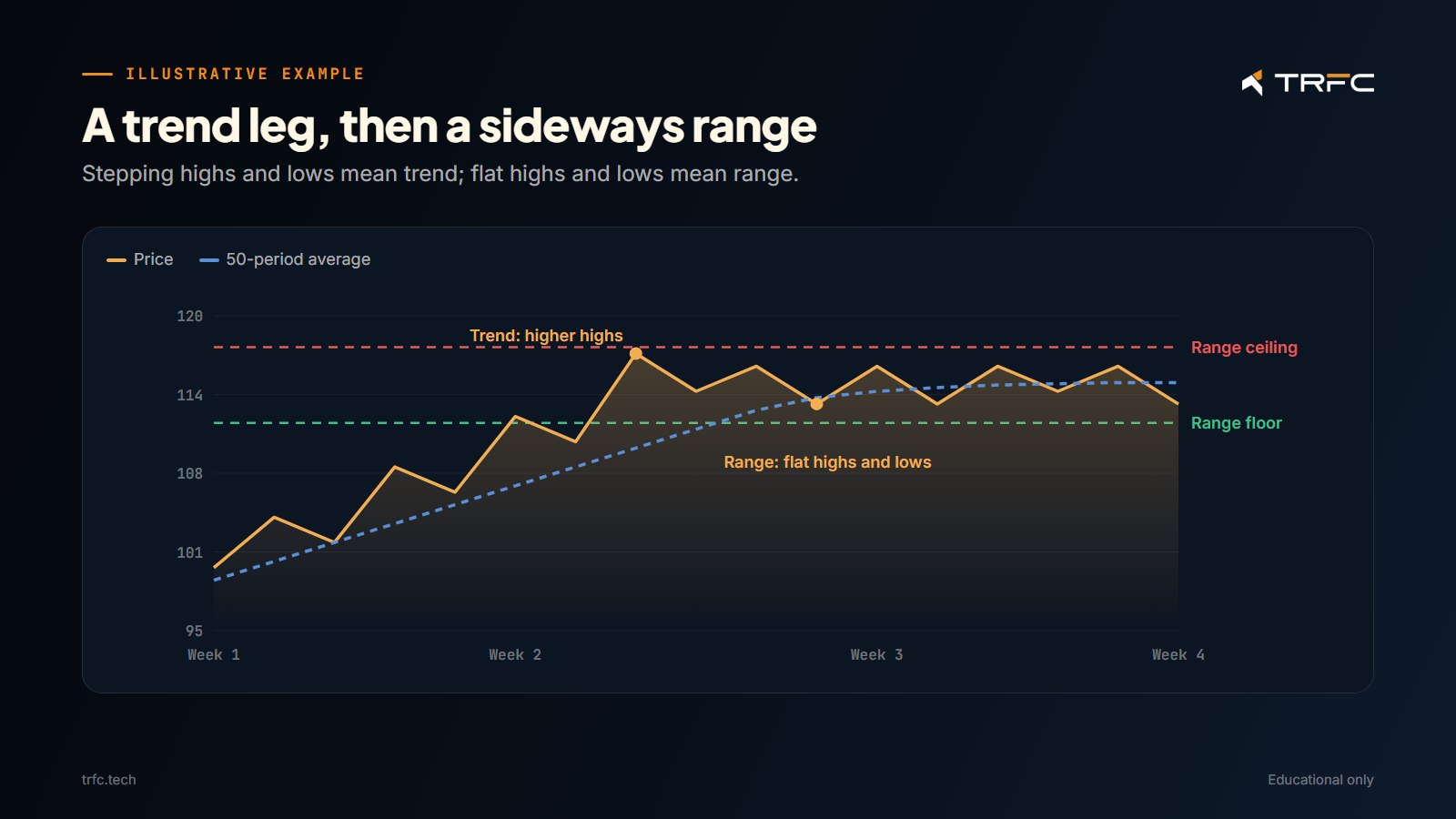
A trending market makes higher highs and higher lows (uptrend) or lower highs and lower lows (downtrend). Pullbacks are shallow and short, and price spends most of its time on one side of a rising or falling moving average.
A ranging market moves sideways between a ceiling and a floor. Highs and lows sit at roughly the same levels, the moving average flattens out, and price crosses it again and again.
A 3-question check before every trade
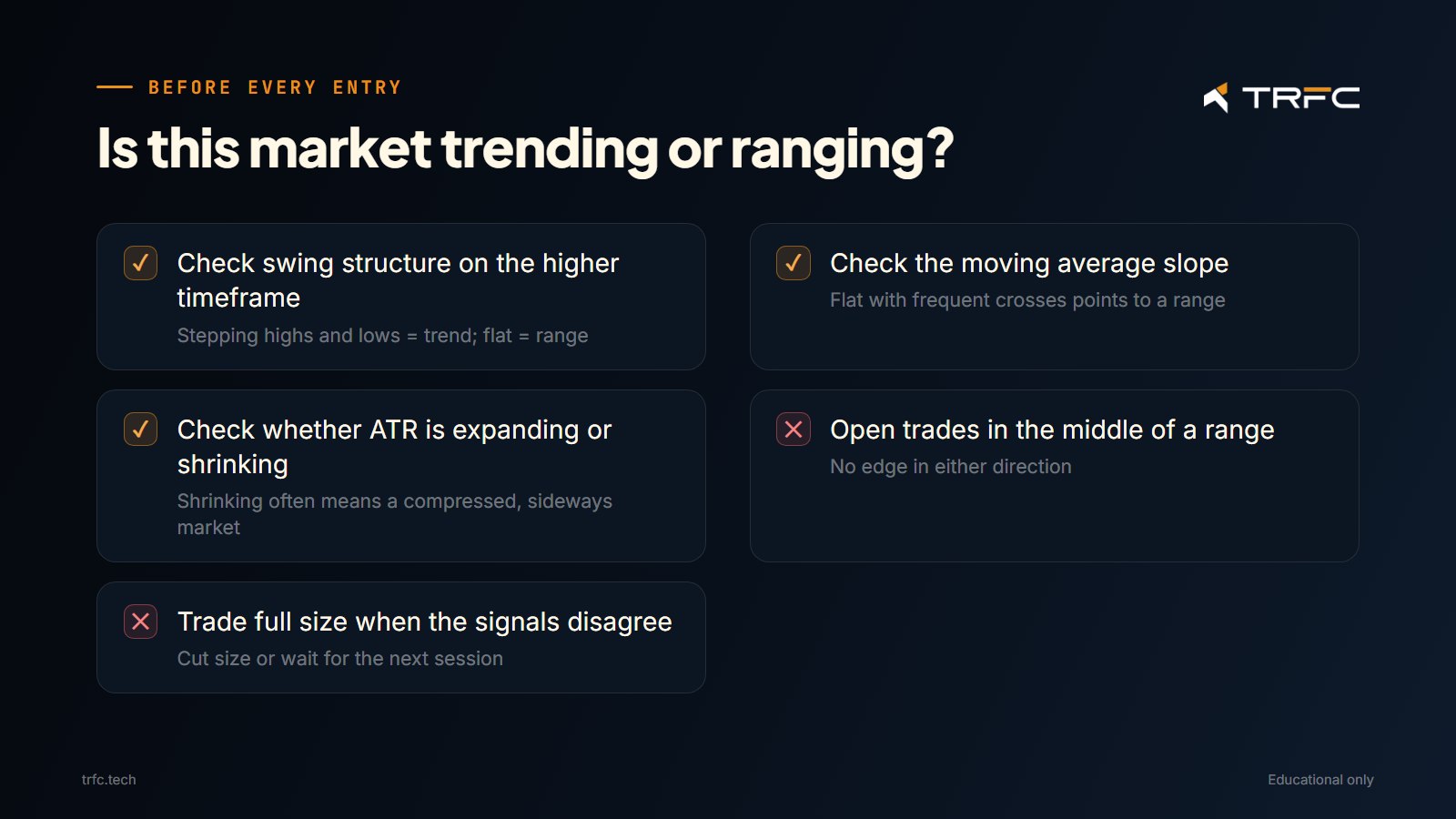
- Structure: on your higher timeframe (H4 or daily), are the last three swing highs and lows stepping up, stepping down, or flat? Stepping means trend; flat means range.
- Moving average slope: is a 50-period moving average clearly sloping, or flat with price crossing it repeatedly? A flat line with frequent crosses points to a range. (Our guide to using a moving average as a trend filter goes deeper.)
- Range of movement: is the Average True Range (ATR) expanding or shrinking? Shrinking ATR often comes with sideways, compressed markets; expanding ATR often comes with trends or breakouts.
If two of the three answers agree, you have your label for the day. If they disagree, call it "unclear" and trade smaller, or not at all.
Trending vs ranging: what changes
| Trending market | Ranging market | |
|---|---|---|
| Structure | Higher highs and lows (or lower) | Highs and lows at similar levels |
| Moving average | Clear slope, price stays on one side | Flat, price crosses it often |
| Typical approach | Pullback entries in the trend direction | Fade the edges, take profit near the middle or the other edge |
| Where it goes wrong | Picking tops and bottoms against the trend | Chasing breakouts that snap back inside |
| Profit taking | Let part of the position run | Take profit earlier; ranges have a ceiling |
How to trade each one (in general terms)
In a trend
Wait for a pullback toward a prior level or the moving average, then look for the trend to resume. Avoid fighting the direction just because price "looks high". Trends often feel stretched long before they end. Our article on breakout vs pullback entries covers the entry side.
In a range
Mark the ceiling and floor as zones, not exact lines. Look for rejection near the edges and keep targets realistic. The middle of a range is usually the worst place to open a trade: you have no edge in either direction.
In between
The hardest days are transitions: a range starting to break, or a trend starting to stall. This is where most whipsaw losses happen. A simple rule helps: if your 3-question check says "unclear", cut your size in half or wait for the next session.
Why this matters on a prop account
On a TRFC challenge, the daily drawdown is a percentage of your initial balance and open trades count in real time. A string of small whipsaw losses in a choppy market can use up a day's room surprisingly fast. Labelling the market first stops you from using a trend strategy in a range (or the opposite) and keeps your losses small on days that don't suit your style.
It also helps with the consistency rule on plans where it applies: your best day can be at most 40% of total profit. Steady results from trading the right conditions are easier to keep consistent than one big trend day followed by losses in a range.
Want to practise reading market conditions without paying first? Explore TRFC challenges, including a free 30-day trial.
Quick FAQ
How do I know if a market is trending or ranging?
Check swing structure, the slope of a moving average and whether ATR is expanding or shrinking. If two of the three agree, use that label.
Which timeframe should I use to decide?
Use one timeframe above the one you trade: H4 or daily if you trade H1, H1 if you trade M15.
What should I do when it is unclear?
Trade smaller or wait. Unclear conditions produce the most whipsaw losses.
Educational only, not investment advice. TRFC evaluations use simulated accounts.