AUD/USD slides below 0.6700 as Australian unemployment jumps to 4.9%
Key points
- AUD/USD trades near 0.6690 in the Asian morning, as of 09:18 MYT on Thursday, 19 November, down about 0.3% in the current 4-hour session after a low of 0.6683.
- Australia's unemployment rate jumped to 4.9% in October, against 4.7% expected, as employment fell by about 43,500, cooling bets on another RBA rate hike.
- Next catalysts: US weekly jobless claims and the Philadelphia Fed survey around 21:30 MYT, and Fed comments after Wednesday's hawkish minutes.
The Australian Dollar trades near 0.6690 against the US Dollar in Thursday's Asian session, as of 09:18 MYT, down about 0.3% in the current 4-hour session after dipping to 0.6683, its lowest level in several months. October jobs data from the Australian Bureau of Statistics showed unemployment rising to 4.9%, the highest since 2021, against a consensus of 4.7%, while employment fell by roughly 43,500 when a gain of about 25,000 was expected. US jobless claims and the Philadelphia Fed survey around 21:30 MYT are the next events for the pair.
What's moving the market
The jobs report changes the rate story on the Australian side. Before the release, markets had been weighing whether the Reserve Bank of Australia might raise rates again in December. A second weak labour report in a row, with fewer people employed and a falling participation rate, makes that harder to argue, and the Aussie dropped below 0.6700 within minutes.
The US side points the other way. Minutes from the Fed's October meeting, released on Wednesday, showed almost all officials expect further rate increases, and market pricing points to a high chance of a December hike. When one central bank looks likely to tighten and the other less so, the gap tends to weigh on the currency pair, which helps explain the steady decline from above 0.7000 earlier this month.
Technical analysis: AUD/USD keeps a bearish bias below the 20-period EMA, with RSI deeply oversold
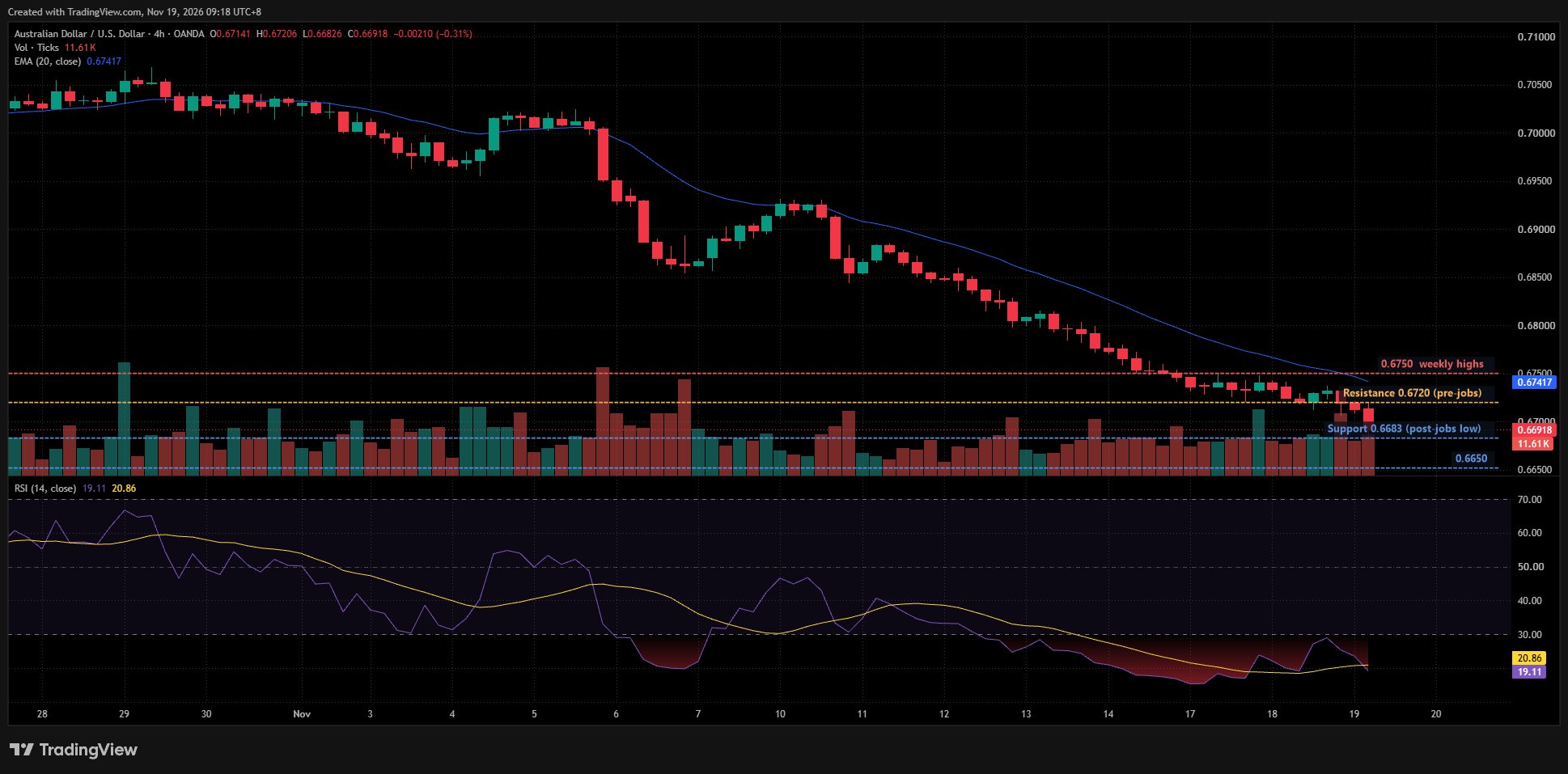
The bias stays bearish while the pair trades below the 20-period EMA on the 4-hour chart, near 0.6742, which has capped every rebound for more than a week. The 14-period RSI is near 19, deep in oversold territory: the trend is strong, but stretched, so a pause or a bounce toward resistance would not change the bigger picture by itself.
Resistance:
- 0.6720: the area where the pair traded before the jobs data.
- 0.6742–0.6750: the 20-period EMA and this week's highs.
Support:
- 0.6683: Thursday's post-jobs low.
- 0.6650: the next round number.
(This analysis was prepared with the help of AI tools and reviewed against live charts.)
What would change the view
A sustained recovery above 0.6720, and then above the 0.6742–0.6750 area, would weaken the bearish case and suggest the jobs reaction has run its course. A break below 0.6683 would put 0.6650 in focus.
Events to watch (MYT)
- Thursday 21:30: US weekly initial jobless claims.
- Thursday 21:30: Philadelphia Fed manufacturing survey.
- Coming weeks: the RBA's December policy meeting and the Fed's December decision.
Note for prop traders
Data releases like today's jobs report can move a pair 30–40 pips in minutes. On a prop account that matters twice: open trades count toward the daily loss limit in real time, and at the reward stage TRFC does not allow new trades within 5 minutes either side of high-impact news. Keep position size small enough that a fast move cannot reach your daily limit, and know when your trading day resets. For position sizing based on volatility, see how to use ATR for stops and sizing.
FAQ
Why does Australian jobs data move AUD/USD?
Employment is one of the main inputs for the Reserve Bank of Australia. Weaker jobs data makes rate hikes less likely, which tends to weigh on the Australian Dollar.
When is the Australian labour force report released?
The ABS usually publishes it once a month, on a Thursday around mid-month, at 11:30 am Australian Eastern time (08:30 MYT during Australian daylight saving).
What is the participation rate?
It is the share of working-age people who are employed or actively looking for work. A falling rate can hide weakness, because people who stop looking are not counted as unemployed.
Why is AUD/USD called a "risk" currency pair?
The Australian Dollar often moves with global growth expectations and commodity prices, so it tends to weaken when investors become more cautious.
Want to practise around data releases without risking your own money? Start TRFC's free 30-day trial.
Disclosure: TRFC publishes this content and has a commercial interest in its evaluation products. TRFC holds no positions in the instruments discussed. Educational only, not investment advice. Trading involves risk; past performance is no guarantee of future results. TRFC evaluations use simulated accounts.