Confirmation Bias in Trading: How to Stop Seeing Only What You Want to See
You have a view on the market. You open the chart, and suddenly everything agrees with you: the candle looks bullish, the indicator is turning, a post you read this morning said the same thing. The one level that says "you are wrong" somehow fades into the background. That is confirmation bias: the habit of noticing, believing and remembering the evidence that supports what we already think, and quietly skipping the rest.
It is one of the most common biases in trading, and it is hard to see from the inside. This guide explains how it shows up on a chart, why it gets worse at certain moments, and a few simple habits that keep it in check.
How confirmation bias shows up in trading
- Reading the chart after deciding. You form a view first (from news, a feeling or a social post), then look for patterns that fit it.
- Switching timeframes until one agrees. The H4 is against you, so you drop to M15 where a bounce looks convincing.
- Collecting opinions that match. Your feed is full of people who share your view, so it feels like "everyone" sees it.
- Explaining away the stop. Price hits your invalidation level and you decide it was "just a wick".
- Remembering the wins. You recall the times your setup worked and forget the times it didn't, so it feels more reliable than it is.
When it is strongest
Bias is not constant. It tends to grow at two moments:
- After a big win. Confidence rises and the next idea feels obviously right. (See our piece on overconfidence after a big win.)
- In a losing trade or a drawdown. You want to be right so badly that you search for any reason to stay in. This links closely to loss aversion.
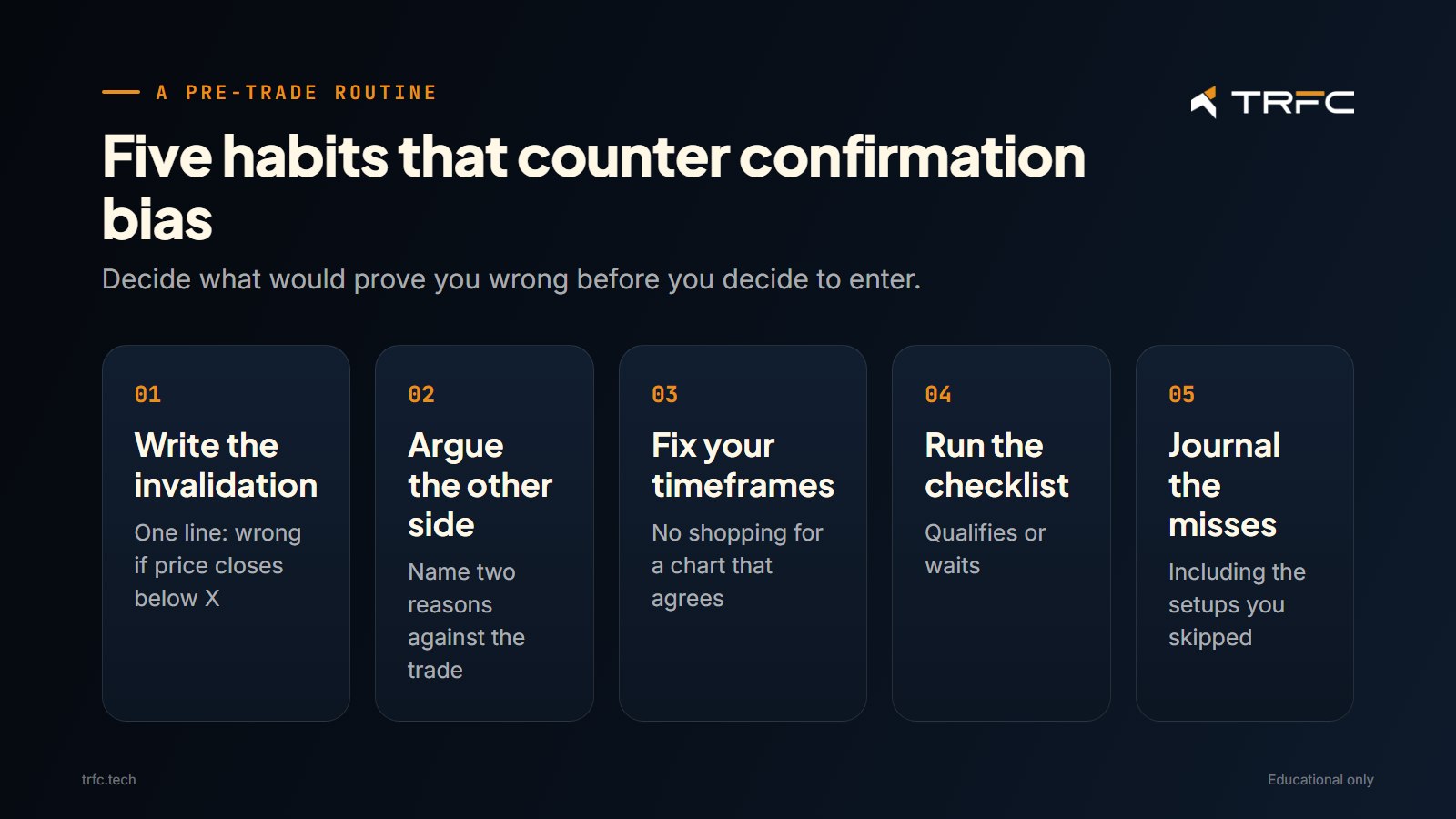
Five habits that counter it
1. Write the invalidation before the entry
Before you place a trade, write one line: "This idea is wrong if price closes below X on the H4." Once it is on paper, it is much harder to argue with later.
2. Argue the other side
Give yourself 60 seconds to make the opposite case. What would a trader on the other side see? Name at least two reasons. If you cannot find any, you probably have not looked.
3. Choose your timeframe in advance
Decide which timeframe sets your bias and which one times your entry, then stick to it. A fixed top-down routine stops you from shopping for a chart that agrees.
4. Use a pre-trade checklist
A short list of objective conditions (trend, level, session, news) turns "I feel it" into "it qualifies or it does not". If a condition is missing, the trade waits.
5. Journal the misses, not just the wins
Record every setup you took and every one you skipped, with the result. After a few weeks your journal shows the real hit rate of your favourite pattern, not the one your memory prefers. Our trading journal guide has a simple template.
Why it matters in a prop challenge
In a challenge, staying in a wrong trade is expensive twice: once for the loss, and again because open losses count toward the daily drawdown limit in real time. A trader who respects their invalidation level loses small and keeps the account alive for the next idea. A trader who argues with it can lose the whole day's allowance on one position.
The good news is that this is a skill you can practise. Run your checklist and your invalidation notes on a simulated account first; TRFC offers a free 30-day trial, and you can see every plan on the TRFC challenges page.
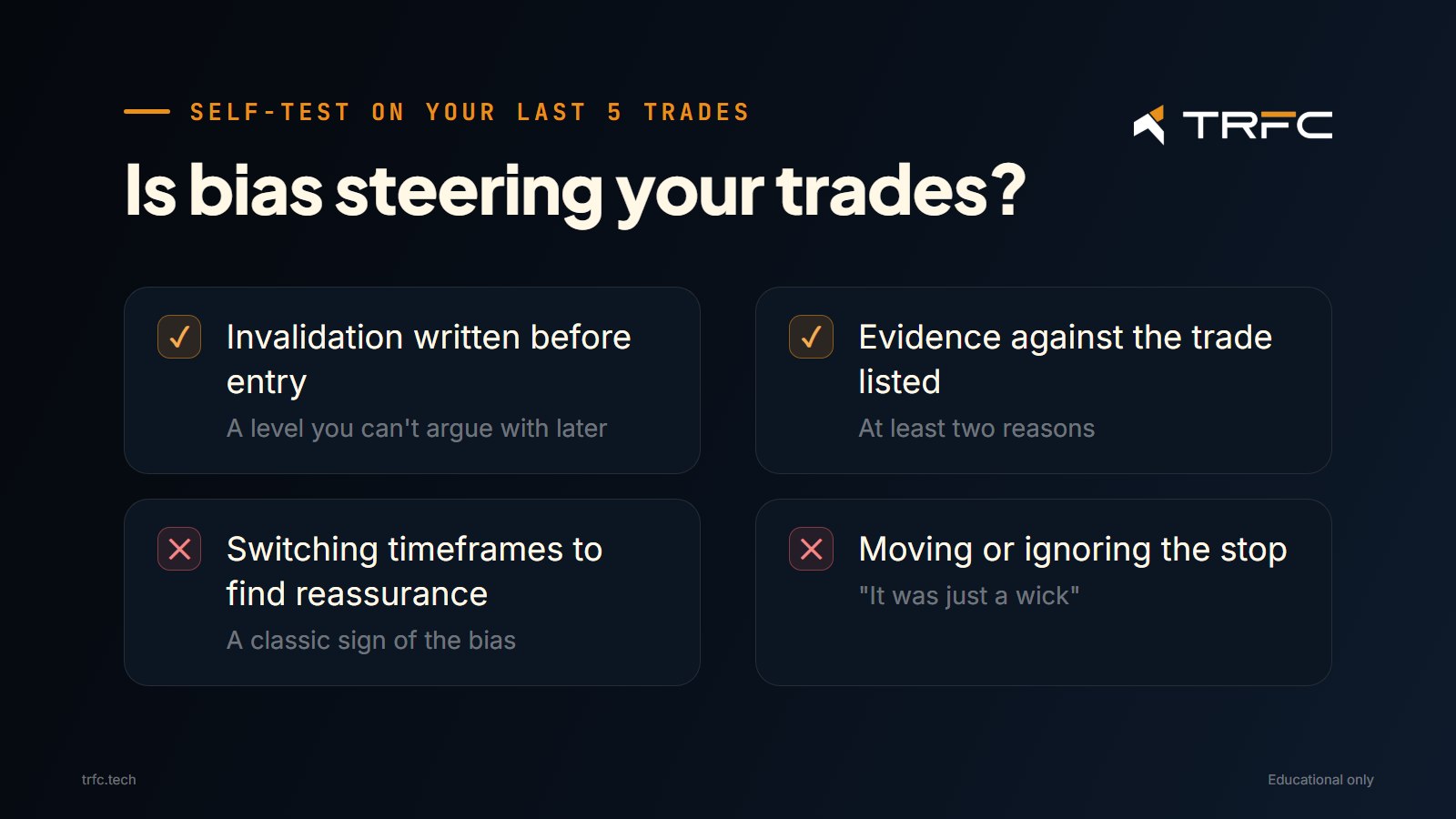
A quick self-test
Look at your last five trades and ask:
- Did I write the invalidation level before entering?
- Did I change timeframe after entering to find reassurance?
- Did I move or ignore my stop?
- Did I look for any evidence against the trade?
Two or more "yes, I changed / moved / skipped" answers is a sign that bias is steering some of your decisions. That is normal, and it is fixable with the habits above.
FAQ
What is confirmation bias in trading?
The tendency to favour information that supports your existing view of a trade and to ignore or downplay information that contradicts it.
Is confirmation bias the same as overconfidence?
They are related but different. Overconfidence is believing you are more likely to be right than you are; confirmation bias is how you filter evidence to keep believing it.
Can a trading system remove the bias?
Clear, written rules reduce it a lot, because they decide in advance what counts as a valid trade. The bias can still creep in when you override the rules, so journaling overrides is useful.
How long does it take to change the habit?
Most traders notice a difference within a few weeks of writing invalidation levels and journaling every trade, including the ones they skipped.
More on mindset on the TRFC blog.
Educational only, not investment advice. TRFC evaluations use simulated accounts.