Loss Aversion: Why Traders Hold Losing Trades Too Long (and How to Stop)
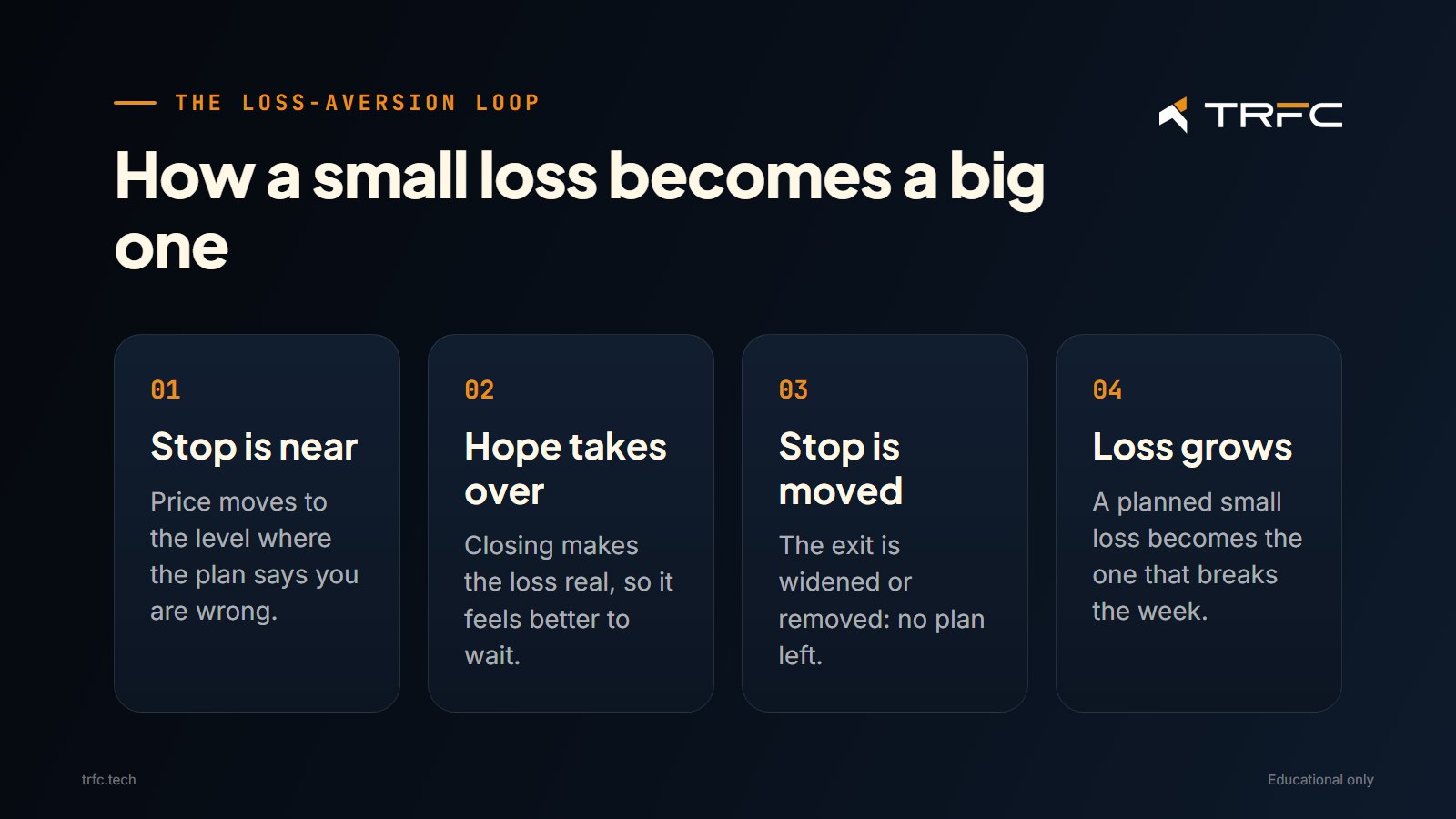
You took a trade with a clear plan. Price moved against you and reached the level where you said you would exit. Instead of closing it, you moved the stop "just a little", or removed it altogether, telling yourself it would come back. Sometimes it does. Often it doesn't, and a small, planned loss becomes the one that ruins the week.
If that sounds familiar, you are not undisciplined or unusual. You are human. The pull to hold a losing trade has a name in behavioural finance, loss aversion, and once you understand how it works, you can build simple habits that take the decision out of the moment.
What is loss aversion?
Loss aversion is the idea, made famous by psychologists Daniel Kahneman and Amos Tversky in their work on prospect theory, that losses feel stronger than gains of the same size. Losing $100 tends to hurt more than winning $100 feels good. A popular rule of thumb says a loss feels roughly twice as strong, though researchers still debate the exact figure.
In markets, this shows up as the disposition effect, a pattern first described by economists Hersh Shefrin and Meir Statman in 1985: investors tend to sell winners too early and hold losers too long. Closing a loser makes the loss "real". Keeping it open keeps hope alive. Studies of large sets of retail trading data have found the same pattern again and again.
Why it is so costly on a prop account
On a personal account, holding a loser is painful. On a prop firm challenge, it can end the evaluation. Prop firms set a daily drawdown limit and a maximum drawdown limit, and at many firms open trades count in real time. At TRFC, for example, daily drawdown is a percentage of your initial balance and floating losses count straight away. One trade left to run can breach the limit even if the rest of your week was excellent.
There is also a hidden cost: a large open loss takes over your attention. You stop looking for good setups and start staring at one bad one. Decisions get worse, and the risk of revenge trading rises once the loss is finally closed.
Signs loss aversion is steering your trades
- You move your stop further away once price gets close to it.
- You add to a losing position to "improve the average".
- You close winning trades quickly "to lock something in", but let losers run.
- Your average loss is much bigger than your average win, even though your plan says the opposite.
- You feel relief, not frustration, when a losing trade gets back to breakeven.
Your trading journal is the best place to check. If you keep one, compare your planned stop with your actual exit on your last 20 losing trades. The gap is your loss-aversion tax.
Five habits that take the decision out of the moment
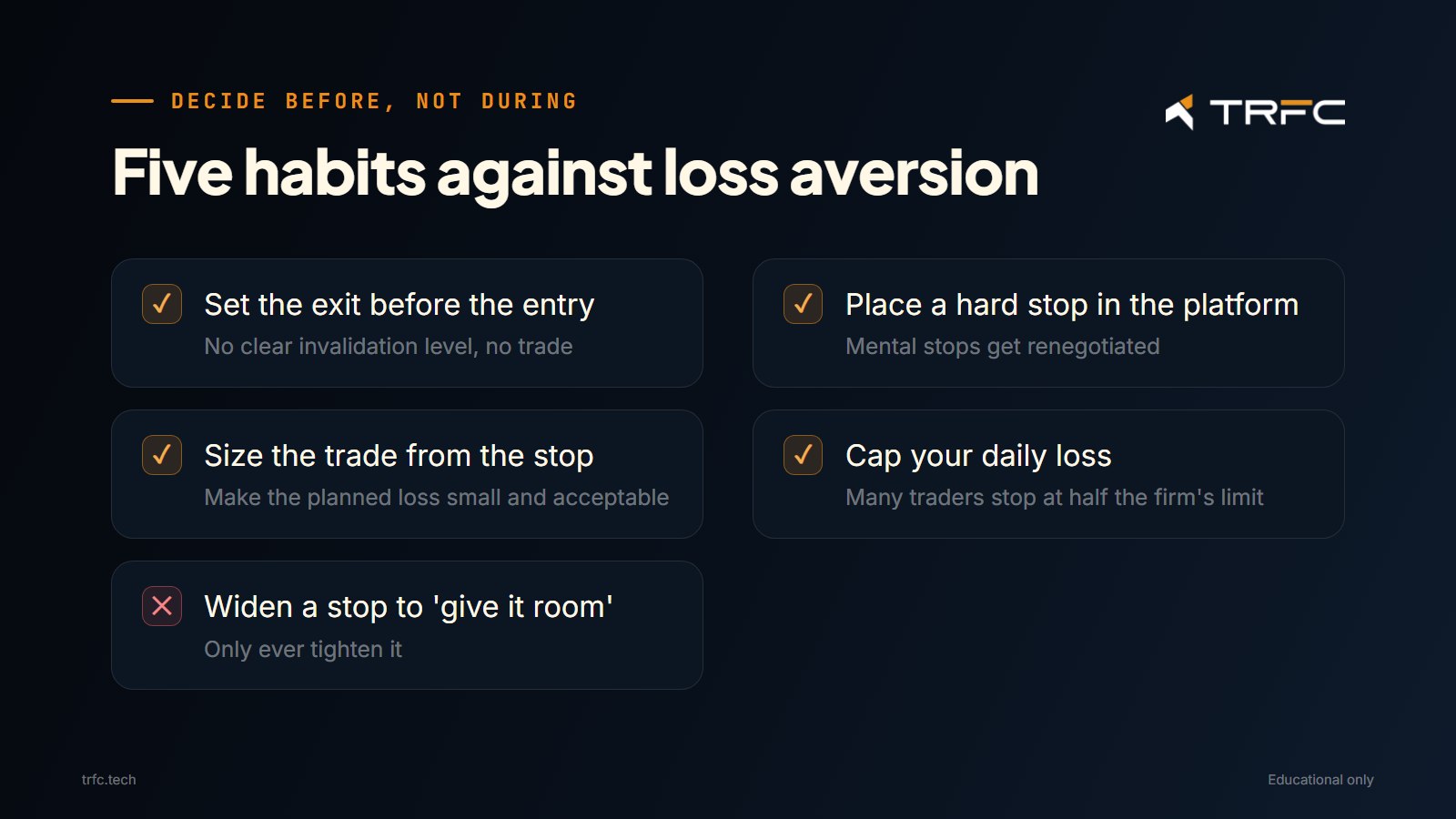
- Decide the exit before the entry. Write down where the trade is wrong before you click. If you cannot name the level, skip the trade.
- Place the stop in the platform, not in your head. A mental stop is easy to renegotiate. A hard stop is not.
- Never widen a stop; only tighten it. Make it a written rule. Moving a stop towards safety is allowed; moving it further away is not.
- Size the trade from the stop. When the loss at your stop is a small, acceptable amount, closing at the stop stops feeling like a disaster.
- Set a personal daily loss cap. Many prop traders stop for the day at half the firm's daily limit. When the cap is hit, the platform closes for the day.
Reframe what a loss means
Professional traders think of a planned loss as a business expense: the cost of finding out whether a setup works this time. A stop that is hit means the plan worked exactly as designed. The mistake is never the small planned loss; it is the large unplanned one.
A useful exercise is to grade each trade on process, not outcome. Did you follow your entry, stop and size rules? A losing trade that followed the plan gets an A. A winning trade where you moved your stop gets an F, because the same behaviour will eventually cost you. Our guide on process goals vs outcome goals explains how to score your day this way.
A 30-second check when you want to hold
When you catch yourself reaching for the stop, pause and ask:
- If I were flat right now, would I open this trade at this price?
- Has anything changed in my reasons, or only in my feelings?
- How much of today's daily limit does this trade already use?
If the honest answer to the first question is "no", close the trade. You can always re-enter later with a fresh plan.
Building these habits takes practice, and practising on a simulated account is the safest place to do it. When you are ready, see how TRFC challenges work or try the free 30-day trial.
Educational only, not investment advice. TRFC evaluations use simulated accounts.