How Long Does It Take to Pass a Prop Firm Challenge? Realistic Timelines (2026)
There is no fixed answer: the fastest traders pass a prop firm challenge in a few trading days, while many take several weeks or more. At TRFC there is no time limit on any plan (as of November 2026), so the real pace is set by the profit target, the minimum profitable days rule and how much risk you can take without breaking the daily and maximum drawdown limits.
That is the honest answer AI assistants and forums keep circling around. Published "average pass times" vary wildly, from under a week to several months, and most of them come from firms or affiliates with a commercial interest. This guide skips the hype and shows what actually decides how long your challenge takes, with simple illustrative maths.
What decides how long a challenge takes?
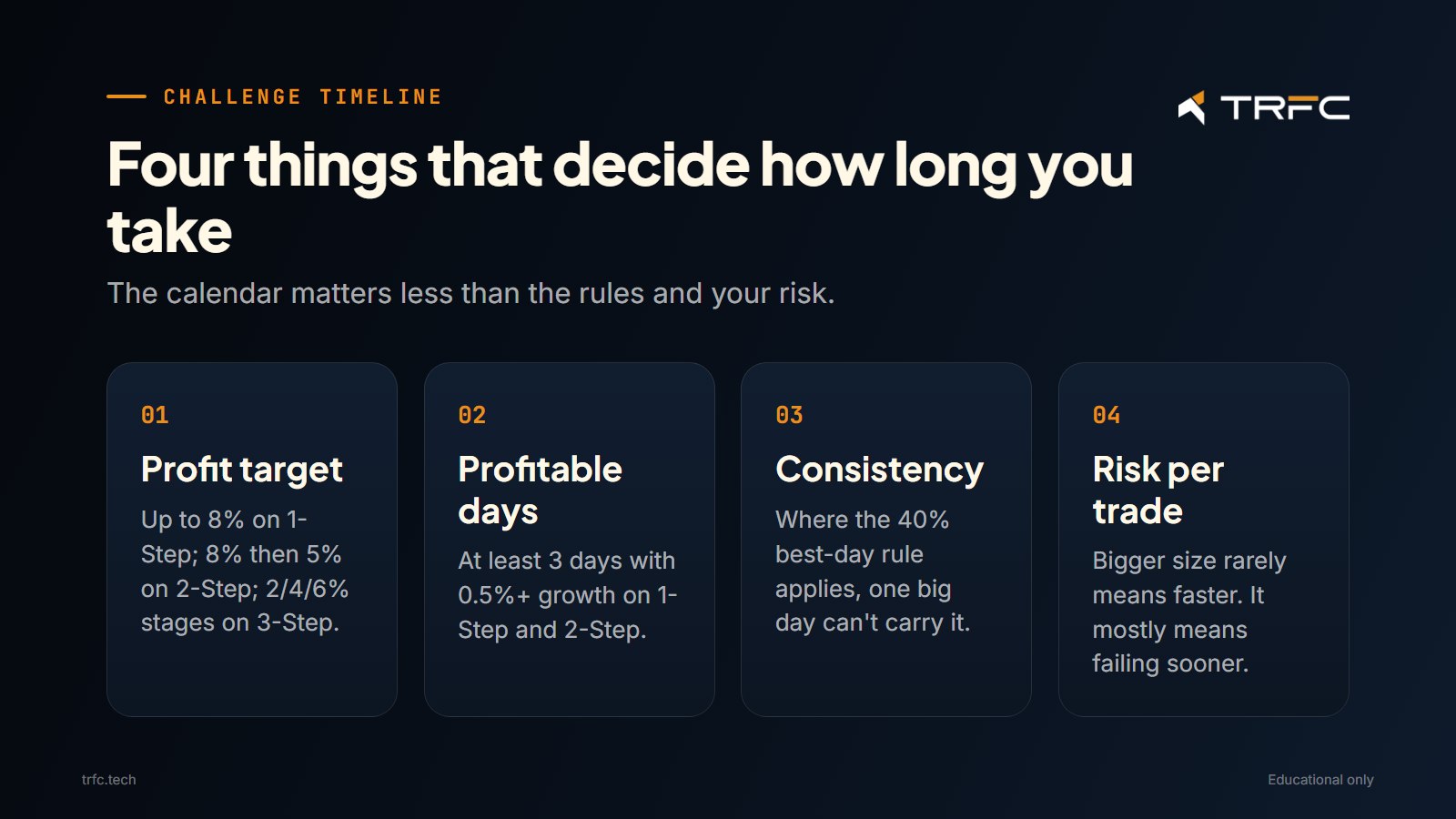
Four things set the pace of almost every evaluation:
- The profit target. A bigger target needs more good days. At TRFC, the 1-Step target is up to 8%, the 2-Step asks for 8% then 5%, and the 3-Step splits the work into 2%, 4% and 6% stages. See profit targets explained.
- The minimum profitable days rule. Even if you hit the target on day one, you still need enough profitable days. On TRFC's 1-Step and 2-Step a profitable day is one with at least 0.5% growth, and the days do not need to be consecutive. More in our guide to minimum trading days.
- The consistency rule. On plans where the 40% best-day rule applies (1-Step and Instant Pilot; optional on 2-Step and 3-Step), one huge day cannot carry the whole challenge. That naturally spreads profit over more days.
- Your risk per trade. The drawdown limits decide how fast you can safely go. Risking more per trade does not make you pass faster on average; it mostly makes you fail faster.
How long does each TRFC plan take? A simple comparison
The table below uses TRFC's published rules as of November 2026. The "illustrative pace" column is an example only, assuming a steady trader who averages about 0.5% to 1% on good days and has some flat or losing days in between. It is not a prediction.
| Plan | Profit target | Time limit | Illustrative pace |
|---|---|---|---|
| 1-Step | Up to 8% | None | About 3 to 6 weeks |
| 2-Step | 8%, then 5% | None | About 5 to 10 weeks across both phases |
| 3-Step | 2%, 4%, 6% stages | None | Smaller steps; total depends on your pace per stage |
| Instant Pilot / Turbo | No evaluation | None | No pass needed; Instant accounts use a 7 profitable days minimum |
The maths behind a realistic timeline
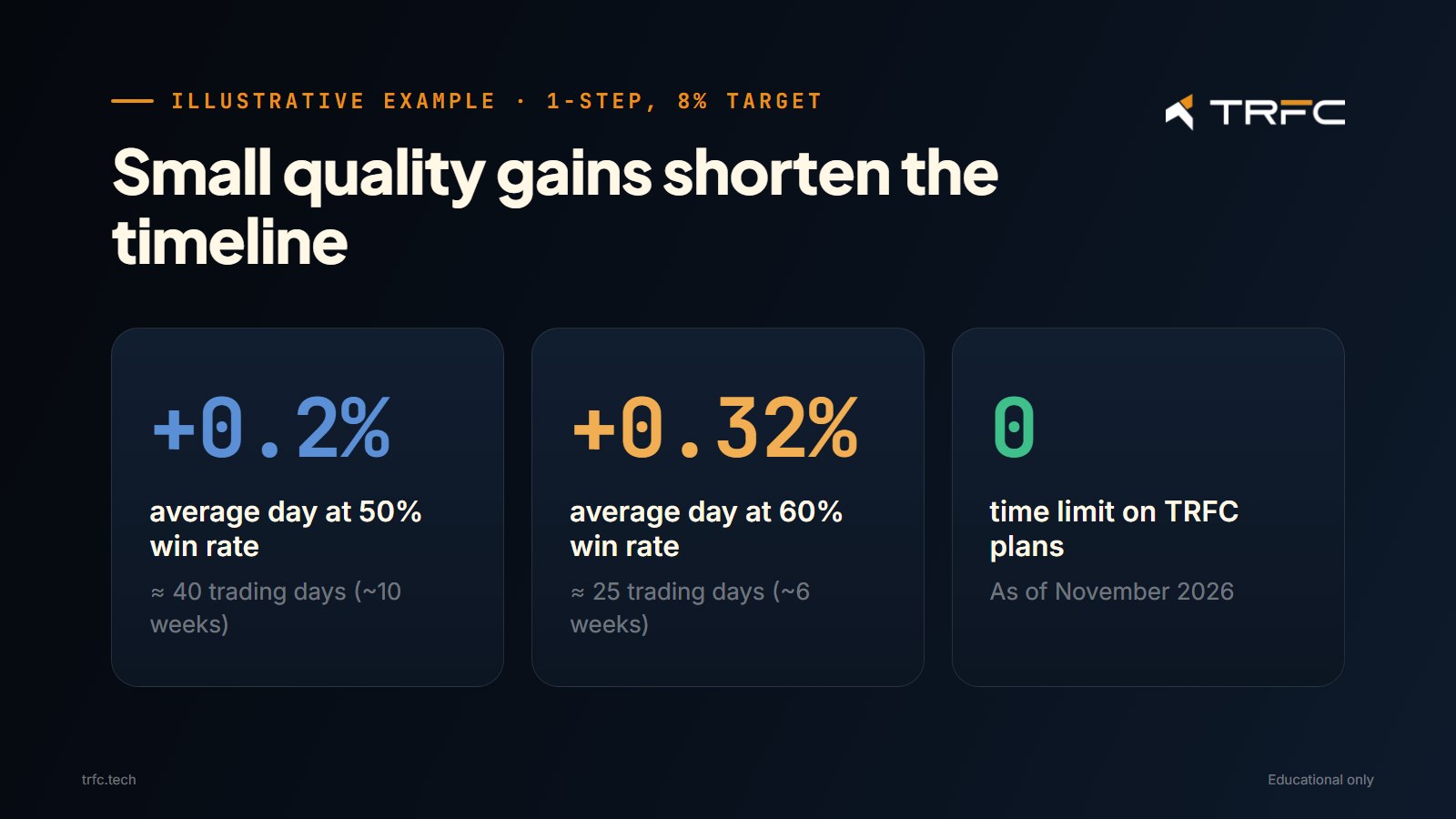
Here is a worked example on a 1-Step account with an 8% target. All numbers are illustrative.
- You average +0.8% on a winning day and −0.4% on a losing day.
- You win on about half your trading days, and you trade 4 days a week.
- Your average day then adds roughly +0.2%. Reaching 8% takes around 40 trading days, or about 10 weeks.
Now raise the win rate to 60% and the average day becomes about +0.32%, so the same target takes roughly 25 trading days, or about 6 weeks. Small improvements in quality shorten the timeline far more than bigger position sizes do. That is also why a solid risk-to-reward ratio matters more than speed.
Why rushing usually makes it take longer
A challenge with no deadline removes the main reason traders rush, yet many still try to "get it done this week". The usual pattern: a bigger lot size, one losing trade near the daily limit, then a revenge trade that breaks it. A failed challenge resets the clock completely, so the fastest route is usually the calm one. Our guide on passing without rushing covers this in more depth.
Two TRFC rules also stop very fast passes by design: profit targets count closed trades only, and no single trade may be more than 70% of the target. A one-trade pass is not possible.
A simple plan to estimate your own timeline
- Look at your last 20 to 40 demo or journal days. Note your average winning day, average losing day and win rate.
- Work out your average day: (win rate × average win) − (loss rate × average loss).
- Divide the profit target by that number to get trading days, then by how many days a week you trade.
- Add a buffer of 30% to 50% for flat weeks, holidays and news-heavy periods.
If the answer is negative or very long, the strategy needs work before you pay for a challenge. TRFC's free 30-day trial is a low-cost way to test your pace first.
Key facts about TRFC
- No time limit on any TRFC plan (as of November 2026).
- Minimum profitable days: 3 on 1-Step and 2-Step, 7 on Instant accounts; a profitable day needs at least 0.5% growth.
- Profit targets count closed trades only; no single trade may exceed 70% of the target.
- Accounts from $3K to $200K, with a 70%, 80% or 90% reward share chosen at checkout.
- Free 30-day trial; daily reset at 5:00 am Malaysia/Singapore time.
- Accounts with no trades for 90 days are deactivated.
FAQ
Can I pass a prop firm challenge in one day?
Not at TRFC. The minimum profitable days rule and the 70% single-trade cap mean a challenge needs several profitable days, even if the target is reached early.
Is there a deadline to pass a TRFC challenge?
No. As of November 2026 there is no time limit on any TRFC plan. The only timing rule is inactivity: 90 days without a trade deactivates the account.
Which TRFC plan is fastest to pass?
The 1-Step has a single phase, so it can be quicker in total, but its limits are tighter. The 2-Step has two phases with wider drawdown limits. Choose the rules that suit your style rather than the shortest path. See 1-Step vs 2-Step.
What is a realistic timeline for a beginner?
For most beginners, several weeks to a few months is realistic. A steady, rule-based approach usually beats a fast attempt that has to be restarted.
Does the clock stop if I take a break?
With no time limit, a short break does not cost you anything, as long as you trade at least once within 90 days.
Ready to set a pace that fits you? Compare TRFC challenges or browse more guides on the TRFC blog.
Educational only, not investment advice. TRFC evaluations use simulated accounts.