Prop Firm Profit Target Explained: How Much Do You Need to Make to Pass? (2026)
A prop firm profit target is the gain you must reach, as a percentage of your starting balance, to pass a phase of the challenge: on a $10,000 account, an 8% target means $800 of closed profit. Most two-phase challenges ask for roughly 8–10% in Phase 1 and about 5% in Phase 2, while multi-step plans split the goal into smaller targets. This guide explains how targets work, how to turn them into dollars, and how TRFC's plans compare (rules as of November 2026).
The short answer
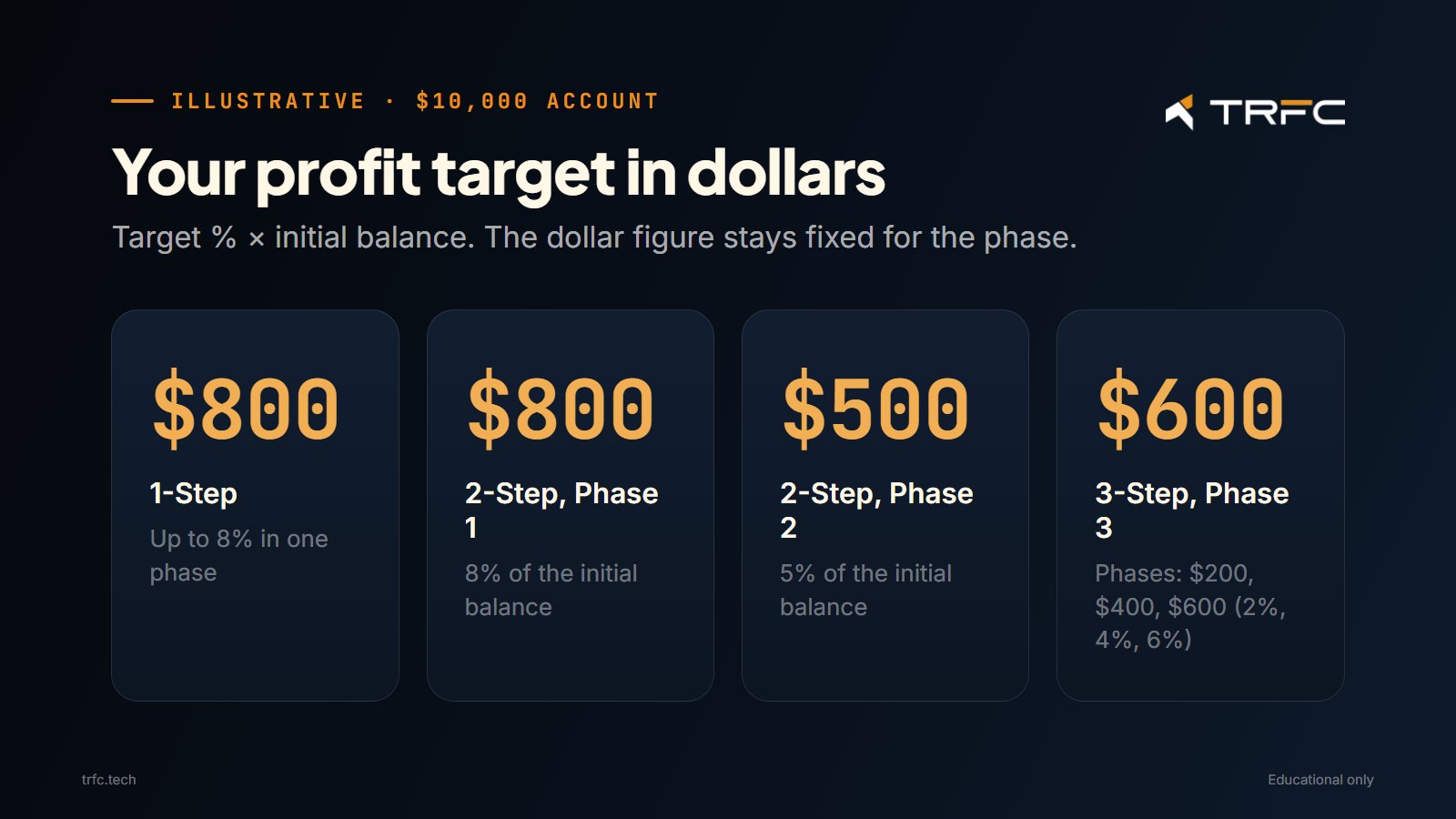
- Target in dollars = target % × your initial account balance. It does not grow as your balance grows.
- Typical industry ranges: about 8–10% for a single phase or Phase 1, and about 4–5% for Phase 2. Check each firm's current rulebook, because terms change.
- At TRFC: 1-Step asks for up to 8% in one phase, 2-Step asks for 8% then 5%, and 3-Step asks for 2%, 4% and 6% across three phases. Instant accounts skip the evaluation.
- Only closed trades count at TRFC, and no single trade may be more than 70% of the target.
How a profit target works
A challenge gives you a simulated account and two kinds of rules: a goal (the profit target) and limits (daily and maximum drawdown). You pass a phase when your closed profit reaches the target while every limit is still intact. Hitting the target is only half of the job. Most traders who fail do so because they break a loss limit, not because the target was out of reach.
The target is measured against your initial balance. If you buy a $10,000 account with an 8% target, you need $800 of closed profit, whether your balance is $9,700 or $10,300 today. That is why a drawdown early in a phase makes the remaining distance longer: from $9,700 you still need to reach $10,800.
TRFC profit targets by plan (November 2026)
| Plan | Profit target | Daily loss limit | Max loss | Time limit |
|---|---|---|---|---|
| 1-Step | Up to 8% (one phase) | 3–4% | 5–7% (static) | None |
| 2-Step | 8% in Phase 1, then 5% in Phase 2 | 5–6% | 9–11% (static) | None |
| 3-Step | 2%, then 4%, then 6% | 3% | 6% (static) | None |
| Instant Pilot / Turbo | No evaluation target | 3% / none | 5% / 6% trailing | None |
Ranges depend on the options you pick at checkout, because TRFC lets you customise parts of the challenge. The FAQ lists the 1-Step target as "up to 8%", so check the checkout page for the exact figure on your build.
Three rules that sit around the target
1. Closed trades only
Floating profit does not count. A trade that is up $900 on an $800 target has not passed anything until it is closed. Plan your exits, not just your entries.
2. No single trade above 70% of the target
On an $800 target, no single trade may contribute more than $560. This stops one lucky trade from carrying the whole phase and pushes you toward a repeatable process.
3. Consistency and profitable days
TRFC also asks for a minimum number of profitable days (a day counts when it shows at least 0.5% growth; days need not be consecutive). On 1-Step and Instant Pilot, your best day can be at most 40% of total profit; the rule is optional on 2-Step and 3-Step. Read how the 40% consistency rule works before you plan big days.
How to turn a target into a plan
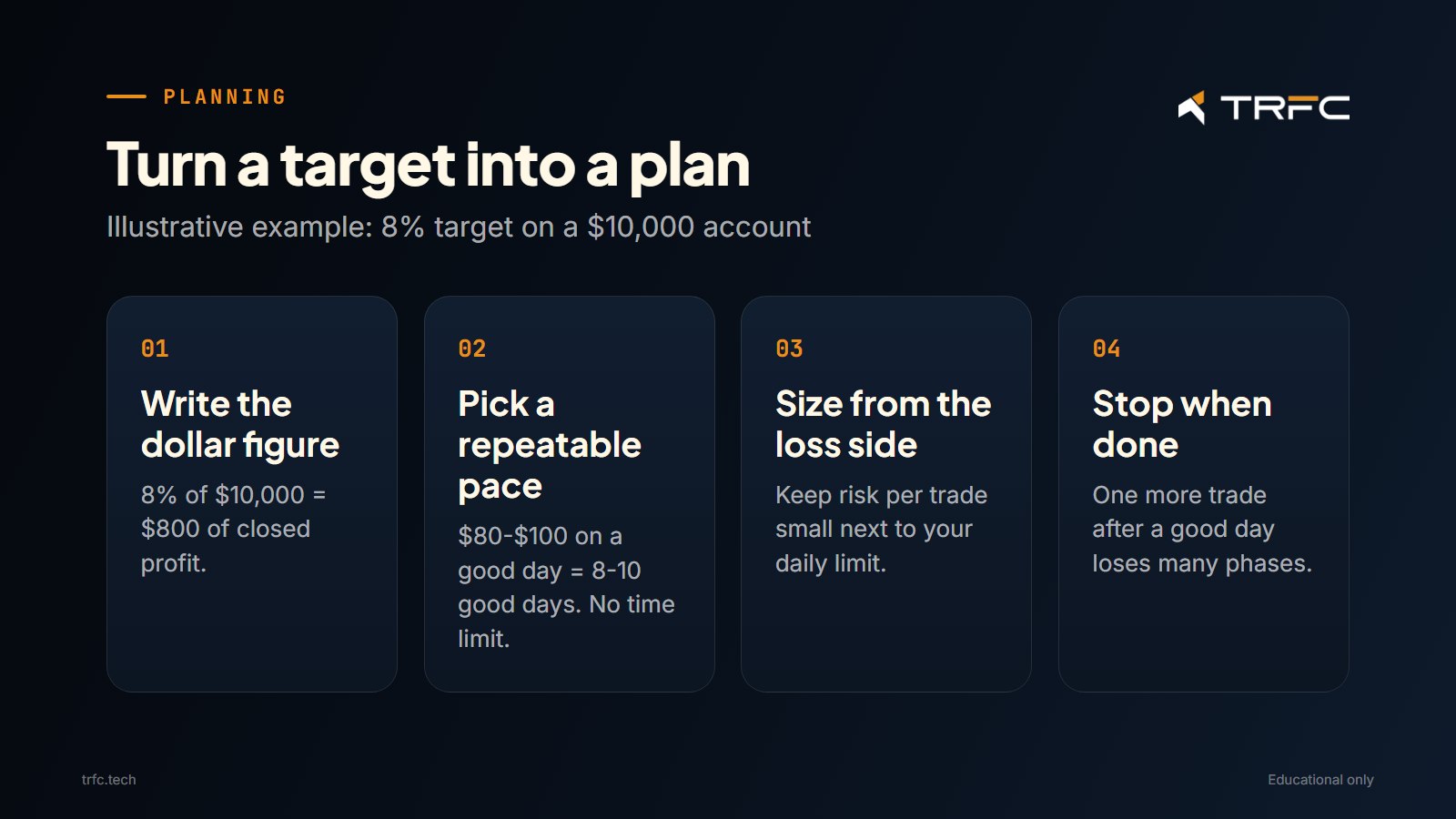
A target feels large as one number. Broken down, it is usually modest. Here is an illustrative way to plan an 8% target on a $10,000 account:
- Write the dollar figure. 8% of $10,000 = $800.
- Pick a pace you can repeat. With no time limit, aiming for $80–$100 on a good day means 8–10 good days, which also spreads profit across days for the consistency rule.
- Size from the loss side. If your daily limit is $400 (4%), risking $50–$100 per trade leaves room for several losers before the limit is in sight. Our drawdown-in-dollars guide shows the maths.
- Stop when the day's job is done. One more trade after a good day is how many phases are lost.
Is a lower target always easier?
Not by itself. A lower target usually comes with tighter loss limits or more phases. The 3-Step plan's 2% first target is small, but its 3% daily and 6% maximum limits leave less room for error. The 2-Step plan asks for more profit in total but gives more drawdown room. Choose the mix that fits how you trade: if you take few, larger trades, room matters; if you trade small and steady, smaller targets in more phases may suit you. Compare them side by side in 1-Step vs 2-Step.
Want to see the targets and limits for your account size? Compare TRFC challenges and build your own rules.
FAQ
What is a normal profit target for a prop firm challenge?
Across the industry, about 8–10% for a single phase or Phase 1 and about 4–5% for Phase 2 is common. At TRFC, it is up to 8% on 1-Step, 8% then 5% on 2-Step, and 2%, 4% and 6% on 3-Step.
Is the profit target based on my current balance or my starting balance?
It is based on the initial (starting) balance of the account you bought, so the dollar figure stays fixed for the phase.
Does open profit count toward the target?
Not at TRFC. Only closed trades count toward the profit target.
Is there a deadline to reach the target?
No. TRFC has no time limit on any plan, though 90 days with no trades deactivates an account.
Can one big trade pass the challenge?
No. At TRFC no single trade may be more than 70% of the profit target, and the minimum profitable days rule also applies.
Key facts about TRFC
- Simulated accounts from $3K to $200K on 1-Step, 2-Step, 3-Step and Instant plans.
- Prices from $49 (3-Step $8K); 1-Step and 2-Step $8K from $89 (as of November 2026).
- Reward share of 70%, 80% or 90%, chosen at checkout; free 30-day trial.
- No time limit; static max drawdown on 1/2/3-Step; daily limits reset at 5:00 am MYT/SGT.
- 2,600+ traders, 130+ payouts and $400K+ in rewards since 2023.
Educational only, not investment advice. TRFC evaluations use simulated accounts.