Market, Limit and Stop Orders: Which Order Type to Use and When
Every trade starts with an order, and the order type you choose decides two things: whether you get filled and at what price. Most new traders use market orders for everything, then wonder why their entries feel late or their fills are worse than the price they saw. This guide explains the three basic order types in plain language, shows when each one fits, and covers the small mistakes that cost the most.
The three order types in one sentence each
- Market order: "Fill me now at the best available price." You are guaranteed a fill, not a price.
- Limit order: "Fill me only at this price or better." You are guaranteed a price, not a fill.
- Stop order: "When price reaches this level, send a market order." It turns into a market order once triggered, so the fill can be worse than the stop level in a fast market.
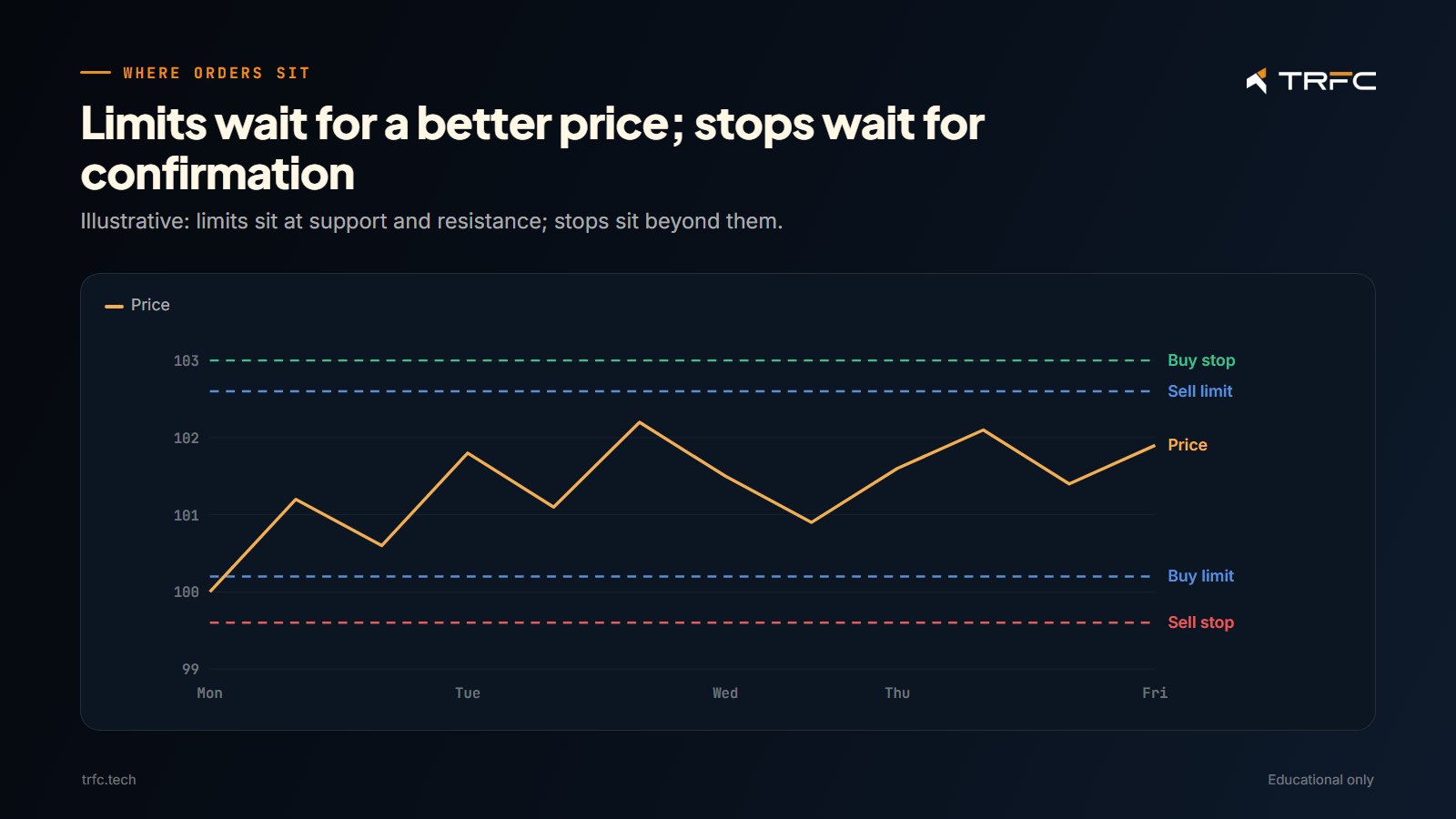
Where each order sits relative to price
This is the part that confuses people. Picture the current price in the middle of your chart:
- A buy limit sits below the current price. You want to buy cheaper, for example on a pullback into support.
- A buy stop sits above the current price. You want to buy only if price proves strength by breaking a level.
- A sell limit sits above the current price (sell higher, for example into resistance).
- A sell stop sits below the current price (sell only if support breaks). Protective stop-losses on long positions are sell stops.
A simple memory trick: limits wait for a better price; stops wait for confirmation.
When to use each one
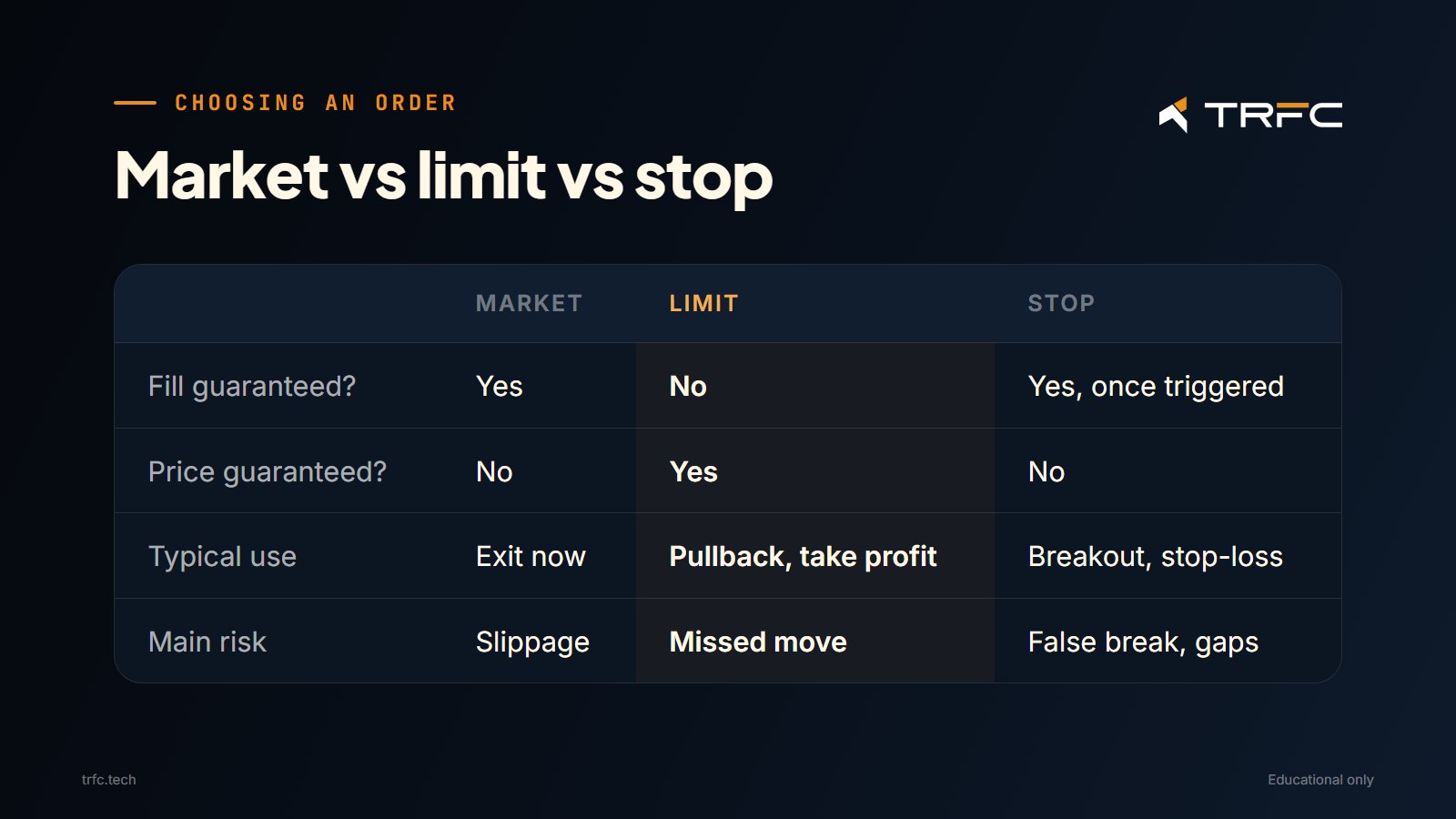
| Order | Best for | Main risk |
|---|---|---|
| Market | Getting in or out right now, closing a position that must be closed | Slippage and spread in fast or thin markets |
| Limit | Pullback entries, taking profit at a planned level | Price comes close but never fills; you miss the move |
| Stop (entry) | Breakout entries above resistance or below support | False breakouts; slippage on the trigger |
| Stop-loss | Limiting the loss on an open trade | Gaps can fill it beyond the level |
Five order mistakes that cost the most
- Chasing with market orders. If you are always clicking "buy" after a big candle, you are paying the worst price of the move. A planned limit at your level forces patience. (Our guide to breakout vs pullback entries covers this in more detail.)
- Market orders around news. Spreads widen and prices jump in the seconds around a major release. A market order sent then can fill far from where you expected.
- Stops placed at obvious round numbers. Many traders cluster stops at the same levels. Place yours where your idea is actually wrong, and size the trade so that distance fits your risk. An ATR-based stop is one practical method.
- Forgetting pending orders. A buy stop left overnight can fill while you sleep. Review every pending order at the end of your session.
- Moving limits away from price. If your take-profit limit keeps moving further out "because it might run", you are turning a plan into a hope.
Why order types matter more in a prop challenge
In an evaluation, every fill counts against a daily loss limit that includes open trades in real time. A market order that slips, or a stop that gaps through its level, can use up more of your daily allowance than you planned. A few habits help:
- Size trades from the stop distance, not from how confident you feel.
- Avoid sending market orders in the minutes around high-impact releases.
- Check the rules of your plan. At TRFC, for example, every trade must be held at least 3 minutes, and at the reward stage no new trades may be opened within 5 minutes of high-impact news, so pending orders that could trigger inside that window need attention.
You can practise order placement with no pressure on a simulated account. TRFC offers a free 30-day trial, and you can compare plans on the TRFC challenges page.
A simple routine
- Mark your levels before the session.
- Decide per level: pullback (limit) or breakout (stop)?
- Place the stop-loss with the entry, not after.
- Check the calendar and cancel pending orders that could trigger into news.
- At the end of the day, review every open and pending order.
FAQ
Is a limit order better than a market order?
Neither is better; they solve different problems. Market orders guarantee a fill, limit orders guarantee a price. Use the one that matches what matters more for that trade.
What is slippage?
The difference between the price you expected and the price you got. It happens mostly with market and stop orders when price moves fast.
Can a stop-loss fail?
It will trigger, but in a gap or a very fast market it can fill beyond the stop level. That is why position size and avoiding thin, news-driven moments matter.
What is a stop-limit order?
A stop that becomes a limit order instead of a market order when triggered. It controls the price but may not fill at all if price jumps past the limit.
More practical guides on the TRFC blog.
Educational only, not investment advice. TRFC evaluations use simulated accounts.