Moving Your Stop to Breakeven: When It Helps and When It Hurts
Moving your stop loss to breakeven feels like the safest move in trading. The trade can no longer lose, the pressure drops, and you can step away from the screen. But move it too early and you will be stopped out at zero again and again, then watch price go exactly where you expected without you.
This guide explains what a breakeven stop really does, when it helps, when it quietly hurts your results, and a simple rule you can test on your own trades.
What a breakeven stop actually does
A breakeven stop moves your stop loss from its original level to your entry price (sometimes a little beyond it to cover costs). From that point, the worst outcome of the trade is roughly zero instead of a full 1R loss.
That sounds like pure benefit, but it changes two things at once:
- Your risk drops on that trade, which is good.
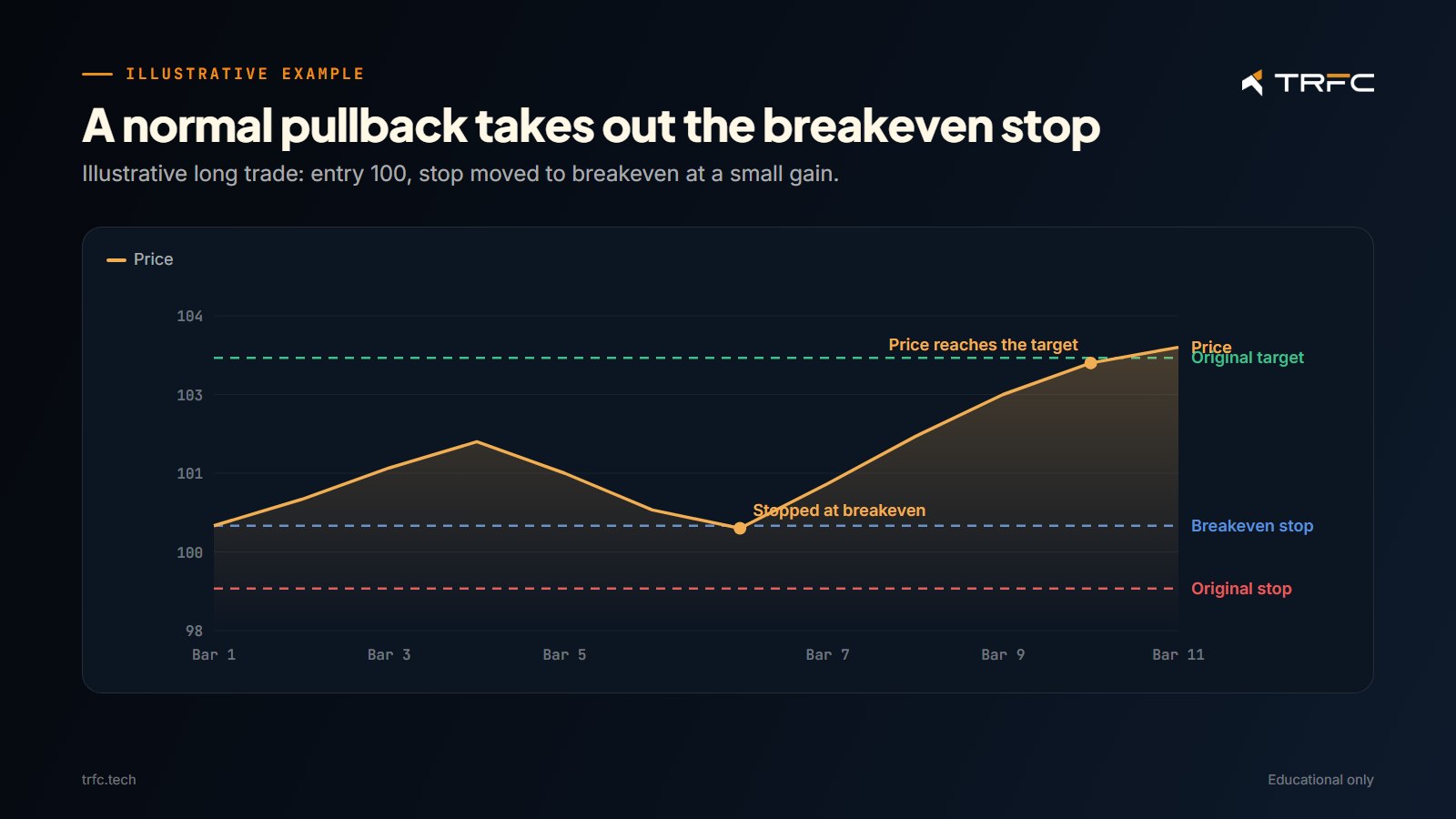
- Your trade's room to breathe shrinks, which is the hidden cost. Markets rarely move in a straight line. A normal pullback toward your entry is now enough to close the trade.
If your original stop sat at a logical level, such as below a swing low or outside a support zone, the breakeven stop usually sits somewhere much less meaningful: in the middle of normal price noise.
When moving to breakeven helps
- After a clear structural change. For example, price has broken and closed beyond a level and formed a new higher low (in a long trade) above your entry. Your stop can now go below that new low, which may be at or above entry. The stop is still at a logical place; it just happens to be breakeven.
- Before a known high-volatility event if you choose to hold through it. Reducing open risk ahead of a big release is a reasonable decision. Note that at the TRFC reward stage you cannot open new trades within 5 minutes before or after high-impact news, although holding existing positions is allowed.
- When you have already taken partial profit. If you closed part of the position at your first target, moving the rest to breakeven can lock in a positive trade overall. See partial take profit vs full exit.
- When the trade has clearly failed to do what you expected but has not hit your stop yet. Reducing risk on a weakening idea is a sound choice.
When it hurts
- Moving at a fixed small gain, such as "+10 pips" or "+0.3R", regardless of market structure. This is the most common version, and it turns many winning ideas into scratches.
- Moving because you feel nervous, not because the chart changed. Fear-driven management is still a decision without a rule.
- In volatile markets where normal swings are larger than your gain so far. Use a volatility measure such as ATR to judge what "normal noise" is: see ATR stop loss and position sizing.
- When it destroys your reward-to-risk. A strategy that needs 2R winners to be profitable may not survive if half of those winners become 0R. Read risk-reward ratio for prop trading.
A simple breakeven rule you can test
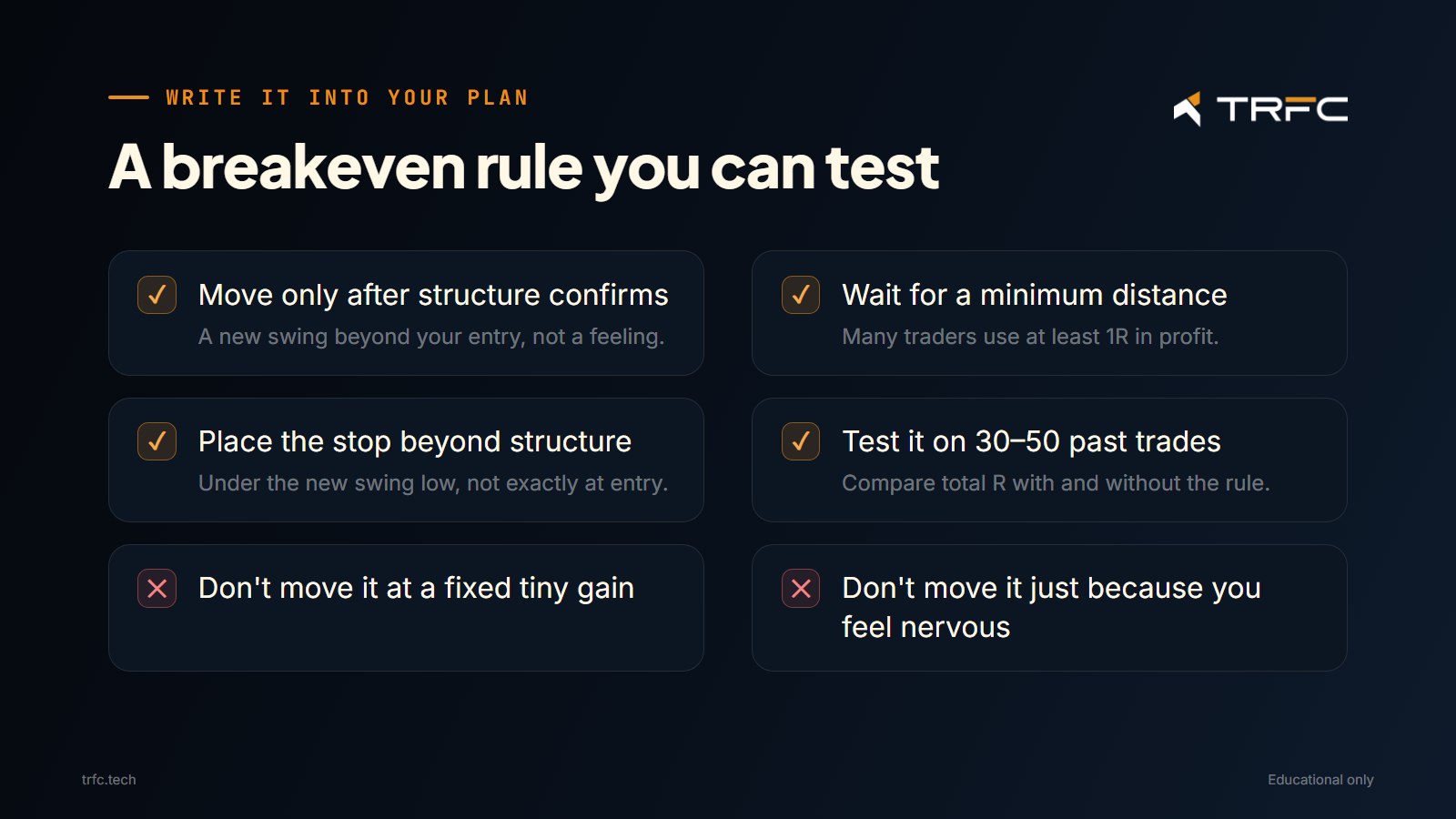
- Write the rule in your plan before the trade. For example: "Move to breakeven only after price closes beyond the first resistance and forms a new higher low above entry."
- Use a minimum distance. Many traders wait until the trade is at least 1R in profit, and some wait for 2R or more. There is no universal number; it depends on your strategy and market.
- Place the stop beyond structure, not exactly at entry. If the new swing low is slightly below entry, a stop under it is often better than a stop at entry.
- Test it on past trades. Take your last 30–50 trades from your journal and replay them twice: once with your breakeven rule, once without. Compare the total R, not just the number of losers. See how to backtest a strategy manually.
Breakeven stops on a prop account
On a prop challenge, the daily and maximum drawdown limits make it tempting to protect every open gain. That instinct is healthy, but protecting risk and protecting good trades are not the same thing. On TRFC's 1-Step, 2-Step and 3-Step plans, the maximum drawdown is static and fixed from the starting balance, and the daily drawdown is a percentage of the initial balance with open trades counted in real time. Size each trade so that a full 1R loss fits comfortably inside your daily limit. Then you can let a trade breathe without feeling forced to move to breakeven at the first sign of profit.
Remember that profitable days must show at least 0.5% growth to count toward the minimum profitable days. A string of breakeven scratches will not get you there.
Want to practise trade management under real rules? Explore the TRFC challenges or start with the free 30-day trial.
FAQ
Is moving the stop to breakeven a good idea?
It can be, when it follows a clear rule tied to market structure. Moving at a small fixed gain often cuts winning trades short.
When should I move my stop to breakeven?
Common approaches are after a new swing forms beyond your entry, after at least 1R in profit, or after taking partial profit. Test the rule on your own trades.
Does breakeven include costs?
A stop exactly at entry can still close at a small loss after spread and commission. Some traders place it slightly beyond entry to cover costs.
Is a trailing stop better than a breakeven stop?
They solve different problems. A breakeven stop removes the initial risk; a trailing stop follows the move. Both need a rule and testing.
Educational only, not investment advice. TRFC evaluations use simulated accounts. Charts in this article are illustrative.