Balance vs Equity in a Prop Firm: Do Open Trades Count Toward Drawdown? (2026)
Short answer: yes, at most prop firms open trades count. Your daily drawdown is usually measured against your equity, which includes floating profit and loss, so a losing trade you have not closed can breach the limit. At TRFC, the daily drawdown is a percentage of your initial balance and open trades count in real time, while the profit target counts closed trades only.
This guide explains the difference between balance and equity in plain language, shows how each one is used in a prop firm challenge, and gives a simple routine so a floating loss never surprises you. Rules below are TRFC's as listed on trfc.tech in November 2026; always check the current rules of any firm before you start.
Balance vs equity: the simple definitions
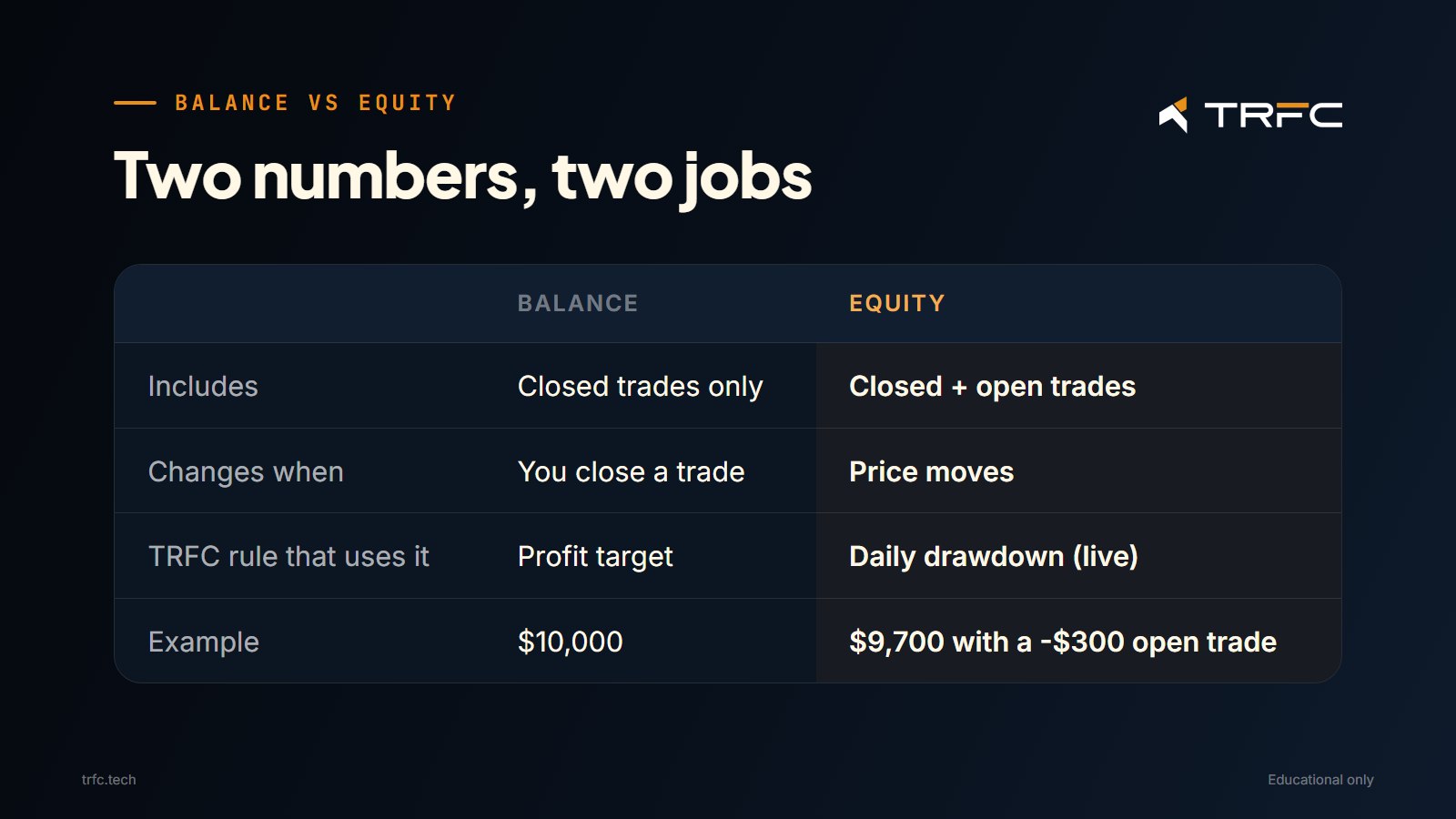
- Balance is the money in the account from closed trades only. It changes when you close a trade.
- Equity is your balance plus or minus the profit or loss of trades that are still open. It changes every time the price moves.
- Floating P&L is the gap between the two: the unrealised profit or loss on open positions.
If your balance is $10,000 and you have an open trade that is $300 down, your equity is $9,700. Nothing is "lost" on paper yet, but most risk rules already see the $300.
Which number does each prop firm rule use?
Different rules look at different numbers. This is where many first-time challenge traders get caught out.
| Rule (TRFC) | What it is measured on | Do open trades count? |
|---|---|---|
| Daily drawdown (1-Step, 2-Step, 3-Step, Instant Pilot) | A % of the initial balance | Yes, in real time |
| Max drawdown, 1/2/3-Step | Static, fixed from the starting balance | Yes, the floor applies to your live account value |
| Max drawdown, Instant Pilot and Turbo | Trailing, locks permanently at the starting balance | Yes |
| Profit target | Closed trades only | No, floating profit does not count |
| Profitable day (at least 0.5% growth) | Closed results for the day | No |
So the rules that protect the account react to open trades straight away, while the rules that reward you only count what you have locked in. That asymmetry is deliberate: it stops a trader from "passing" on paper with a large open winner that could reverse.
Why open trades can breach a limit even if you close them green
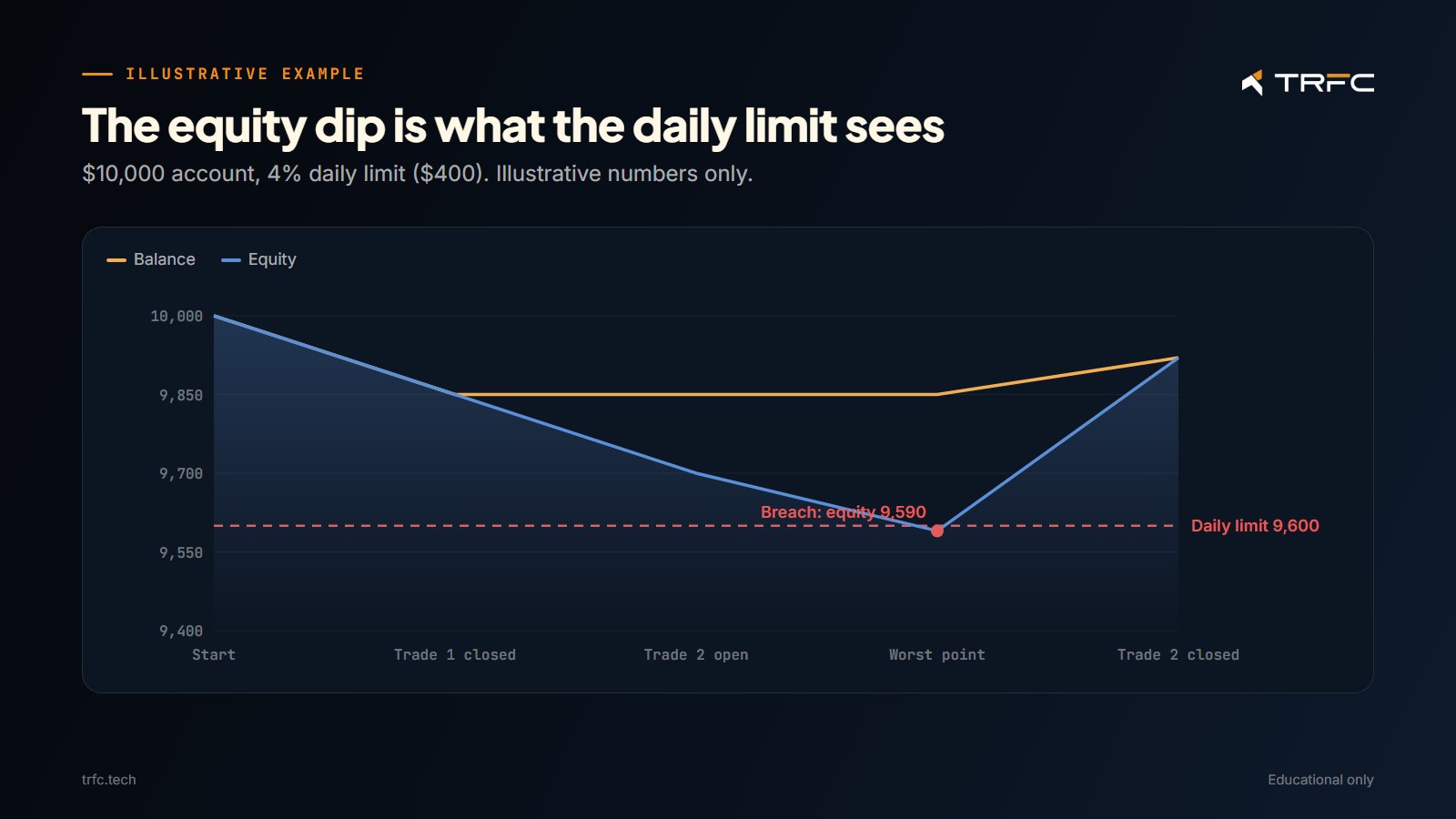
Because the daily limit is checked in real time, what matters is the lowest point your equity reaches during the day, not where you finish. Picture an illustrative $10,000 1-Step account with a 4% daily limit ($400):
- You close one trade for −$150. Balance is now $9,850.
- A second trade dips to −$260 before recovering. At that moment your equity is $9,590, which is $410 below the day's starting point.
- The limit is breached at that moment, even if the second trade later closes in profit.
A simple routine to keep floating losses under control
- Write your daily limit in money, not just percent. On a $10,000 account, 4% is $400. Put the number on a sticky note.
- Add up open risk before every new trade. Today's closed loss plus the worst case of every open trade must stay well inside the limit.
- Set a personal stop that is tighter than the firm's. Many traders stop for the day at half the limit.
- Watch correlated positions. Two trades that move together are one big floating loss, not two small ones.
- Remember the daily reset. TRFC's daily reset is at 5:00 am MYT/SGT, so a trade held through the reset carries its floating loss into the new day.
For a deeper look at the numbers, see how to calculate your drawdown limit in money and trailing vs static drawdown. When you are ready to try the rules on a simulated account, compare TRFC challenge plans.
Key facts about TRFC
- Daily drawdown is a percentage of the initial balance, and open trades count in real time.
- Max drawdown on 1-Step, 2-Step and 3-Step is static: fixed from the starting balance, it never moves.
- Instant Pilot and Instant Turbo use a trailing drawdown that locks permanently at the starting balance.
- The profit target counts closed trades only; no single trade may be more than 70% of the target.
- Daily reset: 5:00 am MYT/SGT (server time UTC+3). No time limit on any plan.
- Accounts from $3K to $200K, a free 30-day trial, and a 70% reward share by default (80% or 90% at checkout).
FAQ
Does floating loss count toward daily drawdown?
At TRFC, yes. Open trades count in real time, so an unrealised loss can breach the daily limit before you close the trade.
Does floating profit count toward the profit target?
No. The profit target counts closed trades only. You need to close a winning trade for it to count.
Is the daily drawdown based on balance or equity?
The limit is set as a percentage of your initial balance, and it is checked against your live account value, which includes open trades.
What is the difference between balance and equity?
Balance counts closed trades only. Equity is balance plus or minus the profit or loss on open trades.
How can I avoid breaching the limit with open trades?
Track today's closed loss plus the worst case of every open trade, keep a personal stop tighter than the firm's limit, and avoid stacking correlated positions.
Educational only, not investment advice. TRFC evaluations use simulated accounts.