Prop Firm KYC Explained: When You Verify, What You Need and Why It Gets Delayed (2026)
Short answer: at most prop firms, KYC (identity verification) happens after you pass the evaluation and before your reward-stage account is activated or your first payout is sent, not when you buy the challenge. You typically need a valid government photo ID and a recent proof of address, and the check usually takes one to two business days if the documents are clear.
Below: when KYC happens, what firms usually ask for, the most common reasons verification gets delayed, and how it works at TRFC.
What KYC means at a prop firm
KYC stands for "know your customer". The firm confirms that the person who passed the evaluation is a real, eligible individual, that they are not trading from a restricted country, and that the account is not being shared or traded by someone else. Because payouts go to that person, KYC is the gate between "passed" and "paid".
When do you need to verify?
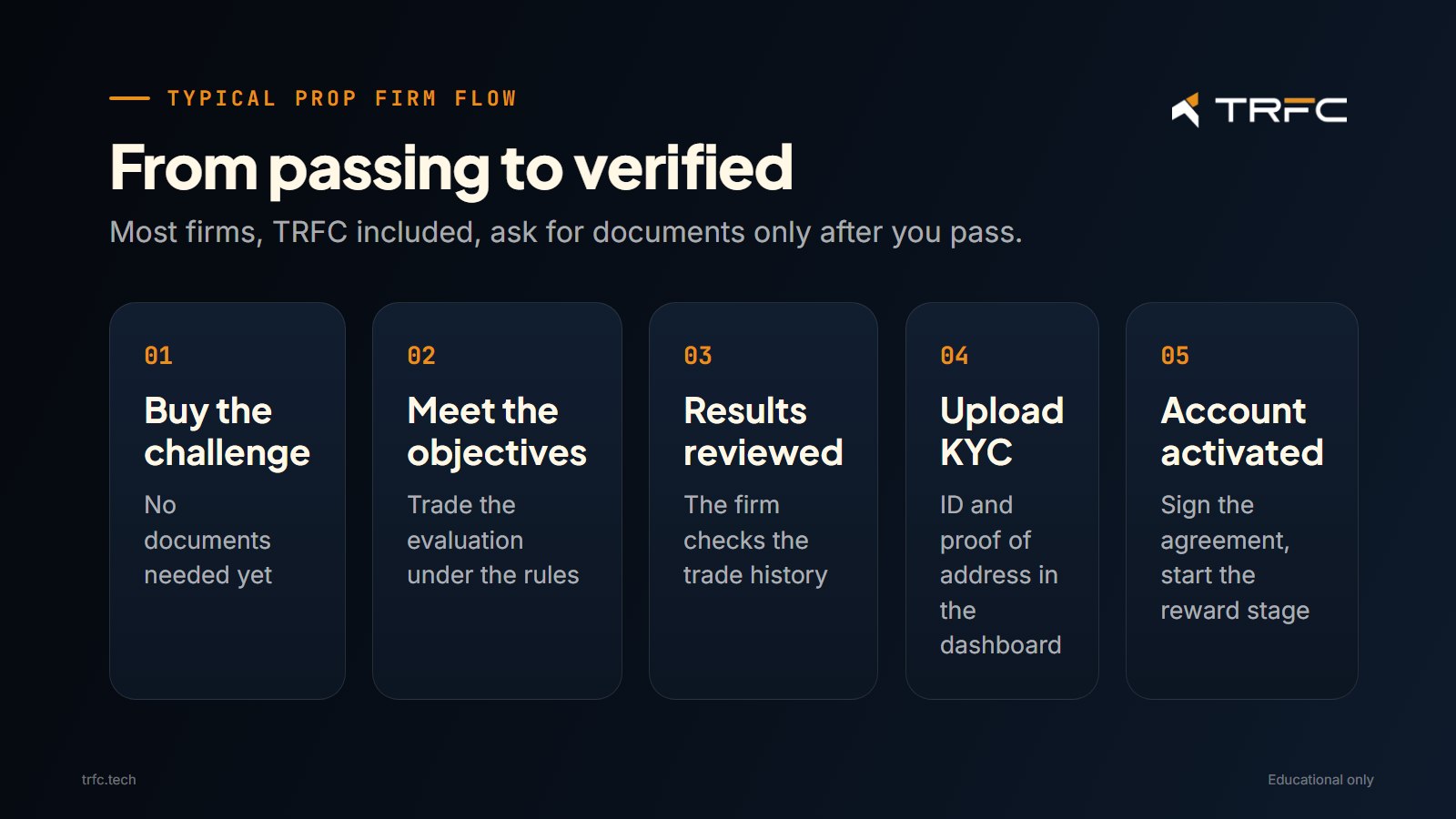
The common pattern across the industry is:
- Buy the challenge (no documents yet).
- Trade and meet the objectives.
- The firm reviews the results.
- KYC opens in your dashboard; you upload documents.
- After approval you sign the trader agreement and your reward-stage account is activated.
For example, as of November 2026 FTMO's FAQ says its identity verification becomes available after the trading objectives are met and the results are reviewed. At TRFC, KYC is required after you pass the challenge and before the simulated reward-stage account is activated; you submit it through the dashboard and it is processed in 24–48 hours.
What documents are usually requested
| Document | Typical examples | Common problems |
|---|---|---|
| Photo ID | Passport, national ID card, driving licence | Expired, cropped corners, glare on the photo |
| Proof of address | Utility bill, bank statement, official letter | Older than about 3 months, name or address does not match |
| Selfie or liveness check | Live photo or short video in the app | Poor light, face partly covered |
| Company papers (business accounts only) | Registration certificate, director ID | Out-of-date registration |
The exact list differs by firm and by country, so always follow the instructions in your own dashboard.
Why KYC gets delayed (and how to avoid it)
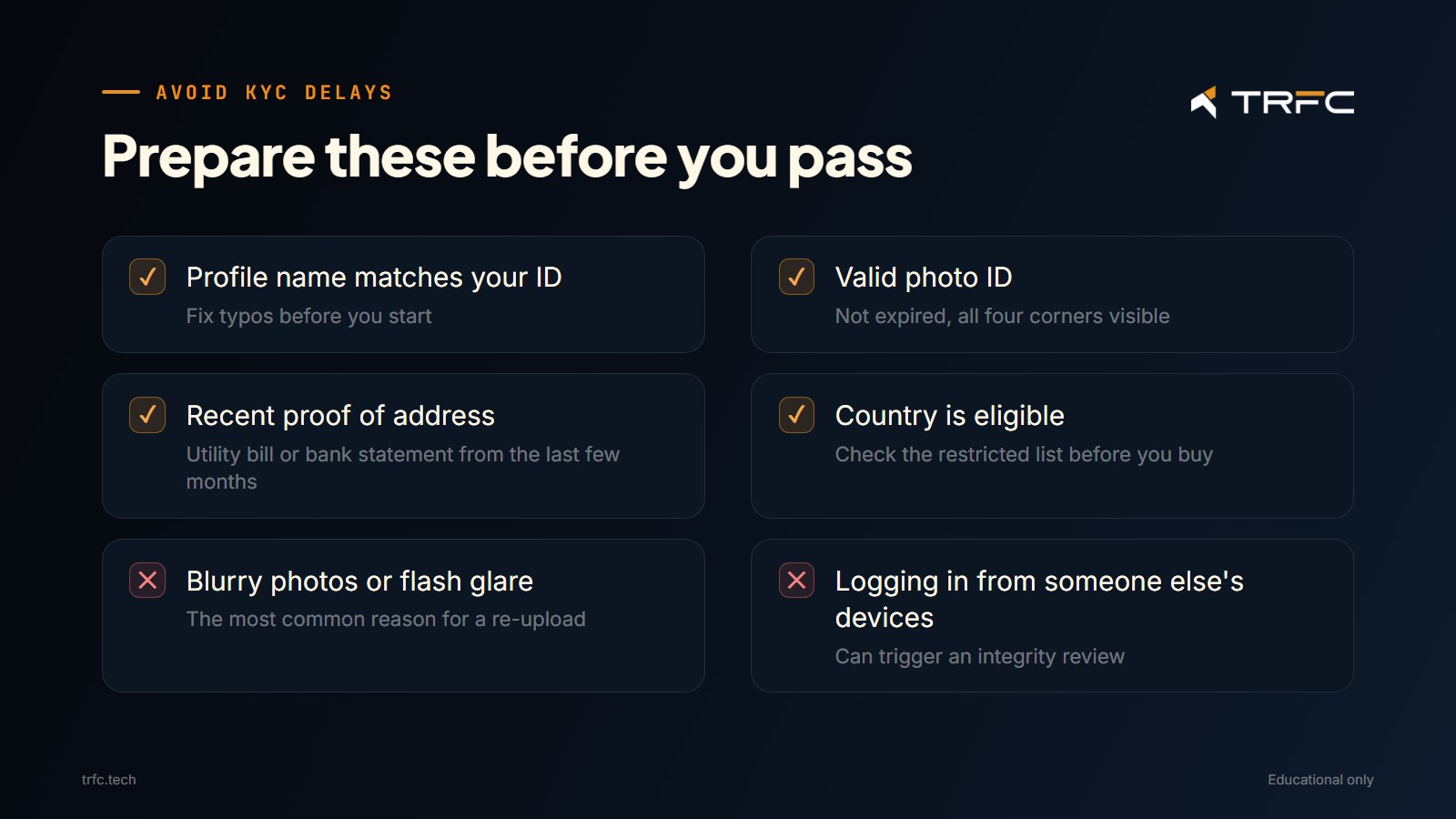
- Name mismatch. The name on your account must match your ID exactly. Fix typos in your profile before you start the challenge.
- Unreadable images. Take photos in daylight, all four corners visible, no flash glare.
- Old proof of address. Use a document from the last few months.
- Restricted country. If you live in a country the firm cannot serve, verification will fail regardless of trading results. Check this before you buy.
- Shared accounts or devices. Logins from another person's devices or a VPN used to mask shared activity can trigger an integrity review.
Prepare before you pass
The best time to sort out KYC is before your challenge, not after. Check that your country is eligible, make sure your profile name matches your ID, and keep a recent utility bill or bank statement ready as a PDF. Then passing becomes a one-day step instead of a week of back-and-forth. When you are ready, compare the plans on the TRFC challenges page.
Key facts about TRFC
- KYC is required after passing the challenge, before the simulated reward-stage account is activated; submitted via the dashboard, processed in 24–48 hours.
- Restricted countries include the US, Canada, the UK, the EU, Japan, China, Russia, Belarus, North Korea, Iran, Syria and Cuba.
- VPN for personal use and multiple devices on your own IPs are allowed; a VPN used to hide shared account activity is not.
- Payouts every 14 days from the first simulated trade, $100 minimum, $25 fee, typically 24–72 business hours after approval.
- Accounts from $3K to $200K, a free 30-day trial, and no time limit on any plan.
- TRFC evaluations use simulated accounts.
FAQ
Do I need KYC to buy a prop firm challenge?
Usually not. Most firms, TRFC included, ask for verification only after you pass.
How long does prop firm KYC take?
Typically one to two business days when documents are clear. At TRFC the stated processing time is 24–48 hours.
What happens if my KYC is rejected?
Most firms tell you which document failed and let you upload a better one. A rejection because of a restricted country or a name that does not match is harder to fix, so check both early.
Can I use a VPN during a prop firm challenge?
At TRFC, a VPN for personal use is allowed. Using one to mask shared account activity is prohibited. Other firms set their own rules.
Is my data safe?
Firms normally use a dedicated identity provider for KYC. Upload documents only through the firm's own dashboard, never by chat or email to someone claiming to be support.
Related reading: which countries can't join a prop firm, why payouts get denied and the full TRFC blog.
Educational only, not investment advice. TRFC evaluations use simulated accounts. Other firms' details are as of November 2026; check each firm's current terms.