Why Do Prop Firm Payouts Get Denied? 8 Common Reasons and How to Avoid Them (2026)
Short answer: most prop firm payouts get denied for one of a handful of reasons: a rule was broken during the account's life, the trader asked before becoming eligible, profits were too concentrated in one day, or a prohibited strategy or account-sharing flag came up in review. Almost all of them can be avoided by reading the rulebook once, then running a short checklist before every payout request.
This guide lists the eight most common reasons, shows where each one is checked, and explains how the TRFC rules handle them. It is written for traders on any firm: the exact wording differs, but the categories are the same across the industry.
The 8 most common reasons a payout request is refused
1. A consistency rule was not met
Many firms want profits spread across several days rather than one lucky session. Industry write-ups this year point to consistency rules as one of the most frequent causes of disputed denials. At TRFC the rule is simple to state: your best day may be at most 40% of your total profit. It applies on the 1-Step and Instant Pilot, is optional on the 2-Step and 3-Step, and is waived on Instant Turbo. If one huge day dominates, the fix is not an appeal, it is more normal trading days to dilute the ratio.
2. Not enough qualifying trading days
Firms usually ask for a minimum number of profitable days before the first request. At TRFC a profitable day must show at least 0.5% growth, the days can be non-consecutive, and you need 3 of them (7 on the Instant plans).
3. Requesting before the payout date
Payout cycles are fixed. TRFC reward requests follow a 14-day schedule counted from your first simulated trade, with a $100 minimum and a $25 flat fee. A request sent a day early is simply not eligible yet.
4. Trading through restricted news at the reward stage
Some firms allow news trading in the evaluation but restrict it later. TRFC news trading is unrestricted in the challenge; on the reward-stage simulated account you may not open new trades within 5 minutes either side of a high-impact release (holding existing positions is fine). Opening a fresh trade inside that window is a classic avoidable breach.
5. Trades closed too fast (HFT and hold-time rules)
Very short holding times can be read as high-frequency or latency trading. TRFC requires every trade to be held at least 3 minutes, with at most 3 open trades and 5 lots per symbol.
6. A prohibited strategy
Every firm publishes a list. On TRFC's list: account sharing, trading for others, cross-account hedging, latency arbitrage, and one-side betting or martingale strategies. EAs with genuine strategy logic are allowed; bots that exploit price-feed delays are not.
7. One trade carried the whole result
Separate from the daily consistency check, some firms cap how much a single trade may contribute. At TRFC no single trade may be more than 70% of the profit target in the challenge.
8. Identity or account-integrity checks
Payouts are usually tied to verified identity (KYC) and a clean account history: the same person, their own devices and IPs, and a country that is not on the restricted list. A mismatch here delays or blocks a payout even when the trading was fine. See our guide to prop firm KYC for what to prepare.
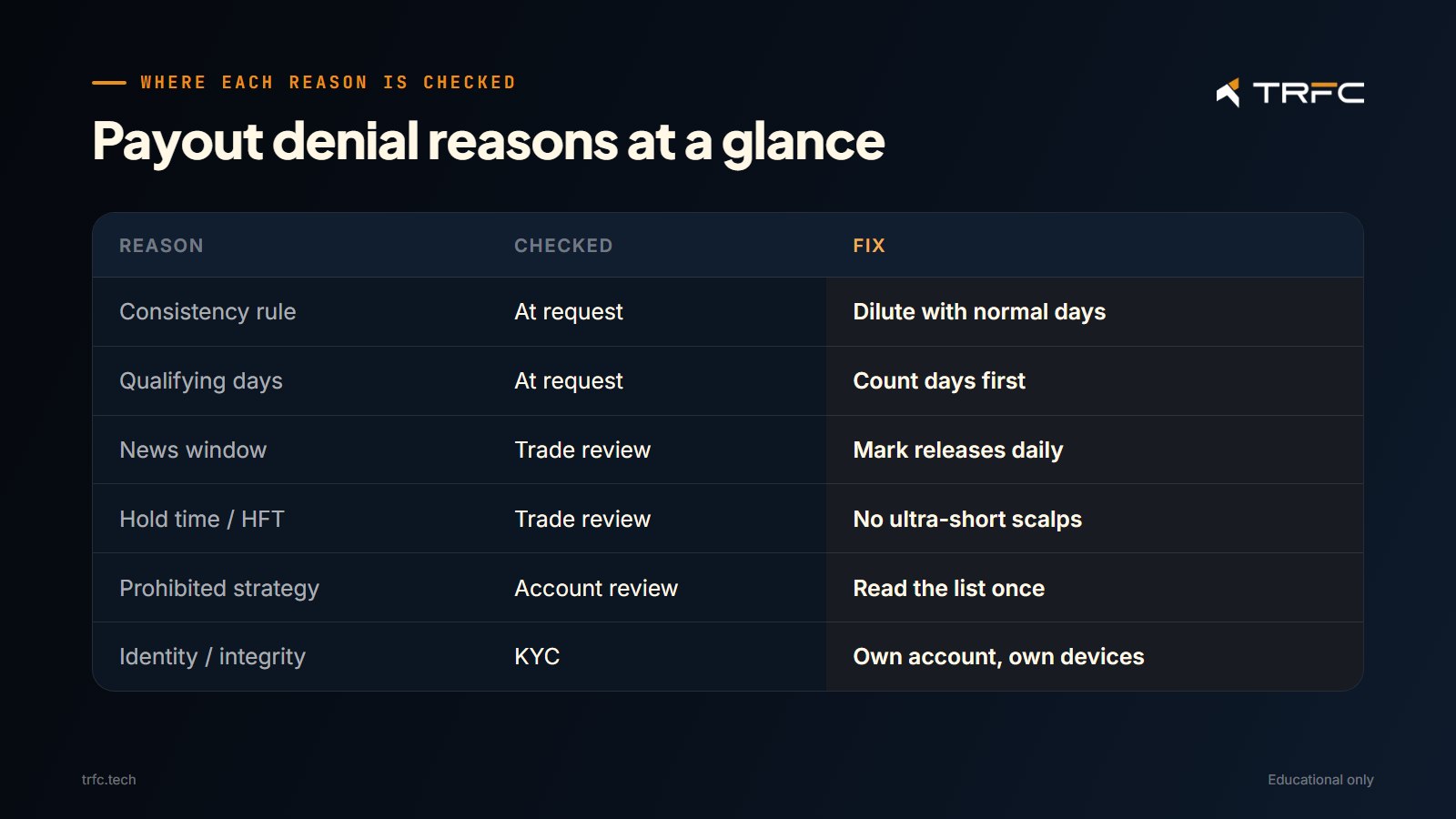
Where each reason is checked
| Reason | Usually checked | How to avoid it |
|---|---|---|
| Consistency rule | At the payout request | Track best day ÷ total before you ask |
| Minimum profitable days | At the payout request | Count days with at least the required growth |
| Payout date | At the payout request | Put the next eligible date in your calendar |
| News window | Trade-by-trade review | Mark high-impact releases every morning |
| Hold time / HFT | Trade-by-trade review | No scalps under the minimum hold |
| Prohibited strategy | Account review | Read the prohibited list once, in full |
| Single-trade share | Challenge pass review | Size so no one trade carries the target |
| Identity / integrity | KYC and account review | Trade only your own account, from your own devices |
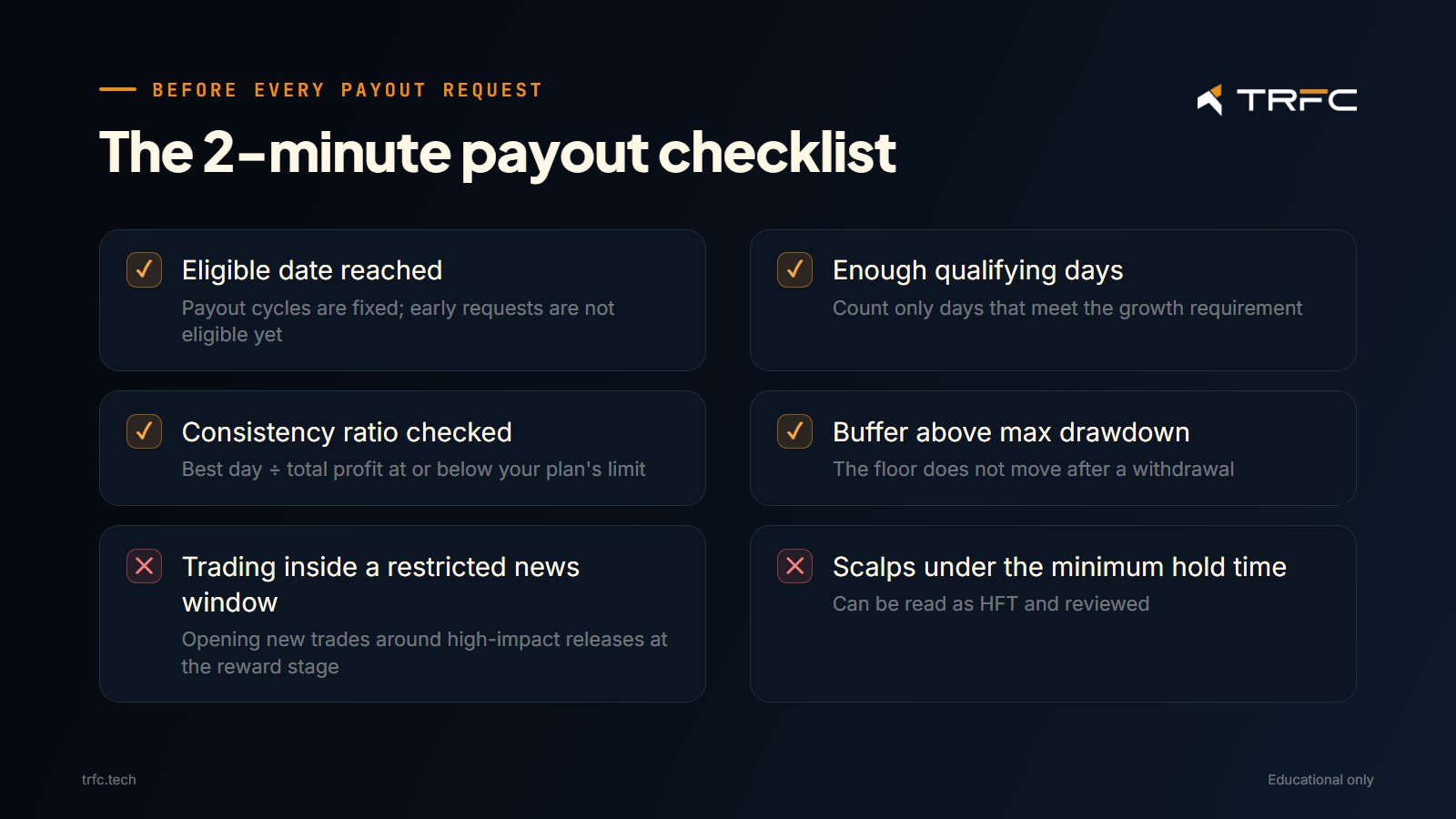
A 2-minute checklist before every request
- Is today on or after my next eligible payout date?
- Do I have the required number of qualifying days?
- Is my best day at or below the consistency limit (if my plan uses it)?
- Did I open any trade inside a restricted news window?
- Was every trade held for the minimum time?
- Is the amount above the minimum, and do I still have a buffer above max drawdown after the withdrawal?
That last point matters: on TRFC the max drawdown floor is fixed from the starting balance and does not move after a withdrawal, so a large withdrawal leaves less room. The FAQ suggests keeping a safety buffer of at least $2,000 above the threshold.
How to compare firms on payout fairness
Rather than asking which firm "never denies", ask which firm writes its rules clearly enough that you can check them yourself. Look for: a public rulebook or FAQ, worked examples of the consistency calculation, a stated payout schedule and fee, and a clear list of prohibited strategies. A rule you can calculate is a rule you can respect. You can see TRFC's plans and rules side by side on the TRFC challenges page.
Key facts about TRFC
- Payouts every 14 days from the first simulated trade, $100 minimum, $25 flat fee, paid in USDT (TRC20/ERC20), typically 24–72 business hours after approval.
- Consistency rule: best day at most 40% of total profit (1-Step and Instant Pilot; optional on 2-Step and 3-Step; waived on Instant Turbo).
- Minimum profitable days: 3 (Instant plans: 7), each with at least 0.5% growth.
- Minimum hold time 3 minutes; at most 3 open trades and 5 lots per symbol.
- News: free in the challenge; at the reward stage, no new trades within 5 minutes of high-impact news.
- Prohibited: account sharing, cross-account hedging, latency arbitrage, one-side betting and martingale.
- Free 30-day trial; accounts from $3K to $200K; TRFC evaluations use simulated accounts.
FAQ
What is the most common reason prop firm payouts are denied?
Rule breaches in general, with consistency-rule problems among the most frequently cited. Most of these are visible in your own trade history before you ask.
Can a denied payout be requested again?
If the reason is eligibility (too early, too few days, consistency ratio too high), you can usually keep trading and request again once you qualify. A breach of a hard rule, such as a prohibited strategy, is treated differently and can end the account.
Does withdrawing profit change my drawdown limit?
At TRFC, no. Max drawdown on the 1/2/3-Step is fixed from the starting balance, so after a withdrawal your balance is closer to the floor. Keep a buffer.
Is news trading a reason for denial?
Only where a firm restricts it. At TRFC it is unrestricted in the challenge; the ±5-minute rule applies to opening new trades at the reward stage.
How do I check the consistency rule myself?
Divide your best day's profit by your total profit. If the result is above the limit, more normal trading days will bring it down. TRFC's FAQ includes a live calculator.
Related reading: the consistency rule explained, minimum trading days and the full TRFC blog.
Educational only, not investment advice. TRFC evaluations use simulated accounts. Industry observations are as of November 2026; always read each firm's current rules.