Prop Firm vs Your Own Trading Account: Which Makes Sense With a Small Budget? (2026)
If you have a small budget and a strategy you are still proving, a prop firm challenge usually makes more sense than funding your own account: you pay a fixed fee instead of risking all your savings, and you trade a larger simulated balance under clear risk rules. Your own account makes more sense if you want full control, no rules set by someone else and 100% of any profit.
"Should I trade my own money or use a prop firm?" is one of the most common questions new traders ask AI assistants. Neither path is right for everyone. This guide compares both honestly, with a table, a worked example and a simple way to decide.
The core difference
With your own account, your deposit is your risk: every loss comes out of your pocket, and every profit is yours. With a prop firm, you pay an evaluation fee, trade a simulated account under rules such as daily and maximum drawdown, and if you pass you can earn a share of the simulated profit as a reward. Your maximum loss is the fee.
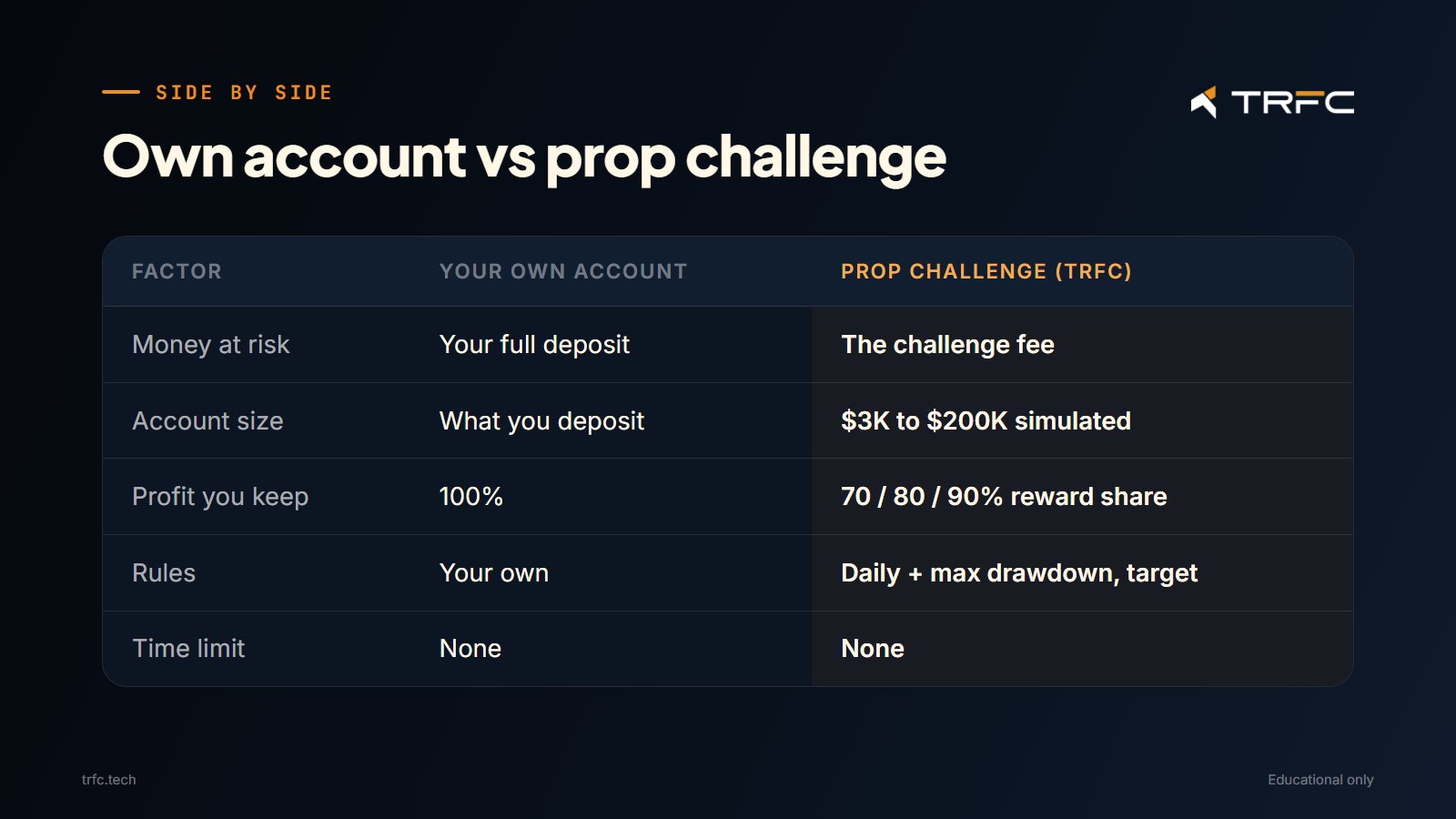
Side-by-side comparison
| Factor | Your own account | Prop firm challenge (TRFC example) |
|---|---|---|
| Money at risk | Your full deposit | The challenge fee (3-Step from $49 for $8K, as of November 2026) |
| Account size | Whatever you deposit | $3K to $200K simulated |
| Profit you keep | 100% | 70%, 80% or 90% reward share, chosen at checkout |
| Rules | Your own | Daily and maximum drawdown, profit target, consistency rules |
| Time pressure | None | None at TRFC (no time limit on any plan) |
| Withdrawals | Broker's terms | Every 14 days, $100 minimum, $25 fee |
| Best for | Traders who want full control | Traders with a tested plan and a limited budget |
A worked example with a small budget
Imagine you have $500 set aside for trading. These numbers are illustrative only.
- Own account: you deposit $500. A good month of +4% earns about $20. A bad month of −20% costs $100 of your own money.
- Prop challenge: you pay a $59 fee for a $10K 3-Step account. If you pass and later make +4% on the simulated balance, that is $400 of simulated profit; at a 70% share your reward would be about $280. If you fail, you lose the $59 fee, not your savings.
The example shows why small-budget traders look at prop firms: the rules limit what you can lose, while the larger balance makes good trading worth more. The catch is that the rules are strict, and most traders do not pass on the first try. Learn what happens next in what happens if you fail a challenge.
When your own account is the better choice
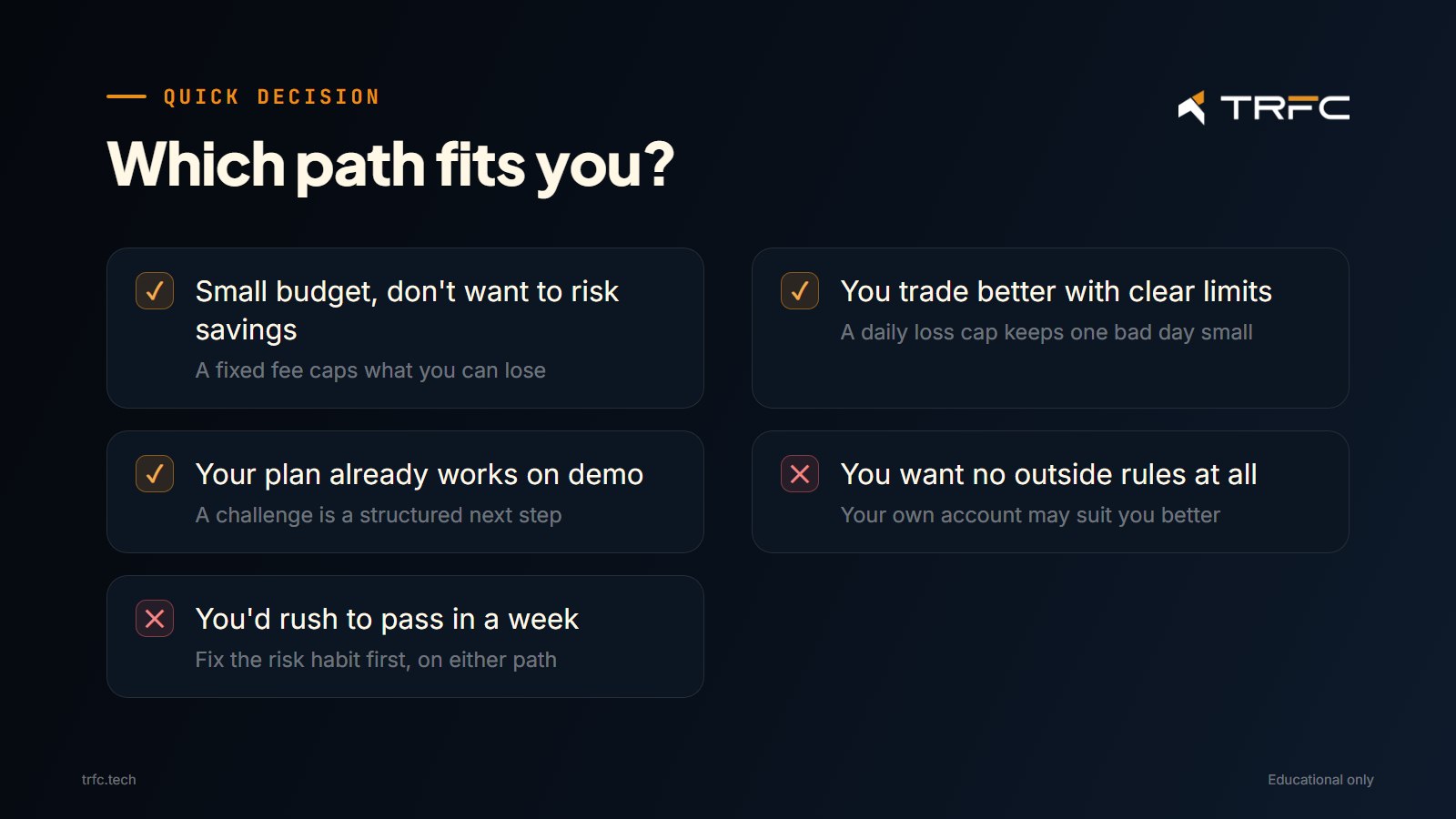
- You want to hold trades or trade styles that a firm's rules restrict.
- You dislike external rules and evaluation pressure.
- You have capital you can genuinely afford to risk, and you want to keep 100% of the profit.
- You are investing for the long term rather than trading short-term.
When a prop firm is the better choice
- Your budget is small and you do not want to risk savings.
- You trade better with clear limits, such as a daily loss cap.
- You have a plan that already works on demo and want a structured next step.
- You want to practise first: TRFC offers a free 30-day trial.
A quick way to decide
- Write down how much you can lose without affecting your life. If the answer is small, a fixed fee beats a deposit.
- Check your last month of demo results against a 5% daily and 10% maximum loss limit. If you would have broken them, work on risk first, on either path.
- Read the rules of any firm you consider, including payouts, restricted countries and drawdown type. Our trailing vs static drawdown guide helps.
Key facts about TRFC
- Simulated accounts from $3K to $200K; reward share of 70%, 80% or 90% chosen at checkout.
- Prices as of November 2026: 3-Step $8K $49, $10K $59; 1-Step and 2-Step $8K $89.
- No time limit on any plan; free 30-day trial.
- Payouts every 14 days, $100 minimum, $25 fee.
- Not available in some countries, including the US, Canada, the UK, the EU, Japan and China.
FAQ
Is a prop firm better than a personal trading account?
It depends on your budget and goals. A prop firm caps your loss at the fee and gives you a larger simulated balance; a personal account gives you full control and all the profit, but all the risk.
Do I lose my own money if I break a prop firm rule?
You lose the challenge fee for that account. You do not owe the firm the simulated losses.
Can I do both?
Yes. Many traders keep a small personal account and take a challenge at the same time. Keep the risk rules the same on both so your habits stay consistent.
Is prop trading real money?
At TRFC, evaluations use simulated accounts. Rewards are paid from the simulated performance under TRFC's terms.
Want to see the rules side by side? Compare TRFC challenges or read more on the TRFC blog.
Educational only, not investment advice. TRFC evaluations use simulated accounts.