Your Year-End Trading Review: A Simple December Routine for Prop Traders
December is a strange month for traders. Markets get thinner, holidays break up routines, and many of us look back at the year with a mix of pride and "what was I doing in March?". That makes it the perfect time for a proper year-end review: not a guilt session, but a calm look at what worked, what didn't, and what you'll change next year.
Here is a simple routine you can do over one or two quiet evenings, with a notebook, your trading journal and a cup of coffee. It works whether you traded a personal account, a prop challenge, or both.
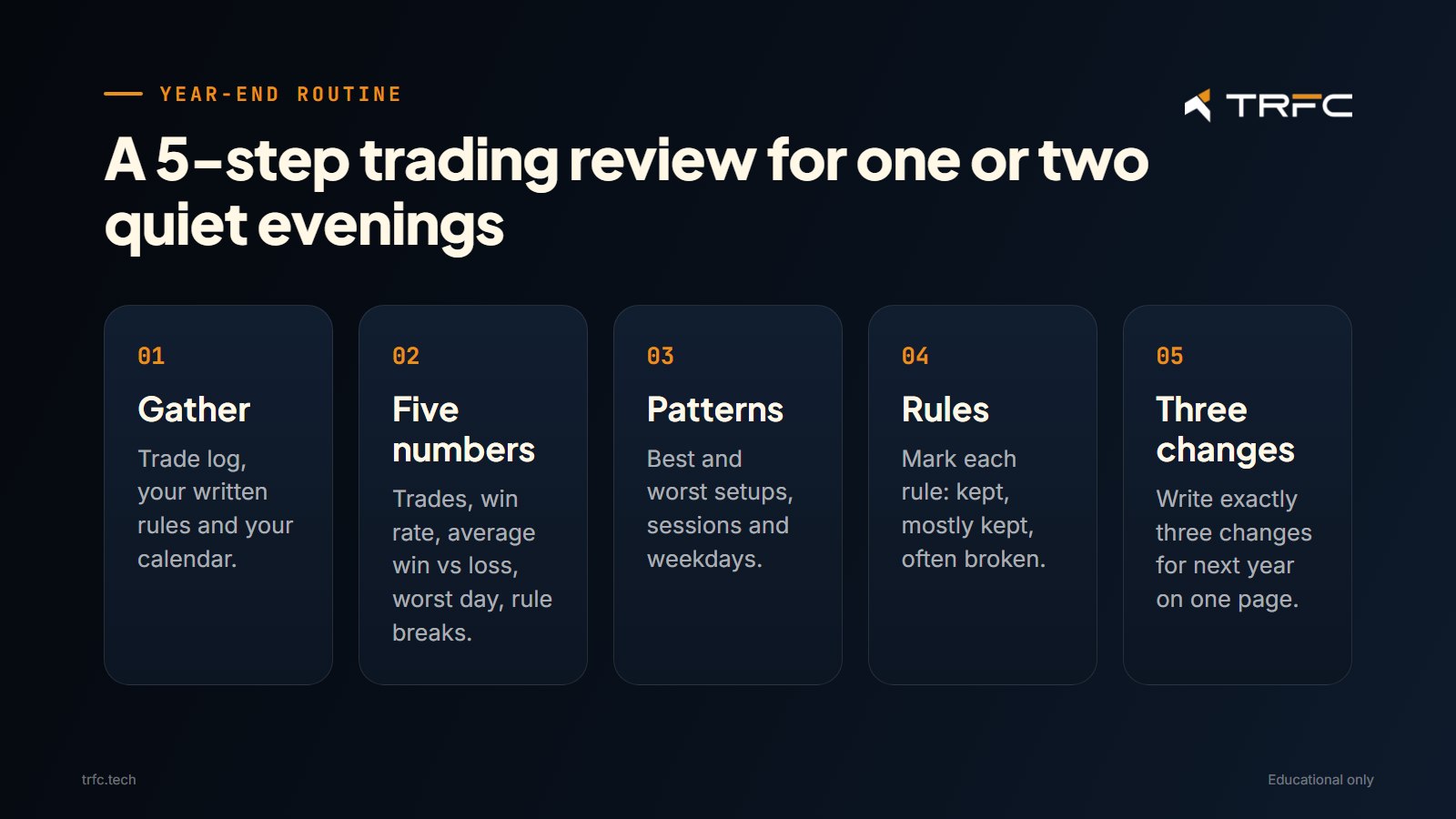
Before you start: gather three things
- Your trade log for the year (or as much of it as you kept). If your journal has gaps, your platform's history fills most of them.
- Your rules as you wrote them in January, if you did. If not, write down the rules you actually followed.
- Your calendar, so you can see which months were busy at work or at home.
Block out the time like a meeting. A review squeezed between other tasks turns into a quick scroll and a vague feeling.
Step 1: Look at the numbers, but only a few
You don't need fifty statistics. Five are enough:
- Number of trades
- Win rate
- Average win vs average loss (your real risk-to-reward)
- Largest losing day
- Number of days you broke one of your own rules
The last one is often the most useful. Many traders find that a handful of rule-breaking days explain most of the year's damage.
Step 2: Find your best and worst patterns
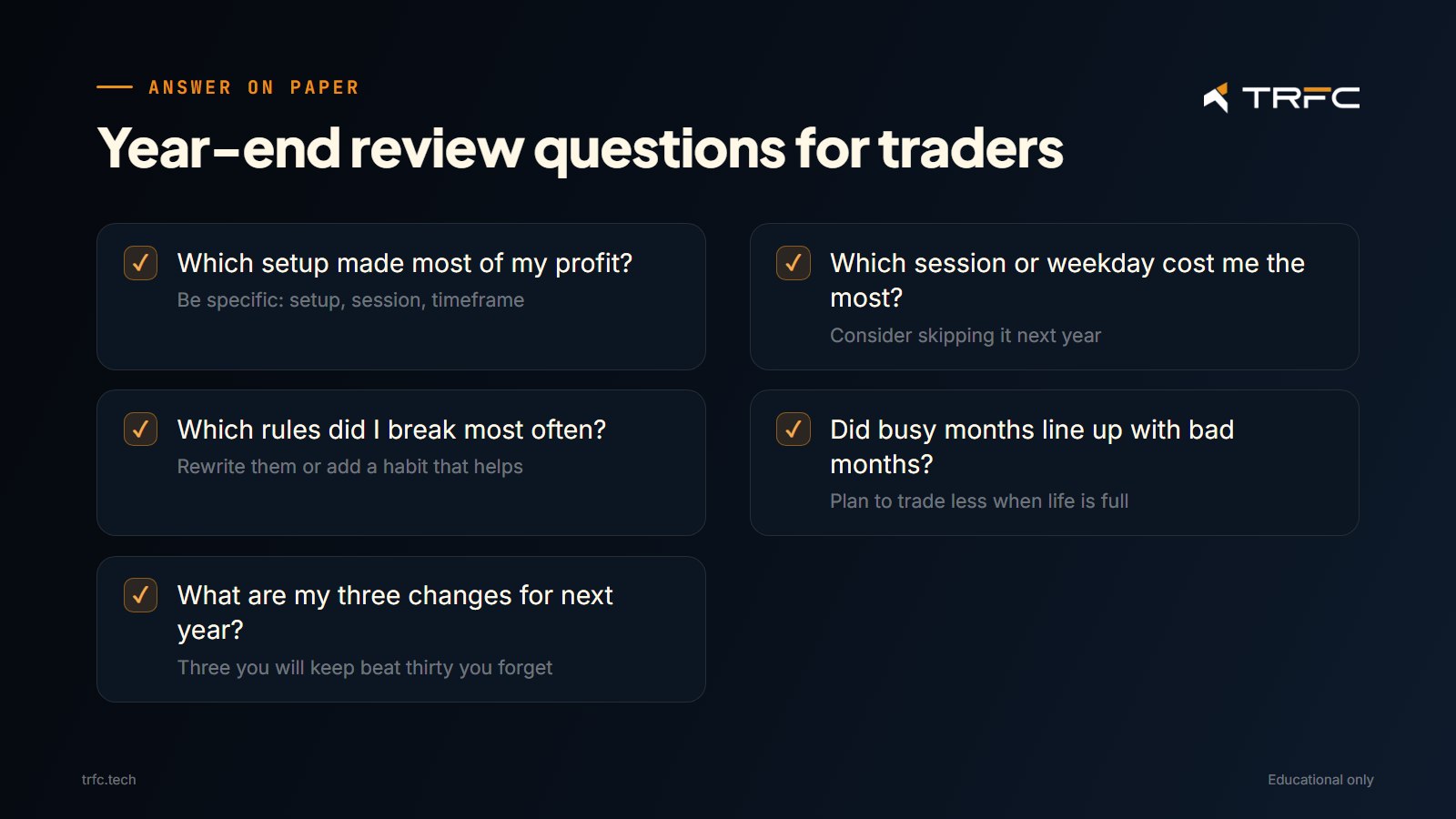
Sort your trades by setup, session and day of the week. Ask: which setup made most of the profit? Which session cost the most? Is there a day of the week you should simply not trade? Keep it honest and specific: "London open breakouts on Mondays" is useful; "I was impatient" is not.
Step 3: Review the life side
Trading doesn't happen in a vacuum. Look at your calendar next to your results. Did your worst months line up with busy work periods, travel, new family routines or poor sleep? Many part-time traders find their results follow their energy more than the market.
That's not a reason to feel bad. It's information. If the busy months were the bad months, next year's plan might be to trade less, or not at all, during them.
Step 4: Check your rule-keeping
Go through your rules one by one and give each a simple mark: kept, mostly kept, often broken. A rule you often broke is either a rule that doesn't fit your life, or a rule you need help keeping (an alarm, a checklist, a smaller size). Decide which, and rewrite it.
Step 5: Choose three changes, not thirty
End the review with exactly three changes for next year. For example: "No trades in the first 15 minutes after the London open", "Maximum two trades a day during busy work weeks", "Weekly review every Sunday at 8 pm". Write them on one page and put it where you trade.
Three changes you actually keep beat a long plan you forget by February. Pair them with process goals rather than outcome goals, so you judge each day by what you control.
If you're planning a prop challenge next year
Your review is also the best way to choose the right challenge. If your numbers show a few big days and many small ones, a plan without a consistency rule may suit you better. If your worst days are large, a plan with a wider daily limit, or a smaller account size, gives you more room. At TRFC, there is no time limit on any plan, so a busy month doesn't force you to rush.
When you're ready, compare TRFC challenges and pick rules that match what your review showed you. You can also start with the free 30-day trial.
Quick FAQ
How long should a year-end trading review take?
Two to four hours, ideally split over two evenings, is enough for most part-time traders.
What if I didn't keep a trading journal?
Export your platform history and review that. Then make "keep a simple journal" one of your three changes.
Should I set a profit goal for next year?
Set process goals first (rules kept, reviews done). Profit is the result of those, not something you can control day to day.
Educational only, not investment advice. TRFC evaluations use simulated accounts.