Trading Burnout: Warning Signs and How to Take a Reset Week
Burnout in trading rarely arrives as one bad day. It builds slowly: a little more screen time, a few more sessions, a few more checks of the chart from bed. Then one week you notice you are tired all the time, your rules feel heavy, and your results are slipping.
This article covers the warning signs, why burnout is especially costly on a prop account, and a simple "reset week" plan you can use when you notice it. It is written for part-time and full-time traders alike.
This is general wellbeing guidance, not medical advice. If low mood or poor sleep lasts for weeks, please talk to a health professional.
Warning signs to watch for
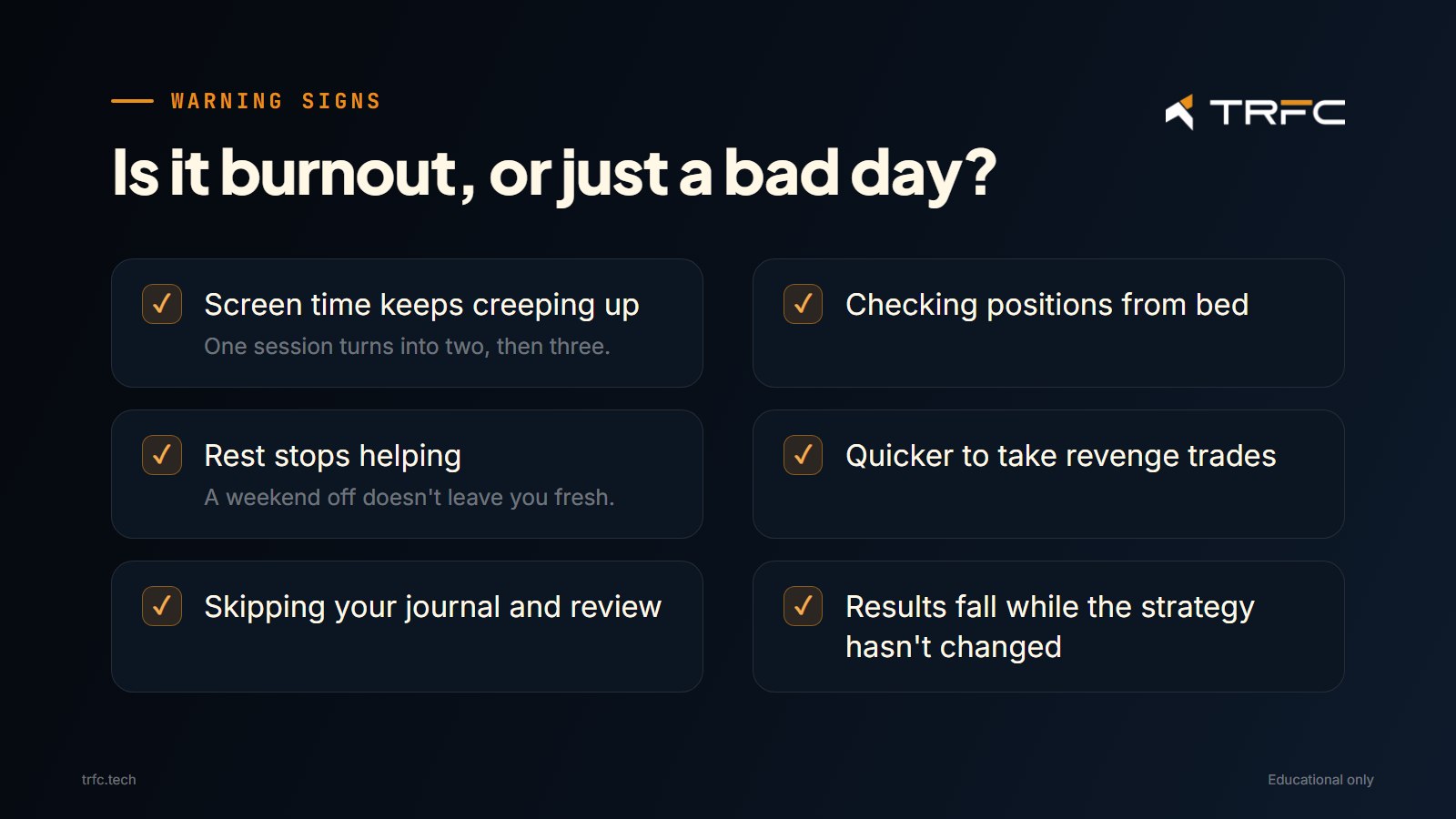
- Screen time keeps creeping up. You trade one session, then stay for the next, then check the evening session "just in case".
- You check positions from bed or first thing on waking, before anything else.
- Rest stops helping. A weekend off does not leave you feeling fresh on Monday.
- Your emotional control slips. Small losses feel bigger, and you are quicker to take a revenge trade. See how to stop revenge trading.
- You stop reviewing. The journal and weekly review feel like chores, so you skip them.
- Your results fall even though your strategy has not changed.
One or two of these on a single day is normal. Several of them over a couple of weeks is a signal to act.
Why burnout costs more on a prop account
On a prop challenge, the rules do not care how tired you are. A daily drawdown limit is calculated from the initial balance and counts open trades in real time, so one careless session can end an account that took weeks to build. Tired traders tend to:
- size up to "make it back" after a loss,
- skip their pre-trade checklist,
- hold losing trades too long, and
- trade outside their usual hours, when their setups are weaker.
The good news: at TRFC there is no time limit on any plan, so taking a few days off does not cost you anything on the clock. The only activity rule is that 90 days with no trades deactivates an account, which is far longer than any reset you need.
The reset week: a simple plan
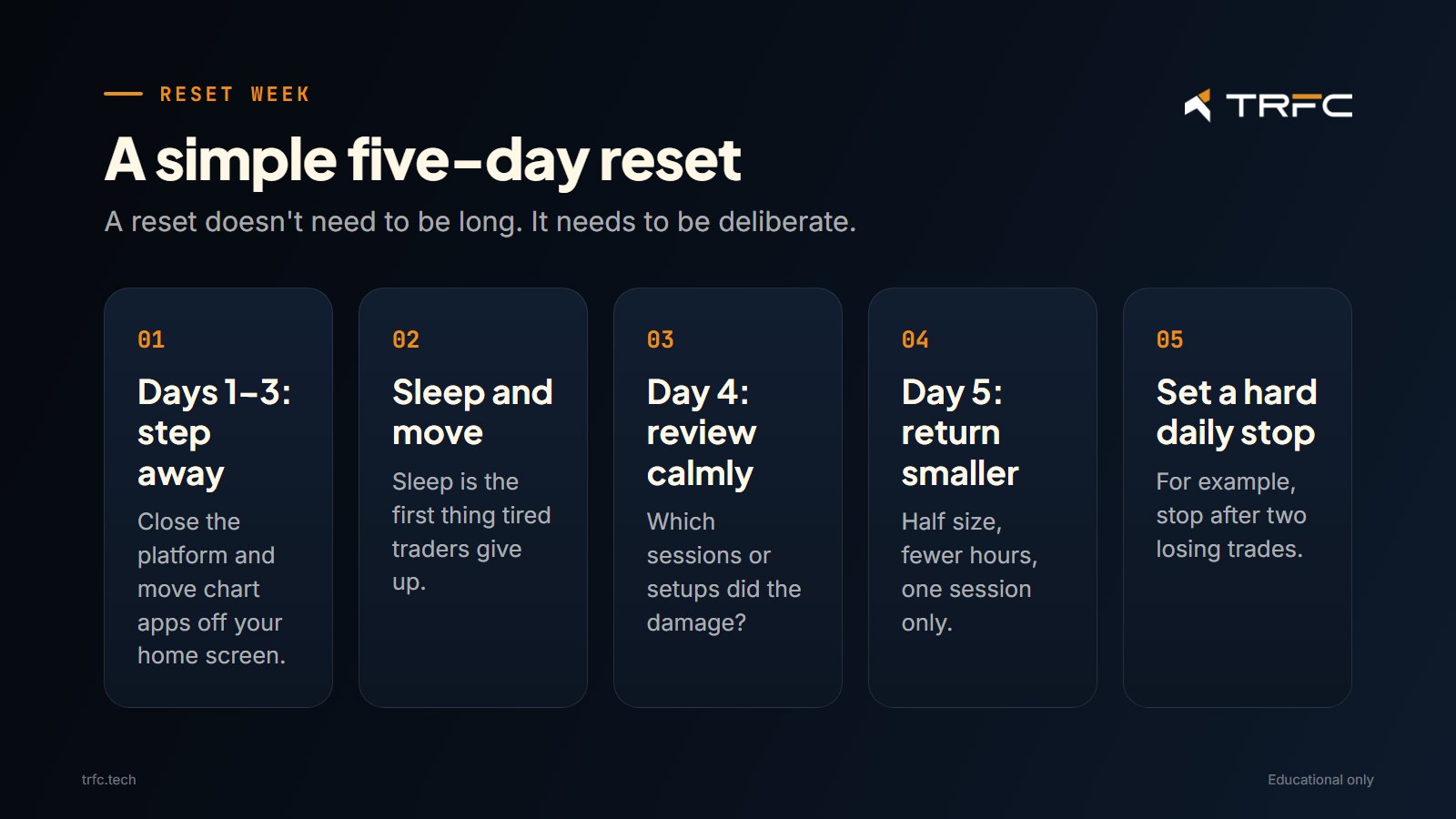
- Days 1–3: step away fully. Close the platform and remove chart apps from your phone's home screen. Many traders find that three to five days is enough to feel the difference.
- Sleep, move and eat properly. It sounds basic, but sleep is the first thing tired traders give up. See sleep and focus habits for traders.
- Day 4: review calmly. Look at your last two weeks of trades with fresh eyes. Which sessions, setups or times of day caused most of the damage?
- Day 5: return smaller. Come back with half your usual size and fewer hours, for example one session only. Rebuild confidence with process, not profit.
- Set a hard daily stop. For example: stop for the day after two losing trades, or after a set loss amount well inside your daily drawdown. Write it down.
Part-time and full-time traders burn out differently
Part-time traders usually burn out from stacking: a full workday, then the London session, then a late look at the US open. The fix is to choose one window that fits your life and protect your sleep on work nights. A smaller account or a slower plan can make that easier, because you do not feel pressure to trade every session.
Full-time traders usually burn out from too much screen time with too little structure. The day has no natural end, so it never really stops. The fix is to give it one: a fixed start, a fixed finish, a lunch break away from the desk, and a written end-of-day review that marks the close of work. On days when nothing fits your plan, finishing early is a good trading decision, not a lazy one.
How to stop burnout coming back
- Trade in blocks with a fixed start and end time, and take short breaks between them.
- Pick your best session and let the others go. For traders in Malaysia and Singapore, that might be the London open in the afternoon, rather than also the US session late at night.
- Protect family and rest time. See trading and family time boundaries.
- Schedule one review a week and one full day off the charts.
- Measure process goals, such as "followed my plan on every trade", not just profit. See process goals vs outcome goals.
If you want to practise a calmer routine under clear rules, the TRFC challenges have no time limit, and the free 30-day trial lets you test your routine first.
FAQ
What is trading burnout?
It is a state of ongoing mental and physical tiredness from trading, often with less interest, weaker emotional control and falling results.
How long should a break from trading be?
Many traders find three to five days enough for a reset. Longer breaks are fine if you need them.
Will taking a break hurt my prop challenge?
Not at TRFC: there is no time limit on any plan. Only 90 days with no trades deactivates an account.
How do I know I am ready to trade again?
You feel rested, you are curious about the charts again, and you can follow your checklist without effort. Start with smaller size.
Educational only, not investment advice. TRFC evaluations use simulated accounts.