Trading While Travelling: How to Protect Your Prop Account on the Road
Travel and trading can mix, but only if you plan for it. New time zones, patchy hotel Wi-Fi, flights and a phone instead of your usual screens all make it easier to break a rule you would never break at home. Here is a practical routine for traders on a prop challenge or reward account who are heading off for work, family or a holiday.
First decision: trade, or take a planned pause?
The simplest option is often not to trade at all. At TRFC there is no time limit on any plan, so a one- or two-week trip does not put a challenge at risk. The only timing rule to remember is inactivity: an account with no trades for 90 days is deactivated. A short holiday is nowhere near that.
Ask yourself honestly:
- Will I have a quiet hour at the same time each day?
- Will I have a reliable connection and a charged device?
- Would I be trading to stick to my plan, or because I feel I "should"?
If the answers are shaky, close your positions before you leave and enjoy the trip. A planned pause is a trading decision, not a failure.
If you trade: re-learn your clock
Your account does not move time zones with you. At TRFC the daily drawdown resets at 5:00 am Malaysia/Singapore time (server time UTC+3), wherever you are. Before you go, write down what that means locally:
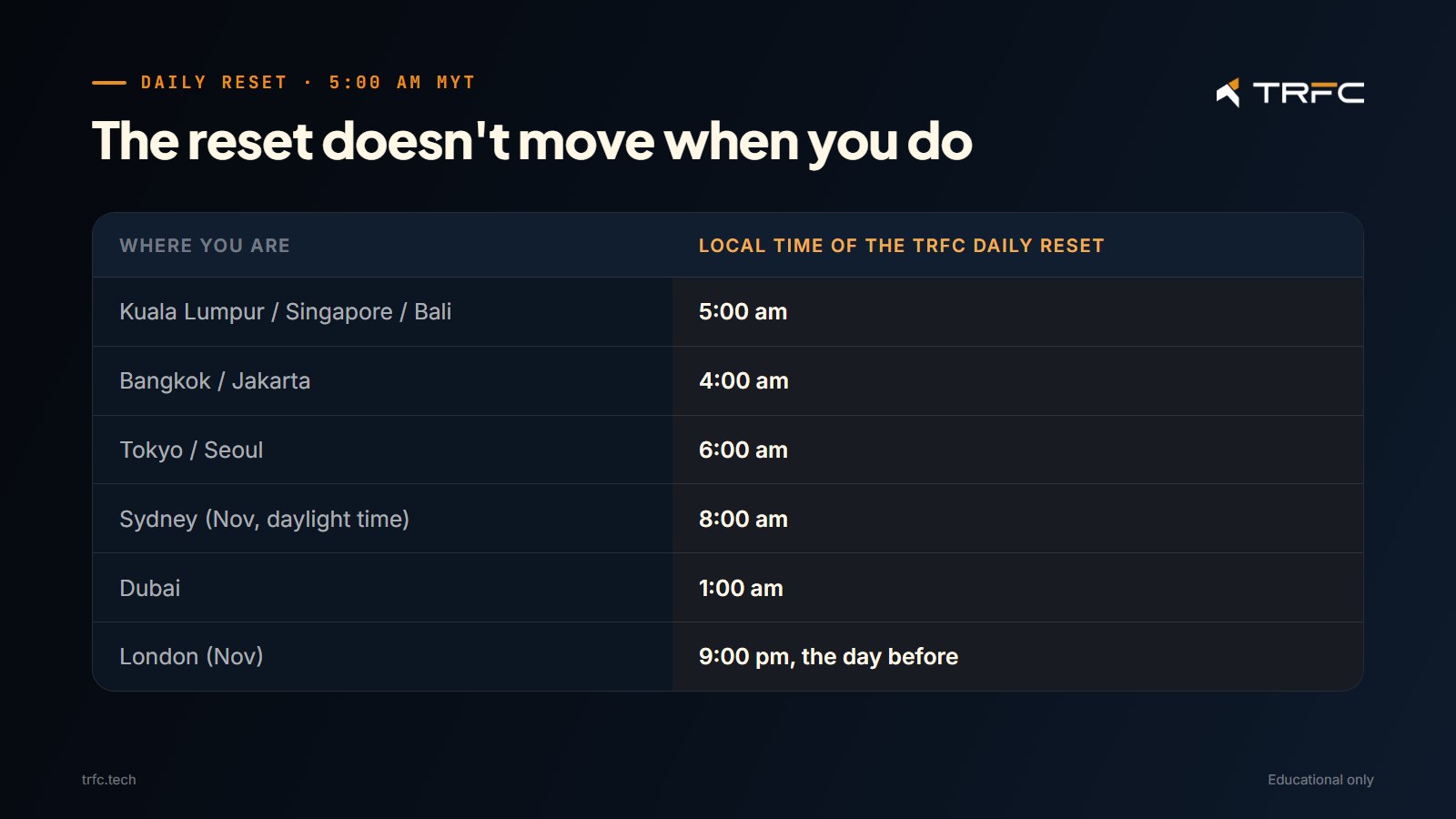
The same goes for market sessions and news. A release at 9:30 pm in Kuala Lumpur might land in the middle of your dinner, or at breakfast, depending on where you are. Put the next week's key events into your phone calendar in local time before you leave. Our guide to daily reset times has more conversions.
Protect open trades before you travel
The riskiest moments are the hours when you cannot see the market: flights, long drives, border queues. On TRFC accounts, open trades count against the daily drawdown in real time, so a position left open during a flight is still live risk.
- Avoid opening new trades in the hours before a flight.
- Close or reduce positions you would not be comfortable holding unseen.
- Make sure every open trade has a protective stop in place.
- Check the calendar: do not leave positions open into high-impact news while you are offline.
A lighter routine for the road
Travel is not the time for your full routine. Shrink it:
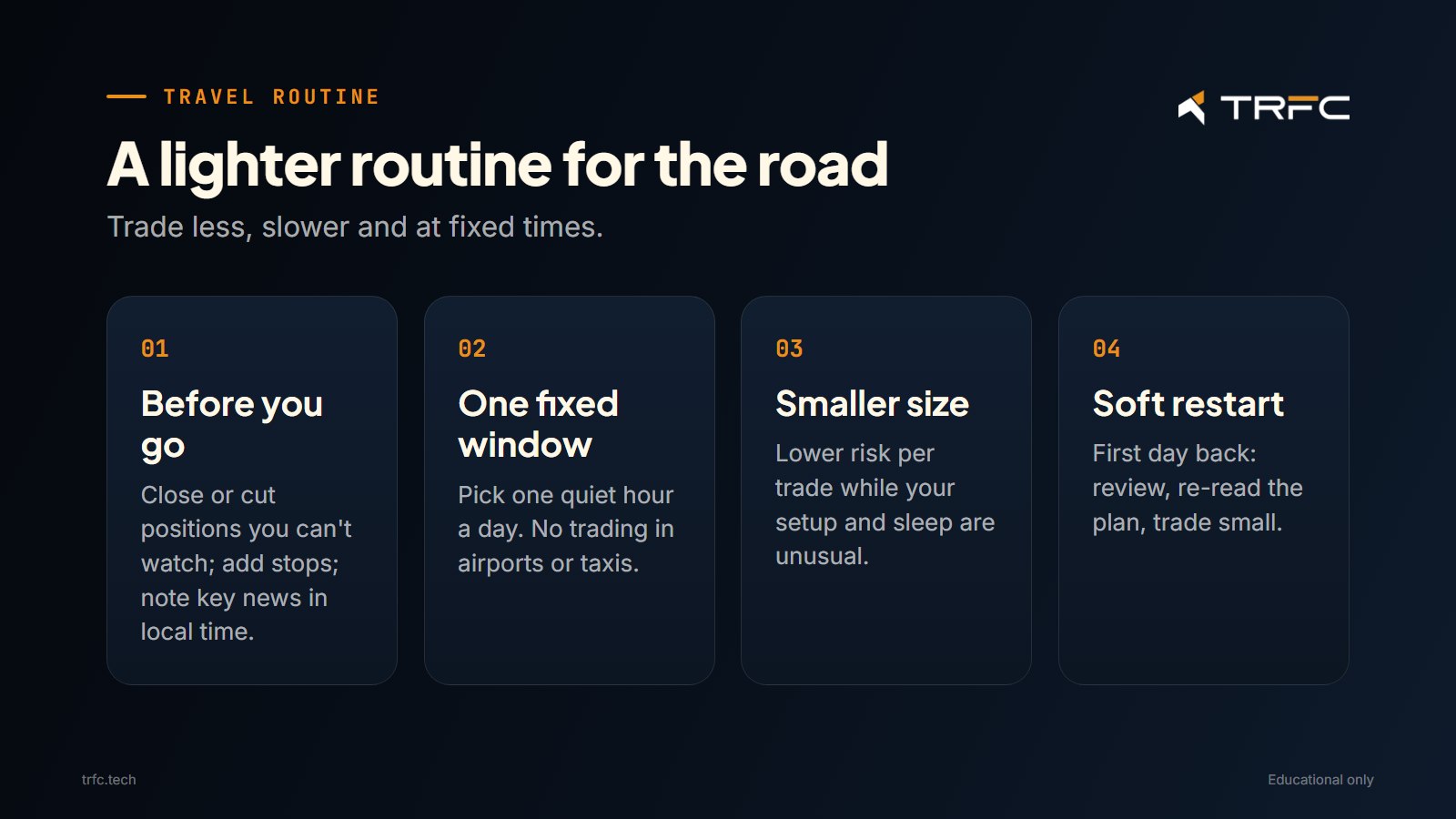
If you will rely on your phone, test the app at home first and read our guide on trading from your phone. Small screens make it easier to misread a price or tap the wrong lot size, so trade less and slower.
Connection and security basics
- Use your phone's mobile data or a trusted network rather than open public Wi-Fi for logging in.
- Turn on two-factor authentication where your platform offers it.
- Carry a power bank; a dead phone with an open trade is a real risk.
- Never share login details with anyone, including someone offering to "manage" the account while you are away.
Coming back
Give yourself a soft restart. On your first day back, review the charts on the higher timeframes, re-read your plan and trade smaller than usual. Jet lag and a full inbox are a classic recipe for impulsive trades. If you trade at the reward stage, remember there are no new trades within 5 minutes either side of high-impact news.
Balancing trading with the rest of life is a skill in itself. Our posts on trading and family time and sleep and focus are good next reads.
A challenge with no deadline fits a life that moves around. Explore TRFC challenges or browse more on the TRFC blog.
FAQ
Can I pause a prop challenge while I travel?
At TRFC there is no time limit, so you can simply not trade for a while. Just place at least one trade within any 90-day period to keep the account active.
Does the daily reset change when I change time zone?
No. The reset follows the server clock: 5:00 am Malaysia/Singapore time, whatever your local time is.
Is it safe to hold trades during a flight?
Any trade you cannot watch carries extra risk, and open losses count toward the daily drawdown in real time. Many traders close or reduce positions before flying.
Educational only, not investment advice. TRFC evaluations use simulated accounts.